You know what they say: no one got fired for buying IBM. The same situation applies to Terraform Cloud, as it’s been the enterprise go-to option for quite some time now.
However, new competitors have emerged on the market, such as Spacelift and ControlMonkey, which may not be backed by IBM but offer interesting use cases and different pricing models.
In this comparison guide, I’ll try my best to accurately and without bias compare Spacelift and Terraform Cloud, including their core capabilities, pricing structures, and integrations, to help you make a better-informed decision for your cloud automation strategy.
I’ll also cover their G2 reviews because this wouldn’t be a comprehensive comparison if I hadn’t included real customer opinions.
I’d also like to introduce you to an alternative that addresses some of the gaps between these 2 tools with a more unified and flexible control plane for cloud infrastructure: ControlMonkey (that’s us).
TL;DR
Spacelift offers a comprehensive IaC orchestration platform designed for teams that want flexibility across multiple IaC frameworks. The tool stood out to me with how fast it runs Terraform and how it can integrate into existing workflows. However, its downsides are that it stops at execution with no cloud visibility, no IaC onboarding, and no automated drift recovery.
I’d go for Spacelift if I already have clean Terraform code, rely on custom CI/CD pipelines, need multi-IaC support (Pulumi, CloudFormation, Ansible, etc.), and if I’m looking for on-premise deployment.
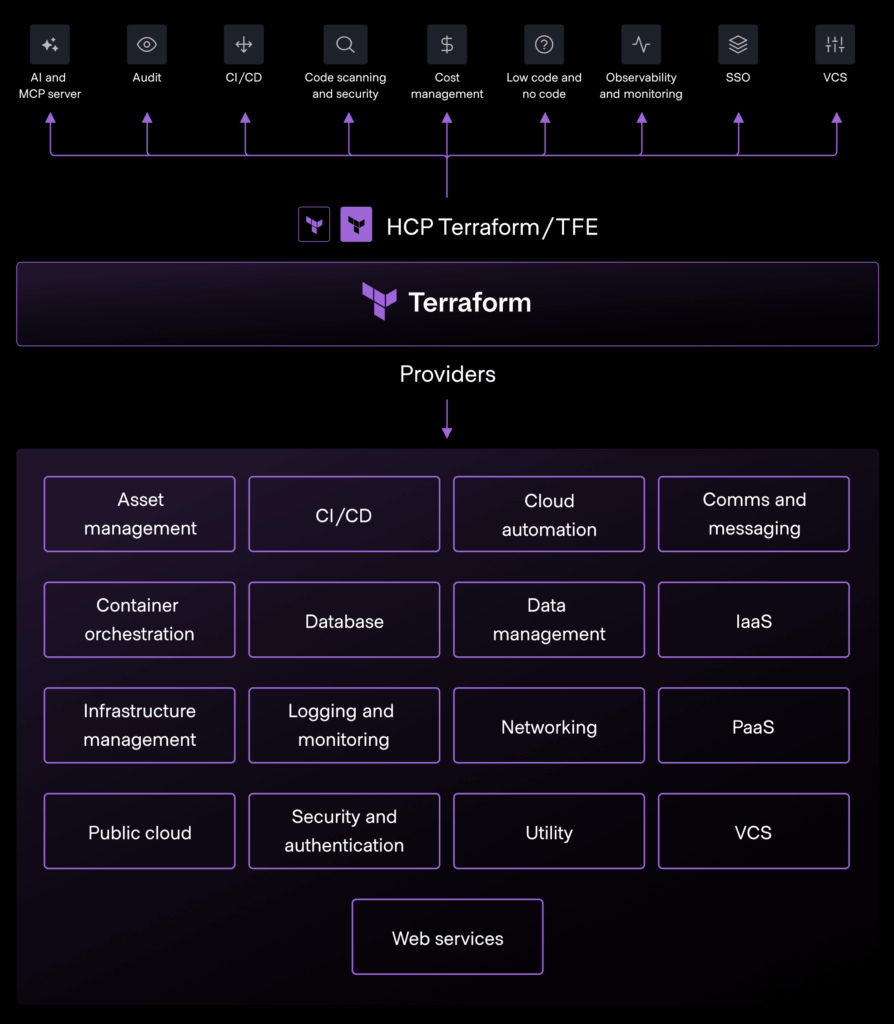
Terraform Cloud is all about Terraform execution and collaboration. The tool is integrated with the Terraform CLI and HashiCorp ecosystem, and is a really good option for teams starting fresh with Terraform. Despite this, the tool provides no visibility into unmanaged infrastructure, has no drift remediation.
I’d go for Terraform Cloud if my infrastructure were already fully managed in Terraform, and if my primary need were remote runs and Terraform collaboration.
ControlMonkey is a cloud infrastructure control plane that we built to bring real-world cloud environments under Terraform safely. The way it works is that on top of the IaC Automation, it provides tools like Terraform Cloud and Spacelift, it scans your cloud accounts, shows what is currently managed and unmanaged, automatically generates Terraform code for existing resources, and begins enforcing governance, drift remediation, and disaster recovery.
I’d go for ControlMonkey if my main issues were dealing with cloud sprawl, unmanaged resources, frequent (and expensive) drift, governance complexity, and if I wanted visibility and compliance at scale, as well as cloud DR backup.
Spacelift vs. Terraform Cloud vs. ControlMonkey: Features
Spacelift has custom CI/CD integrations, self-hosting, and supports multiple IaC frameworks. However, it lacks some key features, such as cloud account scanning, Terraform code generation, drift remediation, state storage, and built-in disaster recovery.
Terraform Cloud is really good at tiering Terraform execution and collaboration with policy management in Terraform through Sentinel, but it has a fundamental assumption that infrastructure is already neatly governed and organized in Terraform. The tool does not offer cloud scanning, Terraform code generation, drift remediation with state recovery, or disaster recovery.
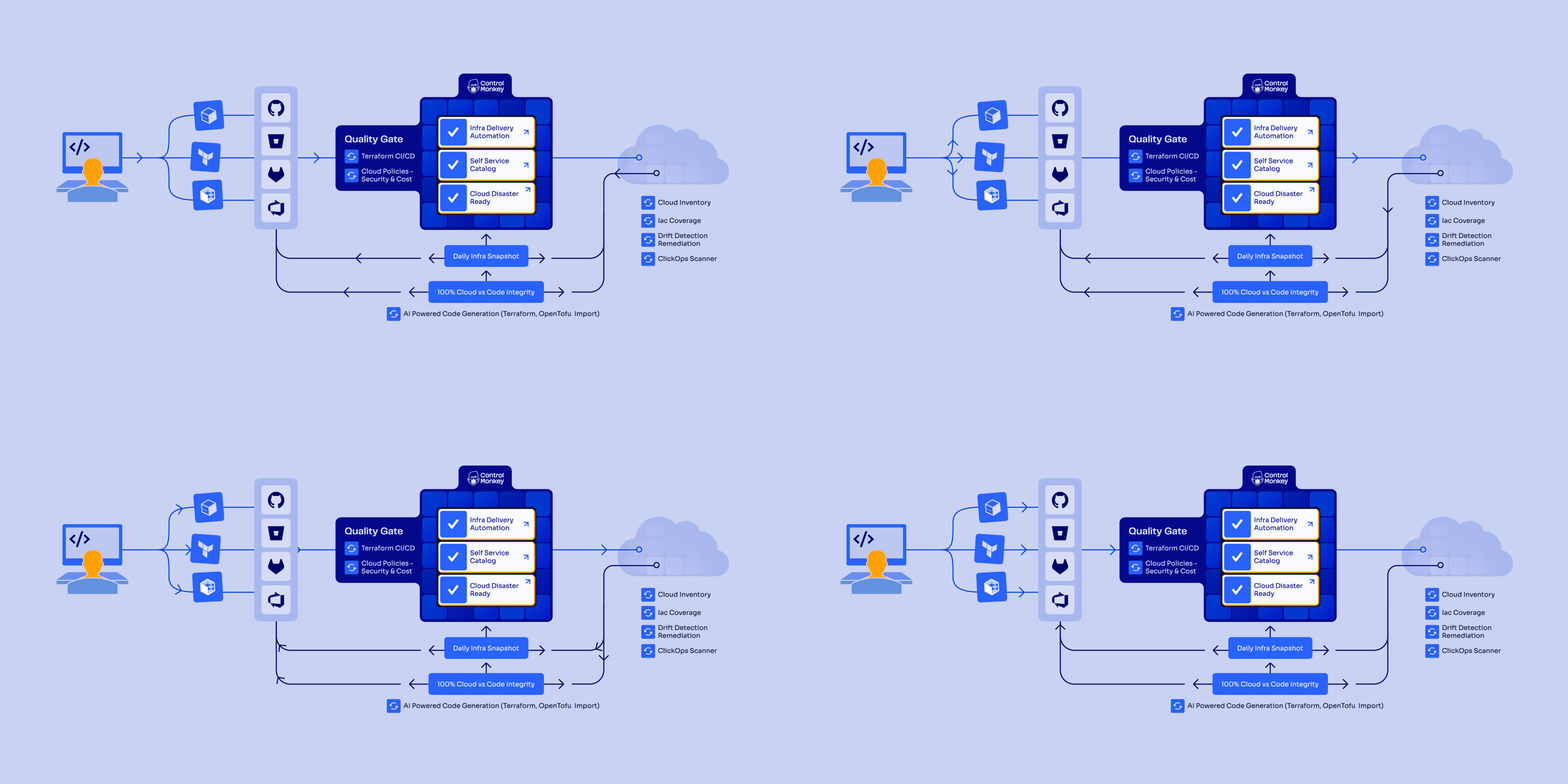
ControlMonkey delivers an all-in-one infrastructure governance and resilience platform on top of Terraform and OpenTofu. Our platform combines full cloud inventory, automatic Terraform code & state generation, drift detection and remediation (unlike Spacelift and Terraform Cloud), daily cloud infrastructure backups, disaster recovery, self-service blueprints, and AI compliance guardrails to provide you with total cloud control without having to use multiple tools or write custom policies.
Total Cloud Control. One Platform.
Replace fragmented Terraform tools with one governance and resilience platform – start with ControlMonkey in minutes.
There is a full self-hosted & on-premises deployment option.
There is a full self-hosted & on-premises deployment option.
SaaS-only. You can use Terraform Enterprise as a self-hosted option
Periodic Code Scanning for Compliance
Scans existing IaC code for misconfigurations & policy violations.
Requires manual policy enforcement.
Requires manual policy enforcement.
CI/CD Flexibility
You can use ControlMonkey’s out-of-the-box IaC CI/CD pipeline or integrate with your existing pipelines (Jenkins, GitHub Actions, GitLab CI, etc.) to enforce your policies.
Replacement for existing CI/CD pipelines for IaC.
Replacement for existing CI/CD pipelines for IaC.
Let’s go over the 3 platform features, starting with Spacelift:
Spacelift’s Features
Multi-IaC Orchestration Engine
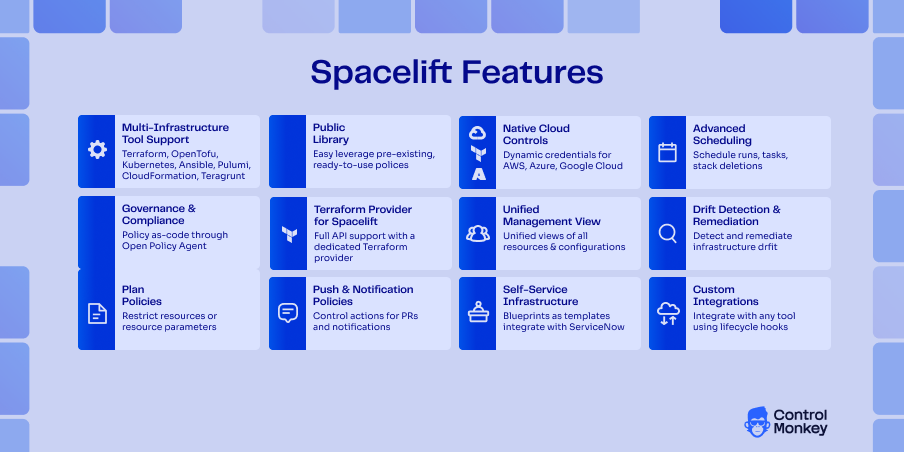
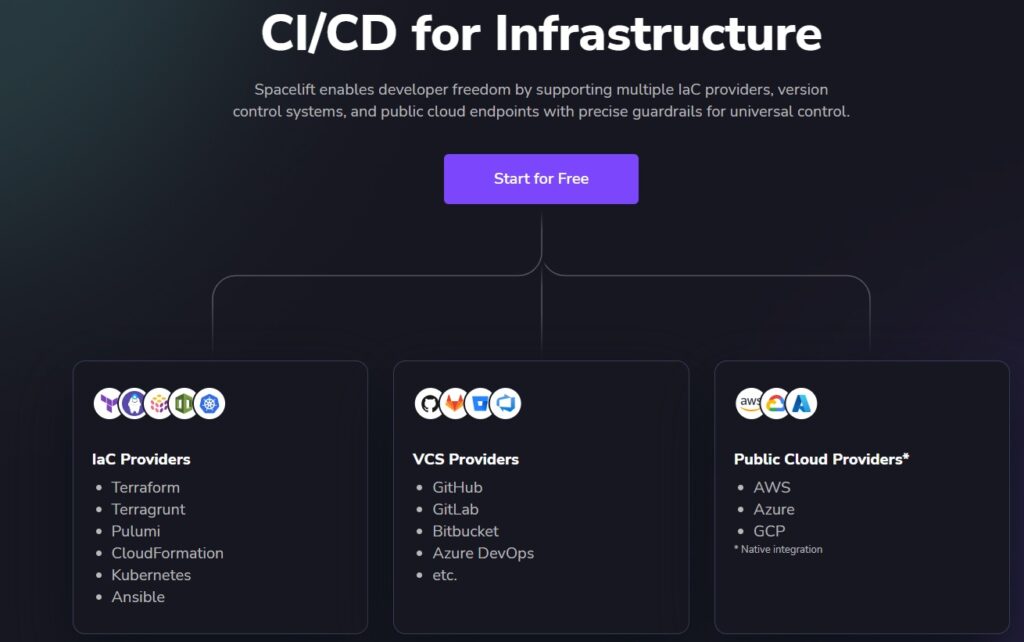
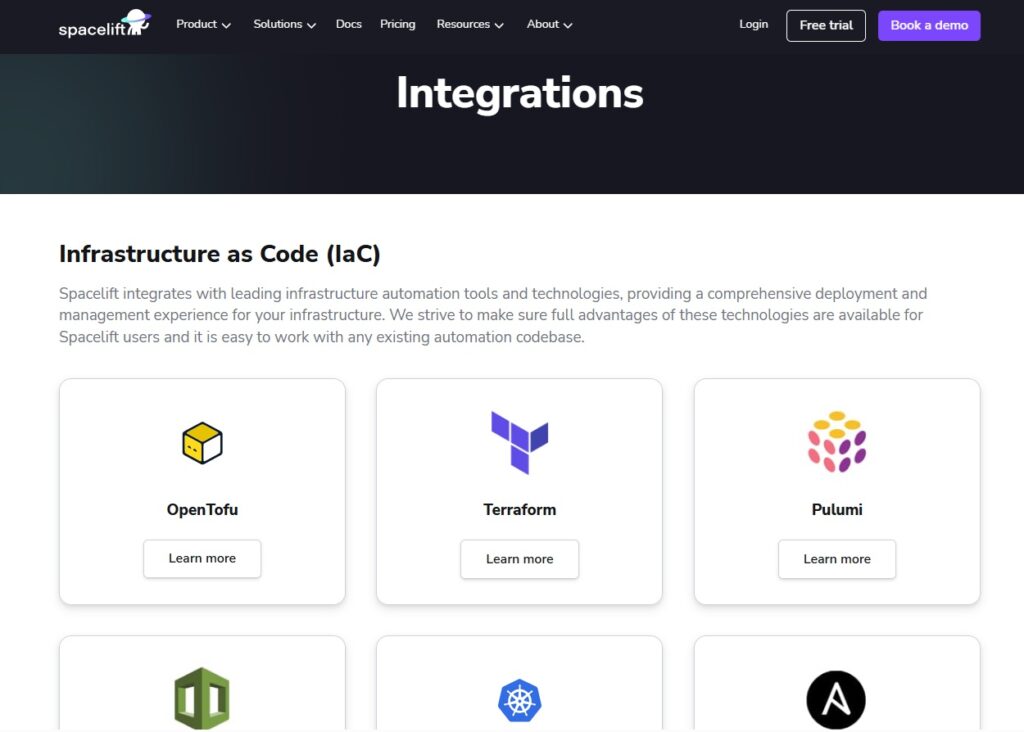
Spacelift’s biggest strength to me is that it supports a wide range of IoC tools, including Terraform, OpenTofu, Terragrunt, Pulumi, CloudFormation, Ansible, Helm, and Kubernetes.
This makes the tool well-suited for organizations running hybrid or transitional IaC stacks rather than standardizing on a single framework.
Your team will be able to orchestrate infrastructure changes across different tools from one control plane, without forcing a rewrite of existing workflows.
When it comes to platform teams managing diverse environments, this flexibility is one of Spacelift’s strongest differentiators.
Spacelift is designed for teams that are not yet ready to commit to a single IaC standard, in contrast to Terraform Cloud, which is Terraform-only by design.
CI/CD-Aware Infrastructure Workflows
Spacelift’s CI/CD platform is purpose-built for Infrastructure as Code (IaC) that applies GitOps principles to infrastructure delivery.
Unlike generic CI/CD pipelines, it provides a dedicated execution environment, state handling, locking, and policy enforcement designed specifically for IaC workflows.
Spacelift integrates natively with version control systems (VCS) such as GitHub, GitLab, Bitbucket, and Azure DevOps to trigger infrastructure runs based on familiar Git events like pull requests, merges, and commits.
This can help you manage infrastructure changes using the same collaboration patterns they already use for application code, without embedding complex Terraform execution logic in traditional CI/CD pipelines.
External pipelines, such as GitHub Actions or Jenkins, can interact with Spacelift via APIs, webhooks, or automation scripts, delegating execution, state management, and governance to Spacelift while keeping higher-level orchestration in the pipeline.
This model is particularly well-suited for teams managing complex infrastructure, as it can help you centralize visibility, governance, and execution in one platform while maintaining flexibility to coordinate with broader CI/CD workflows.
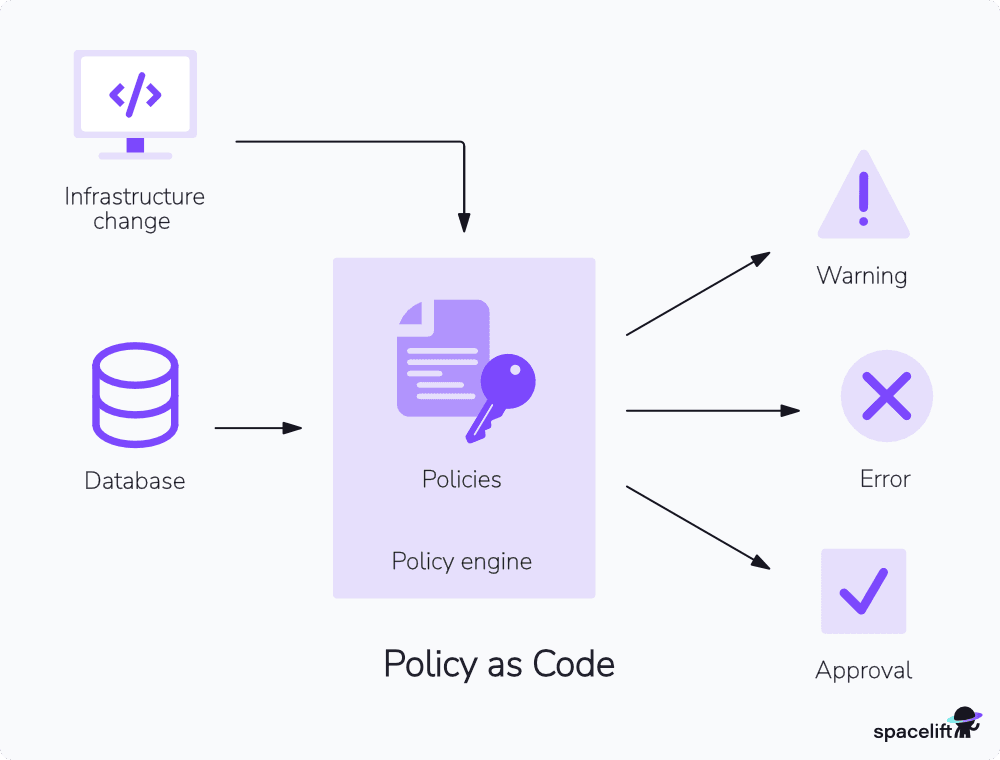
Policy-as-Code With OPA
Open Policy Agent (OPA) is used by Spacelift to enforce governance guidelines throughout infrastructure modifications.
To manage security, compliance, approvals, and execution behaviour, your team can create unique policies.
Although this provides a great deal of flexibility, it also needs constant policy creation, testing, and upkeep.
This gives experienced DevOps teams with knowledge of policy engineering more precise control over infrastructure governance.
Self-Hosted & Enterprise Deployment Options
Spacelift offers a fully self-hosted, on-premises deployment option on top of its SaaS offering.
Because of this, I’ve noticed that organisations with stringent data residency requirements, air-gapped environments, and regulated industries find it appealing.
Without depending on a public SaaS platform, you can keep complete control over infrastructure orchestration.
Even though Terraform Cloud’s HCP Terraform Agents enable on-premise deployment, this feature is often a deciding factor for highly regulated, government, and financial services clients.
Terraform Cloud’s Features
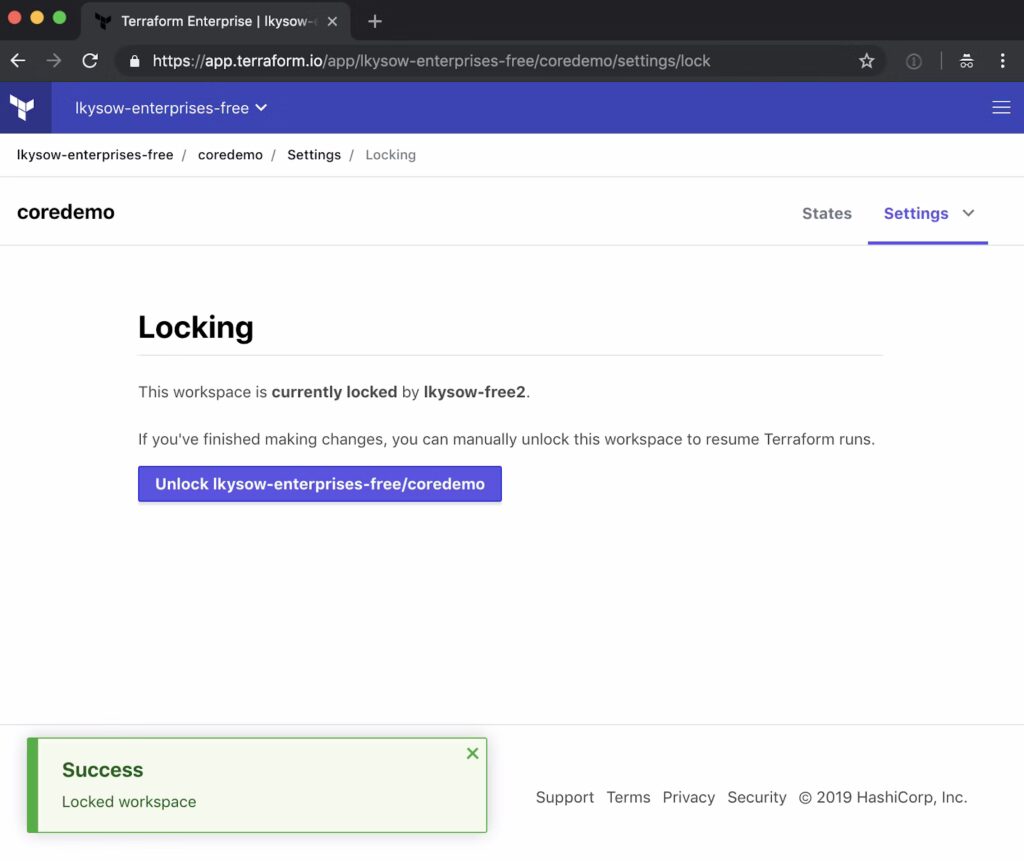
Remote Terraform Execution & State Management
Terraform Cloud provides a managed environment for running Terraform plans and applying them remotely.
It centralizes Terraform state storage, locking, and concurrency control, reducing the risk of state corruption.
This removes the need for teams to manage their own remote backends or execution infrastructure.
For teams adopting Terraform for the first time, this significantly simplifies day-to-day operations.
Unlike Spacelift, Terraform Cloud is opinionated about where and how Terraform runs; everything flows through its managed execution model.
From what I’ve seen in the industry, this simplicity is a major win for smaller or less mature teams, but can feel restrictive for advanced CI/CD setups.
Tight Terraform CLI & Ecosystem Integration
Terraform Cloud is deeply integrated with the Terraform CLI and HashiCorp ecosystem.
Your developers will be able to run familiar Terraform commands while benefiting from centralized execution and collaboration features.
It also integrates with HashiCorp’s private module registry, providers, and tooling.
This makes Terraform Cloud a natural fit for organizations committed to HashiCorp’s first-party stack.
Policy-as-Code With Sentinel & OPA
Terraform Cloud uses Sentinel and OPA to enforce policy-as-code for infrastructure changes.
Teams can define compliance, security, and cost policies that run automatically during Terraform workflows.
Note that, while powerful, Sentinel and OPA policies must be written, maintained, and versioned by the team. This approach works best for organizations with a dedicated platform or security engineering resources.
Collaboration, Workspaces & Access Controls
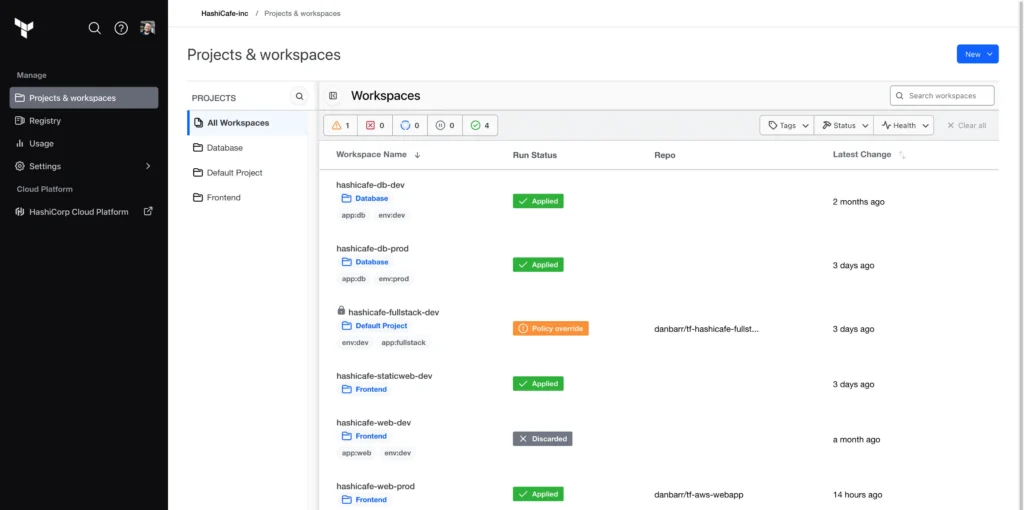
Terraform Cloud introduces workspaces to separate environments, teams, and infrastructure scopes.
It supports role-based access control, approval workflows, and audit logs for enterprise governance.
Multiple teams can collaborate on the tool’s shared infrastructure without stepping on each other’s changes (historically an issue of DevOps).
ControlMonkey’s Features: How Is It Fundamentally Different From Spacelift & Terraform Cloud?
Instead of giving you faster Terraform plans and applications, ControlMonkey gives you full cloud visibility, automatic Terraform code generation, built-in drift remediation, and infrastructure disaster recovery: all out of the box.
So while Spacelift and Terraform Cloud focus on executing Terraform workflows, ControlMonkey helps you:
Automatically discover everything running in your cloud, including unmanaged and shadow infrastructure
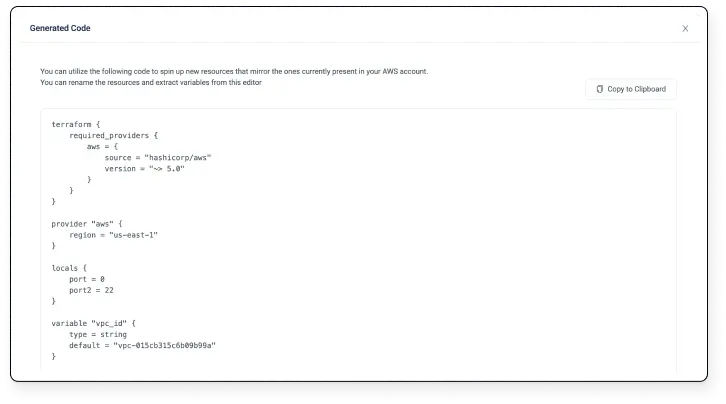
Convert existing cloud resources into clean Terraform code and state with one click
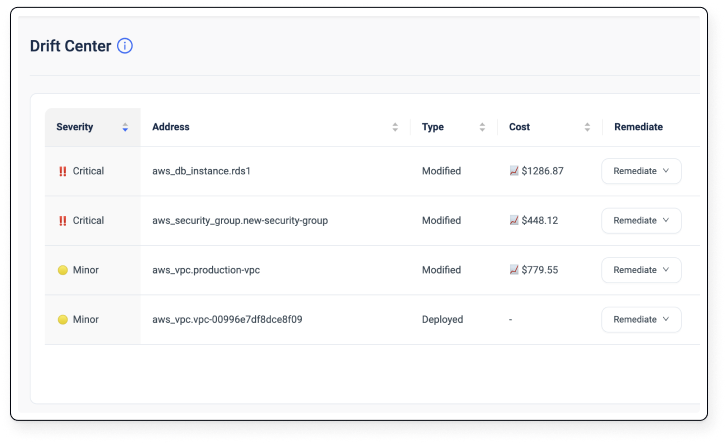
Detect and automatically remediate drift, instead of just alerting on it
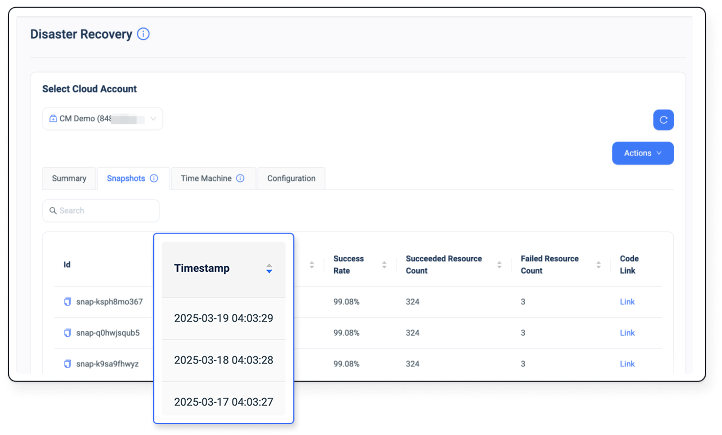
Recover safely from misconfigurations or accidental deletions using daily cloud configurations backups and full cloud disaster recovery
And executing Terraform workflows in a governed, gated and audited way.
And all of that without writing OPA or Sentinel policies, maintaining custom CI/CD pipelines, or stitching together multiple point tools.
In other words:
If Spacelift or Terraform Cloud help you run Terraform more efficiently,
ControlMonkey helps you make your cloud resilient and governable in real-world cloud environments, where infrastructure already exists, drift happens daily, and outages are expensive.
Tired of manually writing and maintaining your policy code?
ControlMonkey provides AI-powered, built-in governance, including out-of-the-box security policies, IaC risk scoring, and automated guardrails for every infrastructure change
Let’s go over the tool’s features in more detail to see why teams at Intel, AWS and Comcast can’t imagine their cloud without ControlMonkey:
Full Cloud Visibility & Automatic Terraform Code Generation
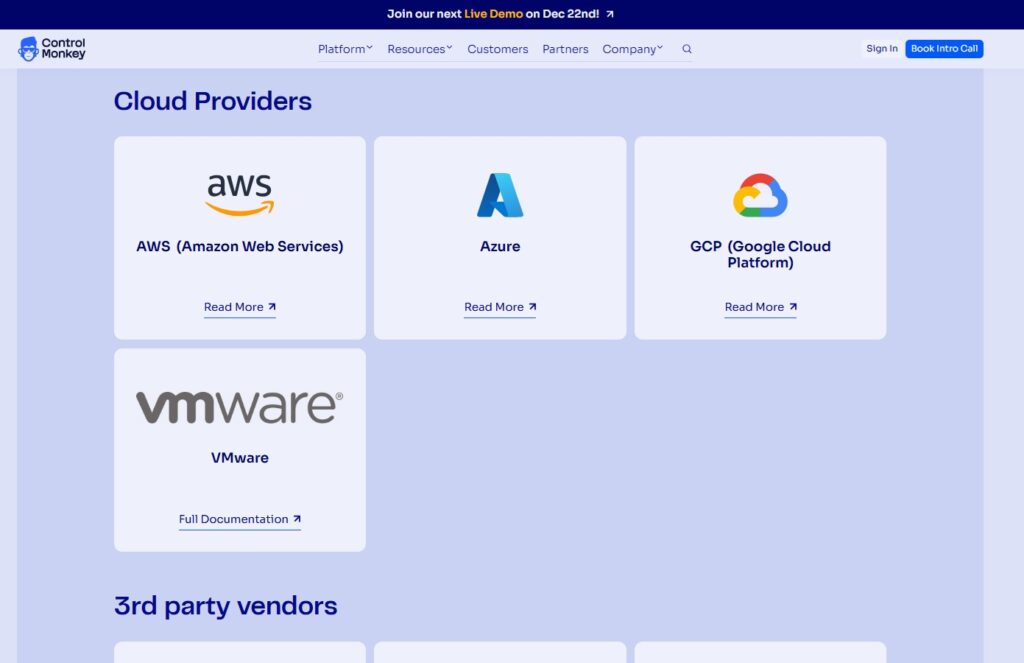
ControlMonkey connects directly to your cloud accounts (AWS, Azure, GCP) and 3rd party vendors (Datadog, Cloudflare, Okta, MongoDB and more) and continuously scans them to create a complete, real-time inventory of all resources.
The platform clearly shows what infrastructure is already managed by IaC and what’s unmanaged, eliminating blind spots and shadow IT.
Unlike Spacelift and Terraform Cloud, ControlMonkey can automatically generate production-ready Terraform code and state files for existing resources.
This “Cloud-to-Code” approach removes the manual, error-prone work of onboarding legacy infrastructure into IaC and dramatically accelerates standardization.
Drift Detection, Automated Remediation & Rollback
ControlMonkey continuously monitors cloud environments for configuration drift, whether caused by manual console changes, misconfigurations, or security issues.
While Spacelift and Terraform Cloud can detect drift, ControlMonkey goes further by automatically remediating it through Git-based pull requests and safe rollbacks.
This turns drift from an alerting problem into a resolved one, significantly reducing outages, downtime, and on-call firefighting.
See how Terraform AI detects drift between your code and deployed infrastructure using remote state in our video guide:
Built-In Governance With AI-Powered Guardrails
ControlMonkey provides enterprise-grade governance without requiring your team to write or maintain OPA or Sentinel policies.
Our platform includes out-of-the-box security, compliance, and cost guardrails, along with AI-driven Quality Gates and IaC risk scoring.
Every infrastructure change is automatically evaluated for risk and compliance before being applied, and our tool keeps a complete audit trail for compliance frameworks like PCI DSS or SOC 2.
See how Windward uses ControlMonkey to provision Amazon Bedrock in a self-serve, governed and private way, without compromising on security, compliance, or costs.
Compared to Spacelift and Terraform Cloud, this delivers faster adoption and lower operational overhead, especially for teams without dedicated policy engineers.
Infrastructure Resilience & Disaster Recovery
ControlMonkey treats infrastructure resilience as a first-class feature rather than an add-on.
It maintains daily snapshots of cloud configurations, enabling instant rollback and recovery from misconfigurations or accidental deletions. You can back up not only your cloud resources, but all other 3rd party vendors, such as Datadog, Cloudflare, Okta, Confluent, Temporal and more
Neither Spacelift nor Terraform Cloud provides native state backups or full cloud disaster recovery.
For DevOps & SRE teams running mission-critical infrastructure, this built-in recovery layer reduces operational risk and increases confidence in Terraform at scale.
Integrations: Spacelift vs. Terraform Cloud vs. ControlMonkey
Spacelift Integrations
Spacelift integrates deeply with modern DevOps and infrastructure tooling to support complex IaC workflows.
It is designed to fit directly into existing engineering stacks with strong VCS and cloud provider support.
Some of the notable integrations include:
GitHub.
GitLab.
Bitbucket.
AWS.
Azure.
Google Cloud.
Slack.
Terraform.
OpenTofu.
Pulumi.
Kubernetes.
Spacelift stands out by supporting multiple IaC frameworks beyond Terraform, including Pulumi and OpenTofu, for more flexible multi-tool workflows.
Terraform Cloud Integrations
Terraform Cloud focuses on tight integration within the HashiCorp ecosystem while also supporting common DevOps tools.
Its integrations are optimized for Terraform workflows and policy-driven infrastructure management.
Some of the notable integrations include:
GitHub.
GitLab.
Bitbucket.
AWS.
Azure.
Google Cloud.
Slack.
Sentinel.
Vault.
Consul.
Terraform Cloud stands out with its deep integration with HashiCorp tools like Sentinel, Vault, and Consul to provide your team with strong governance and security features.
ControlMonkey Integrations
ControlMonkey integrates with modern cloud providers and DevOps pipelines to support IaC-driven infrastructure management at scale.
Our enterprise-ready integrations can help your team maintain consistent governance across multiple environments.
3rd-party vendors like DataDog, Cloudflare, Snowflake, Dynatrace, Databricks, and MongoDB.
Infrastructure as Code (IaC) tools, including Terraform, Terragrunt, and OpenTofu.
Remote state backends like AWS S3 bucket, Azure Storage account, and Gitlab State Management.
Version Control Systems (VCS) like GitHub Enterprise Server, Bitbucket, and Azure DevOps.
‘’Bring your own pipeline’’ tools like Jenkins, GitHub Actions, Azure Pipelines, Atlantis, and Gitlab CI.
ControlMonkey stands out with broad, enterprise-ready integrations and IaC support to manage cloud infrastructure consistently across providers and tools.
Pricing: Spacelift vs. Terraform Cloud vs. ControlMonkey
Spacelift Pricing
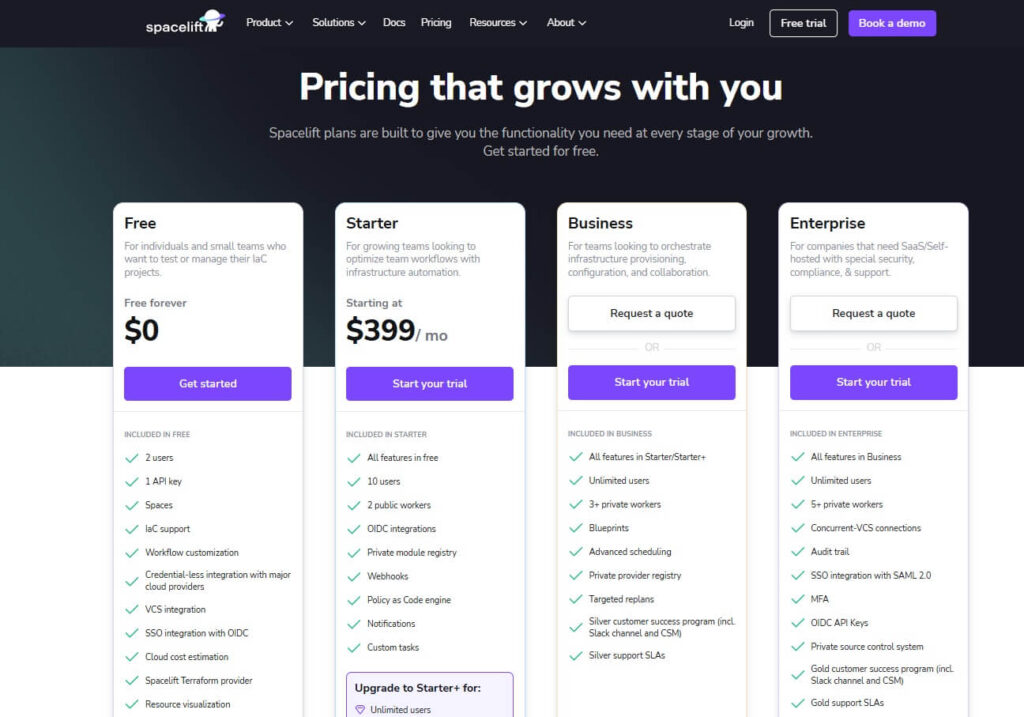
Spacelift offers a free-forever plan that includes 2 users, 1 API key, access to its Spaces, IaC support, cloud integrations, and workflow customization.
To get more users and capabilities, there are 4 paid plans:
Starter: Starts at $399/month, and includes up to 10 users, 2 public workers, OIDC integrations, a private module registry, webhooks, a Policy as Code engine, notifications, and custom tasks.
Starter+: Custom pricing and adds unlimited users, 1 private worker, and drift detection.
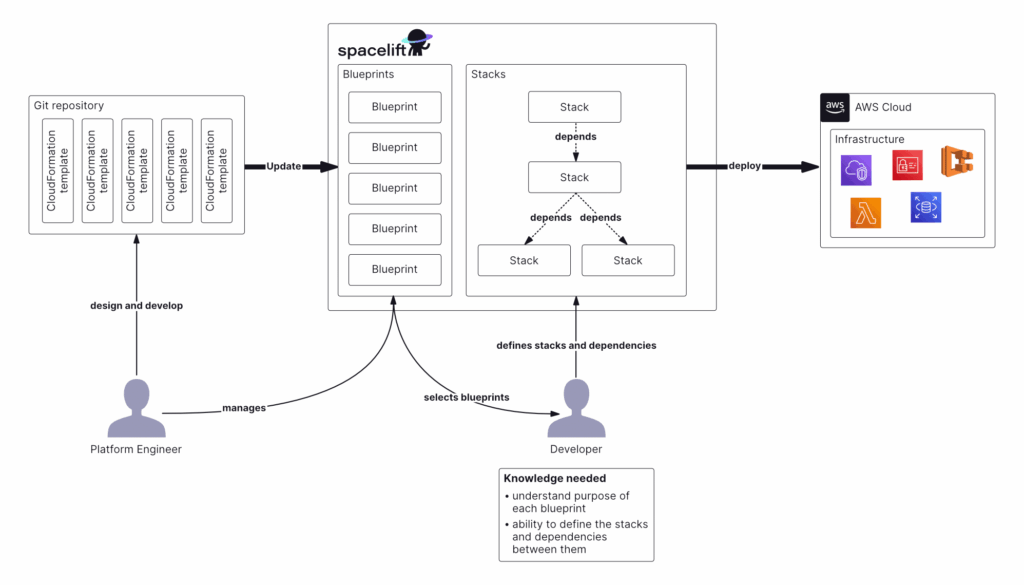
Business: Custom pricing, which includes up to 3+ private workers, blueprints, advanced scheduling, a private provider registry, targeted replans, and better customer support.
Enterprise: Custom pricing, which includes up to 5+ private workers, concurrent VCS connections, audit trails, MFA, OIDC API keys, and more.
Terraform Cloud Pricing
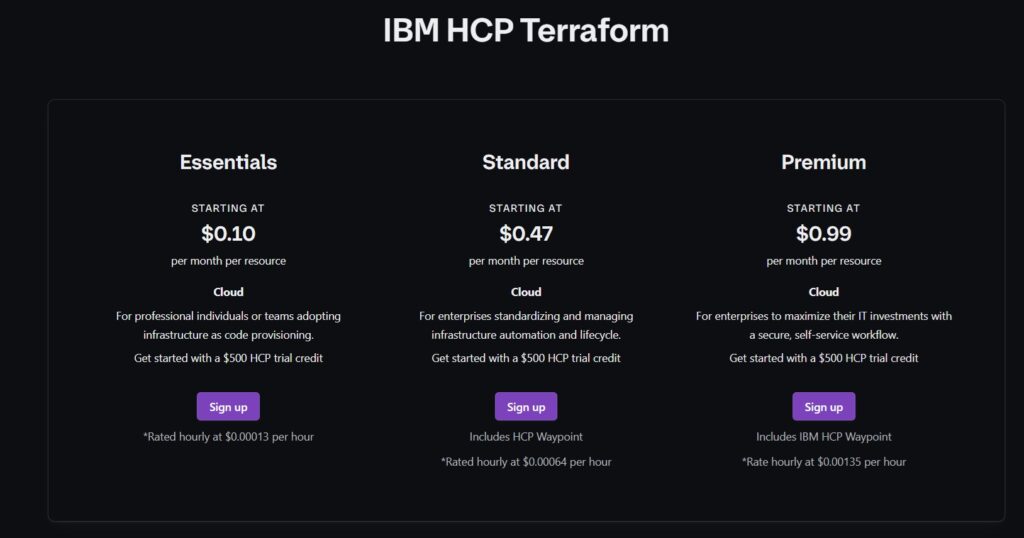
Terraform Cloud’s pricing is based on a Resources Under Management (RUM) model and offers a free trial for up to $500 worth of credits to use across the IBM HashiCorp Cloud Platform.
To get more, there are 4 paid plans to choose from:
Standard: Starts at $0.10 per resource/month, adding team management, cost estimation, drift detection, and Silver support.
Plus: Starts at $0.47 per resource/month, offering unlimited policies, run tasks, audit logs, and HCP Waypoint.
Premium: Starts at $0.99 per resource/month, for advanced governance, self-service workflows, and premium features.
Enterprise: Custom pricing, which adds premium support, making it ideal for enterprises requiring self-managed IBM Terraform to meet security, compliance, and operational needs.
Your costs will then scale with the number of cloud resources (instances, clusters, etc.) your team manages.
ControlMonkey Pricing
Unlike Spacelift and Terraform Cloud, ControlMonkey does not have a free tier or PLG pricing model.
Our platform offers only 2 pricing plans:
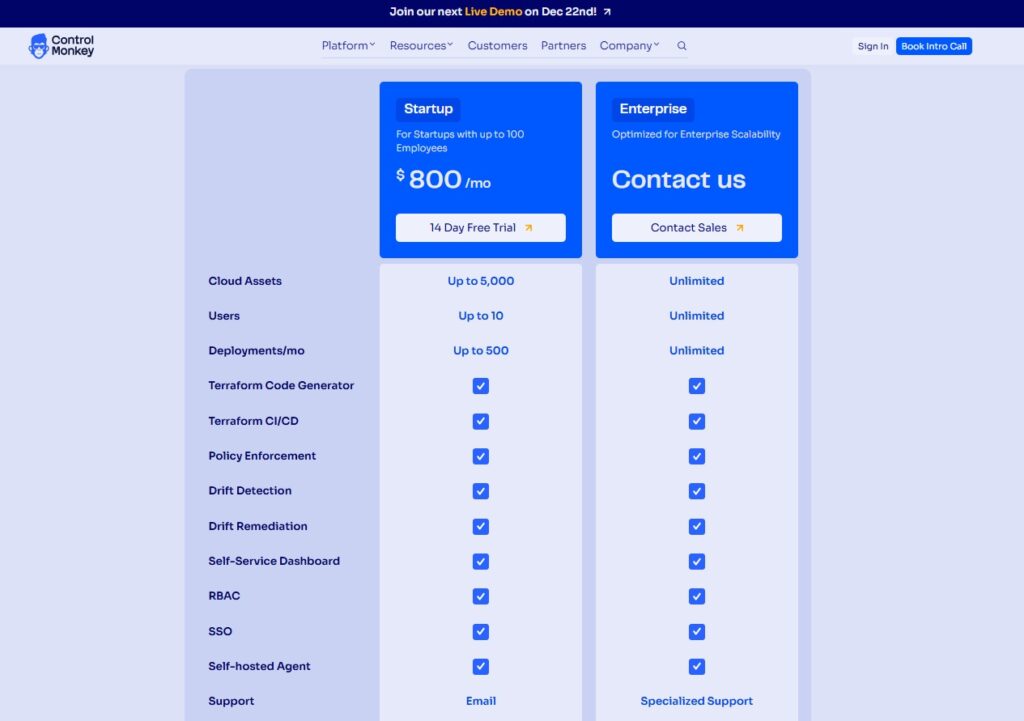
Startup: $800 for up to 10 users, up to 5,000 cloud assets, up to 500 deployments/month, and access to our Terraform code generator, Terraform CI/CD, policy enforcement, drift detection and remediation capabilities, self-service dashboard, RBAC, and self-hosted agent.
Enterprise: Custom pricing for unlimited cloud assets, users, and deployments, and adds specialized support.
What makes ControlMonkey’s pricing stand out to TFC is that it’s fixed, whereas Terraform Cloud’s price can fluctuate at any time.
You can also apply for startup pricing by sending us your company name and size, and register for a free trial.
What are customers saying about Spacelift, Terraform Cloud, and ControlMonkey?
TL;DR:
Spacelift reviews praise how easy it is to start with Terraform and delegate all Terraform actions, but are not happy with how difficult it can be to configure the capabilities you need inside of the platform, and its rather limited control over the data users are storing.
Terraform Cloud’s customers are happy with the tool’s ability to automate and standardize infrastructure provisioning across cloud environments, but are not happy with its initial learning curve and state file management that requires careful handling and secure backend configuration.
ControlMonkey users are satisfied with its ability to streamline Terraform deployments and how the tool simplifies pull request reviews and allows team members to deploy infrastructure independently, but some users are not happy with the fact that the platform currently supports only Terraform, OpenTofu, and Terragrunt’s IaC frameworks.
Spacelift Reviews
G2 Rating: 5/5.
What users love:
How easy it is to delegate all Terraform actions.
Starting with Terraform is smooth.
How the platform makes infrastructure management manageable.
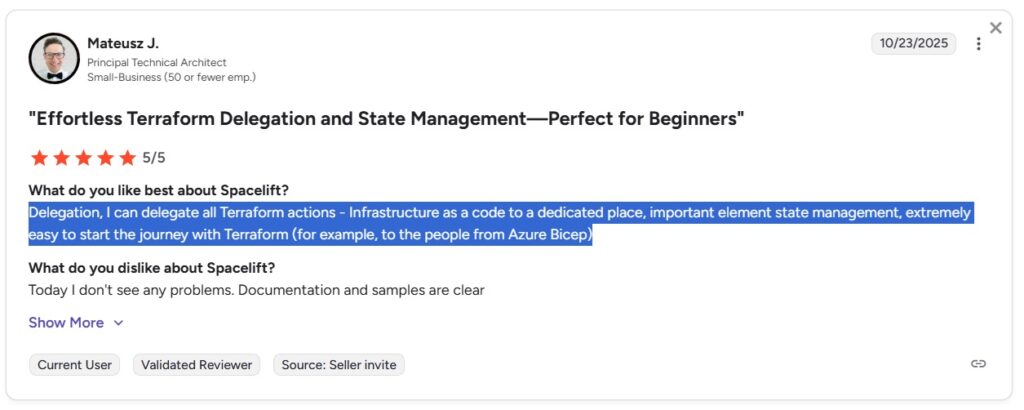
‘’Delegation, I can delegate all Terraform actions – Infrastructure as a code to a dedicated place, important element state management, extremely easy to start the journey with Terraform (for example, to the people from Azure Bicep).’’ – G2 Review.
It can be difficult to configure the capabilities you need inside of Spacelift (i.e., adding new configuration items).
Users would like to see a little more control over the data they are storing.
UI controls can feel clunky.
Common complaints:
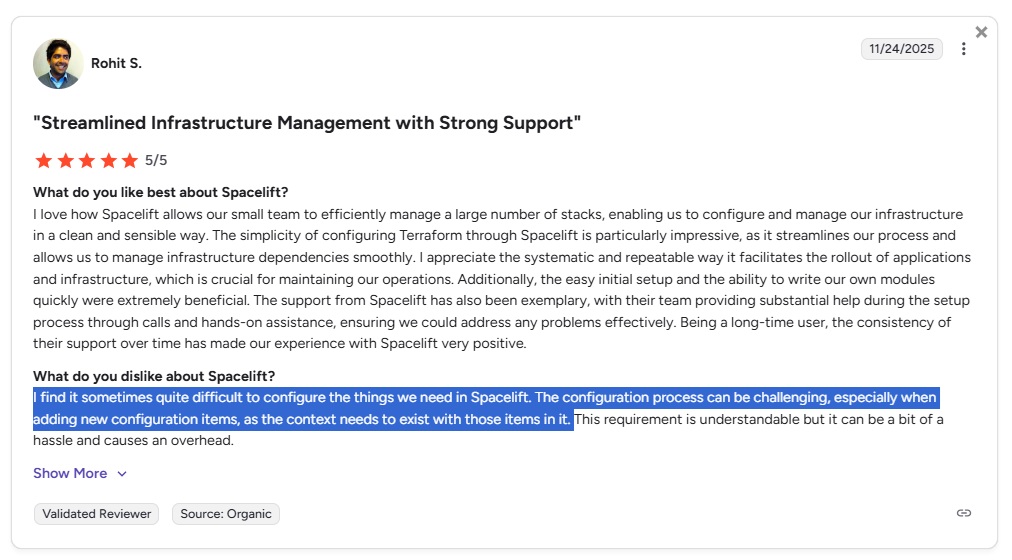
‘’I find it sometimes quite difficult to configure the things we need in Spacelift. The configuration process can be challenging, especially when adding new configuration items, as the context needs to exist with those items in it.’’ – G2 Review.
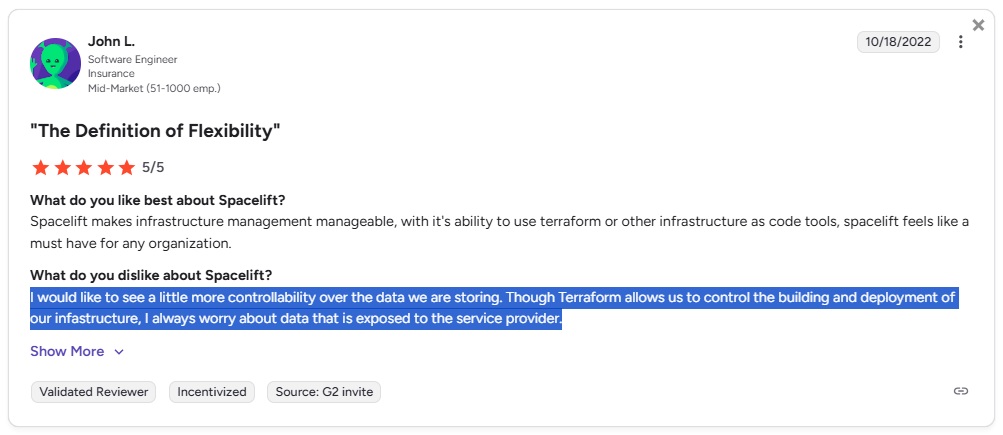
‘’I would like to see a little more controllability over the data we are storing. Though Terraform allows us to control the building and deployment of our infrastructure, I always worry about data that is exposed to the service provider.’’ – G2 Review.
Terraform Cloud Reviews (Hashicorp Terraform)
G2 Rating: 4.7/5.
What users love:
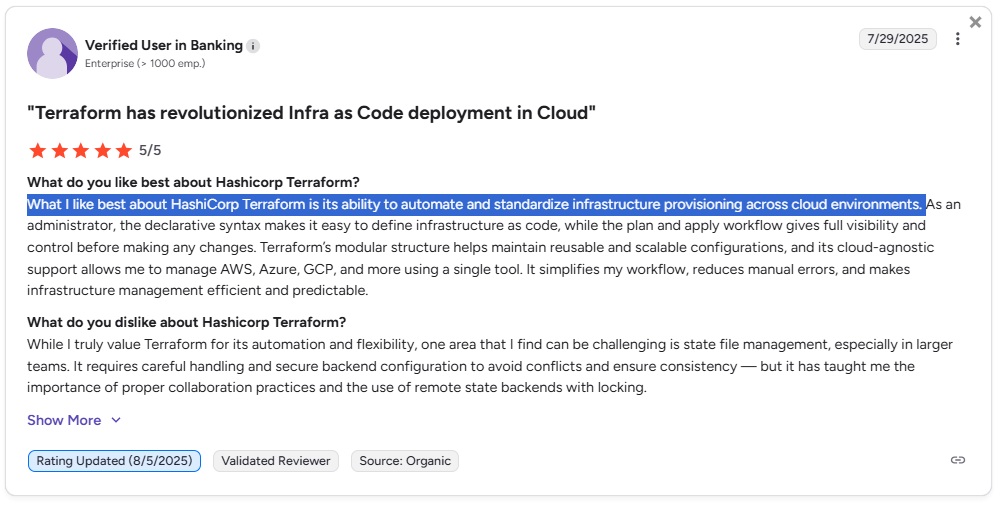
The platform’s ability to automate and standardize infrastructure provisioning across cloud environments.
How easy it is to configure Terraform in Jenkins, Azure DevOps, and Git Actions.
Its cloud-agnostic support that lets users manage AWS, Azure, GCP, and more using a single tool.
‘’What I like best about HashiCorp Terraform is its ability to automate and standardize infrastructure provisioning across cloud environments.’’ – G2 Review.
Common complaints:
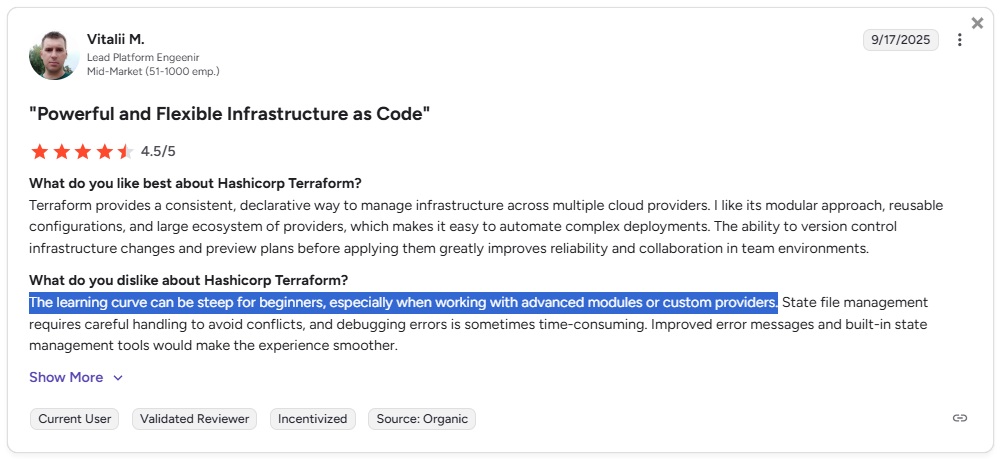
Steep learning curve for beginners, especially when working with advanced modules or custom providers.
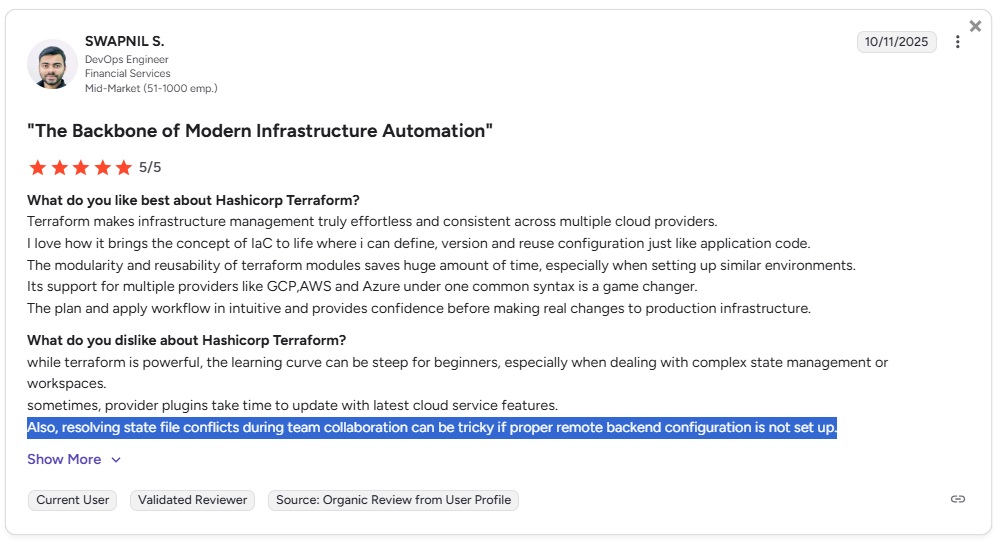
Resolving state file conflicts during team collaboration can be tricky if proper remote backend configuration has not been set up.
State file management in bigger teams needs careful handling and secure backend configuration to avoid conflicts and ensure consistency.
‘’The learning curve can be steep for beginners, especially when working with advanced modules or custom providers.’’ – G2 Review.
‘’Also, resolving state file conflicts during team collaboration can be tricky if proper remote backend configuration is not set up.’’ – G2 Review. ControlMonkey Reviews
G2 Rating: 5/5.
What users love:
Its ability to streamline Terraform deployments.
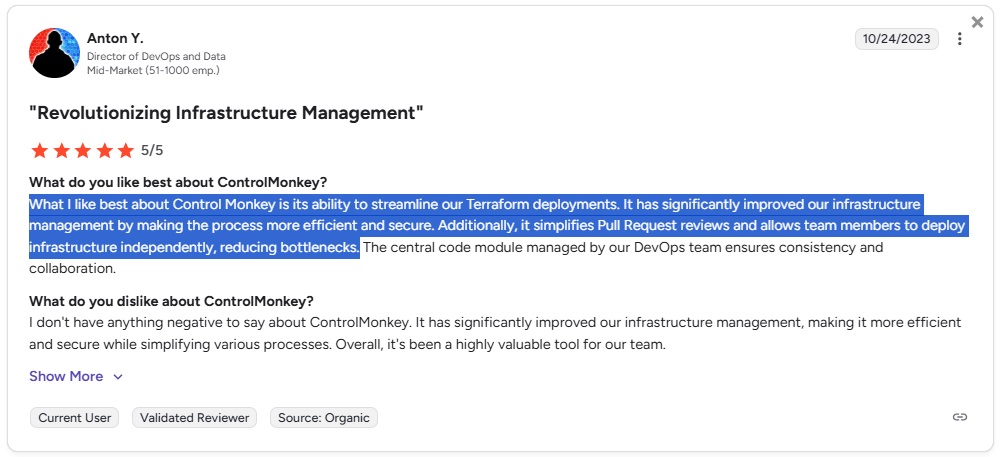
How the platform simplifies pull request reviews and allows team members to deploy infrastructure independently, reducing bottlenecks.
Releasing faster to production, without compromising on security or compliance.
‘’What I like best about Control Monkey is its ability to streamline our Terraform deployments. It has significantly improved our infrastructure management by making the process more efficient and secure. Additionally, it simplifies Pull Request reviews and allows team members to deploy infrastructure independently, reducing bottlenecks.’’ – G2 Review.
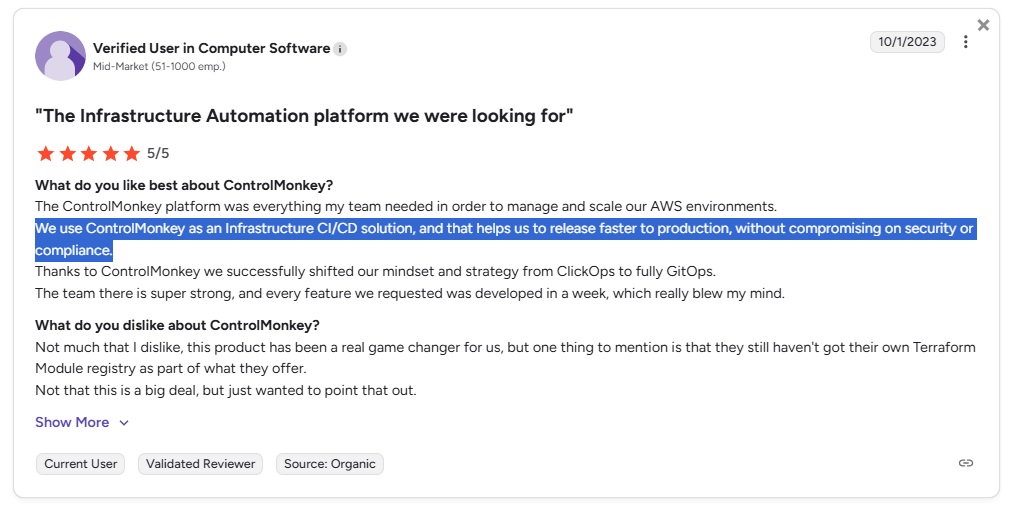
‘’The ControlMonkey platform was everything my team needed in order to manage and scale our AWS environments. We use ControlMonkey as an Infrastructure CI/CD solution, and that helps us to release faster to production, without compromising on security or compliance. Thanks to ControlMonkey we successfully shifted our mindset and strategy from ClickOps to fully GitOps. The team there is super strong, and every feature we requested was developed in a week, which really blew my mind.’’ – G2 Review.
Common complaints:
That the platform currently supports only Terraform, OpenTofu, and Terragrunt.
No on-premise deployment options. [Already supported]
Which platform should you choose for cloud infrastructure management?
If you’ve read through the article so far and you’re still unsure, here’s a quick use case summary to help you see the 3 platforms from a bird’s eye view: ⬇️
ControlMonkey is the right choice if you:
Need full cloud account scanning and an accurate inventory so you can find unmanaged resources and eliminate shadow infrastructure.
Looking for best-in-class IaC automation with out-of-the-box compliance packages and control policies.
Want automatic cloud-to-code conversion that generates production-grade Terraform code and state for existing resources to speed IaC adoption.
Require real-time drift detection plus automatic drift remediation and rollback so incidents are fixed before they become outages.
Care about resilience and want to make sure you can easily restore any resources getting deleted/wrongly updated.
Need predictable pricing with a fixed plan so you do not face sudden price changes.
Spacelift is the right choice if you:
Need broad multi IaC support and want a single orchestration plane for Terraform, OpenTofu, Terragrunt, CloudFormation, Pulumi, Ansible and Kubernetes tooling.
Must run a self-hosted instance for strict compliance, regulatory or air gapped needs.
Want a Git native, CLI-friendly workflow with tight control over run orchestration and custom policy workflows.
Are standardizing on many IaC frameworks and need an orchestration layer that meets that diversity.
Spacelift isn’t the best option if you:
Need automatic cloud scanning or Terraform code generation for existing, unmanaged resources.
Looking for daily backups of your entire cloud and 3rd parties footprint
Want built-in automated drift remediation or daily state backup and disaster recovery out of the box. Spacelift can detect drift, but remediation and state DR are not provided as out-of-the-box features (you’ll have to configure them).
Want governance without investing in policy engineering since Spacelift typically requires writing and maintaining policy code, such as OPA.
Terraform Cloud is the right choice if you:
Rely on HashiCorp native workflows and want the tightest Terraform CLI integration with remote execution, private module registry and Sentinel-style policy enforcement.
Prefer a workflow that is fully Git native and leverages first-party Terraform features and agents.
Are a small team or startup that benefits from Terraform Cloud’s product-led growth pricing options and free tier for early usage.
Terraform Cloud isn’t the best option if you:
Looking for predictable pricing and are worried about a single-vendor lock-in and licensing changes.
Have years of existing, manually created cloud resources and need a way to scan accounts and convert them into Terraform code automatically. Terraform Cloud does not provide cloud-to-code capabilities.
Want automated drift remediation, daily state backups and full disaster recovery for your cloud.
Need governance delivered as out-of-the-box AI-powered guardrails instead of maintaining Sentinel or custom policy code.
Migrate to Terraform in a single click with ControlMonkey
ControlMonkey, Spacelift and Terraform Cloud help teams run Terraform workflows more efficiently, but many organizations are still struggling with visibility, drift, and disaster recovery in real-world cloud environments.
ControlMonkey changes the game: it doesn’t just optimize Terraform workflows, it makes your cloud safe, resilient, and governable.
Our platform combines full cloud visibility, automatic Terraform code generation, built-in drift remediation, and infrastructure disaster recovery into a single, easy-to-use platform.
That means teams no longer have to stitch together multiple tools, maintain custom CI/CD pipelines, or write complex OPA or Sentinel policies.
If you’re tired of:
Not knowing what infrastructure exists or what’s unmanaged.
Terraform drift and ClickOps are constantly breaking things.
Lack of disaster recovery for your cloud configurations
Heavy governance complexity.
Using too many disconnected tools to manage infrastructure.
A 30-min meeting will save your team 1000s of hours
A 30-min meeting will save your team 1000s of hours
Ori Yemini is the CTO and Co-Founder of ControlMonkey. Before founding ControlMonkey, he spent five years at Spot (acquired by NetApp for $400M). Ori holds degrees from Tel Aviv and Hebrew University.

![Spacelift vs. Terraform Cloud vs. ControlMonkey: Which Platform to Pick? [2026]](https://controlmonkey.io/wp-content/uploads/2026/01/Spacelift-vs.-Terraform-Cloud-vs.-ControlMonkey.png)