
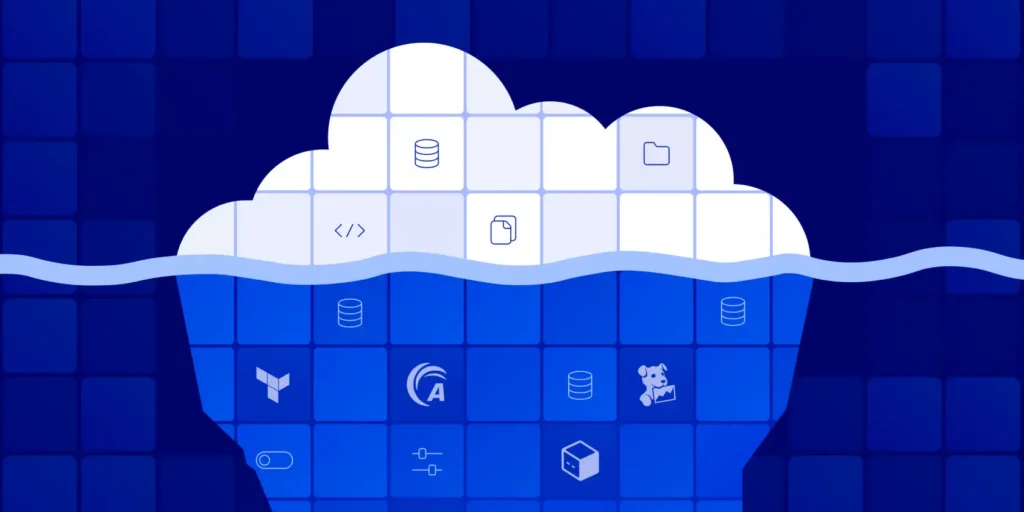
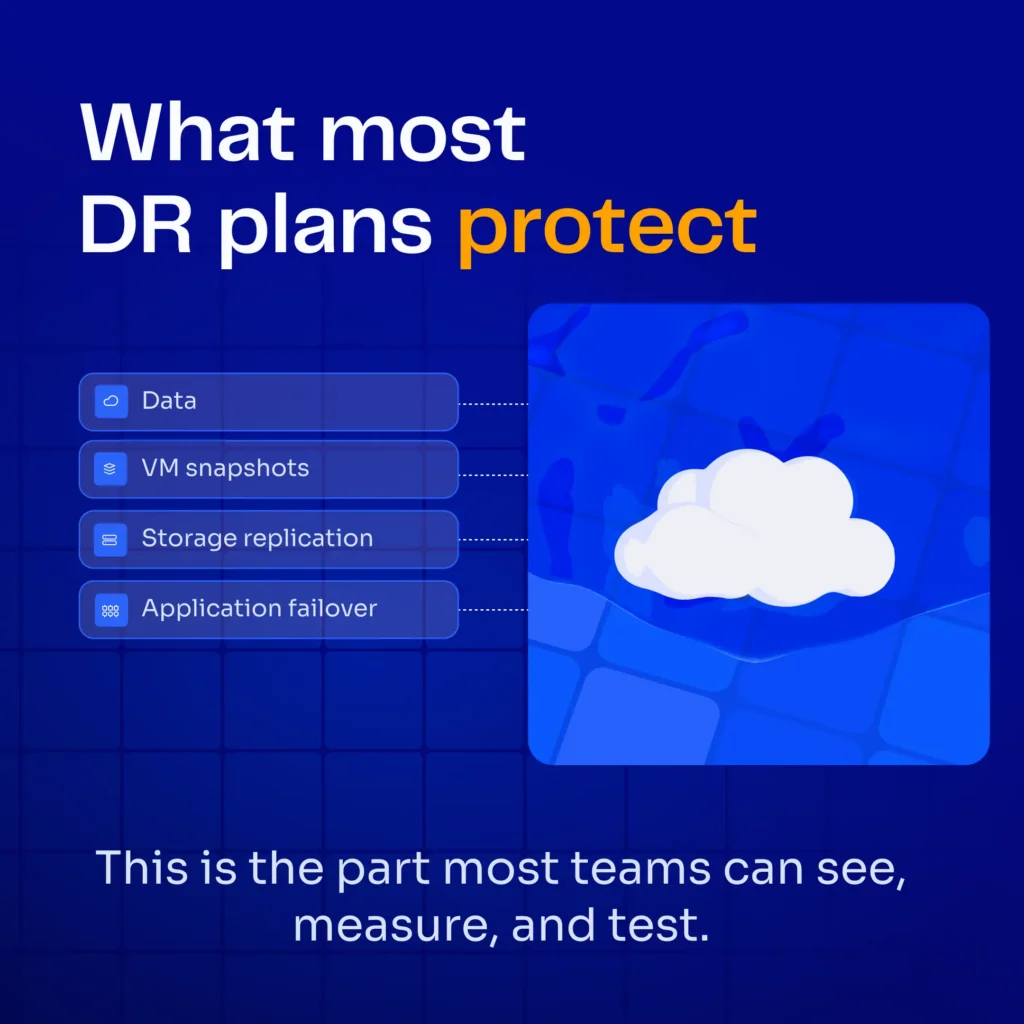
Most disaster recovery plans are built around what teams can see: data backups, VM snapshots, storage replication and application failover.
These are the familiar parts of DR. They are important, measurable, and usually the first things auditors, boards, and executives ask about when they want to know whether the business can recover. But they are not the whole recovery story.
The real problem often sits below the surface. Not in the data itself, but in the cloud, SaaS, identity, network, and security configuration required to make that data usable again. Gartner’s 2026 backup and data protection trends point in the same direction: backup is moving from passive data protection toward active cyber resilience, with identity systems, cloud-native workloads, ransomware recovery, AI-driven backup, and sovereignty requirements becoming central to recovery planning.
That hidden layer is The DR Iceberg.
The Visible Part Is Not the Whole Problem
Traditional disaster recovery was designed around a clear assumption: if the data is protected and the workloads can fail over, the business can recover.
That assumption made sense when infrastructure was more static. It makes less sense now.
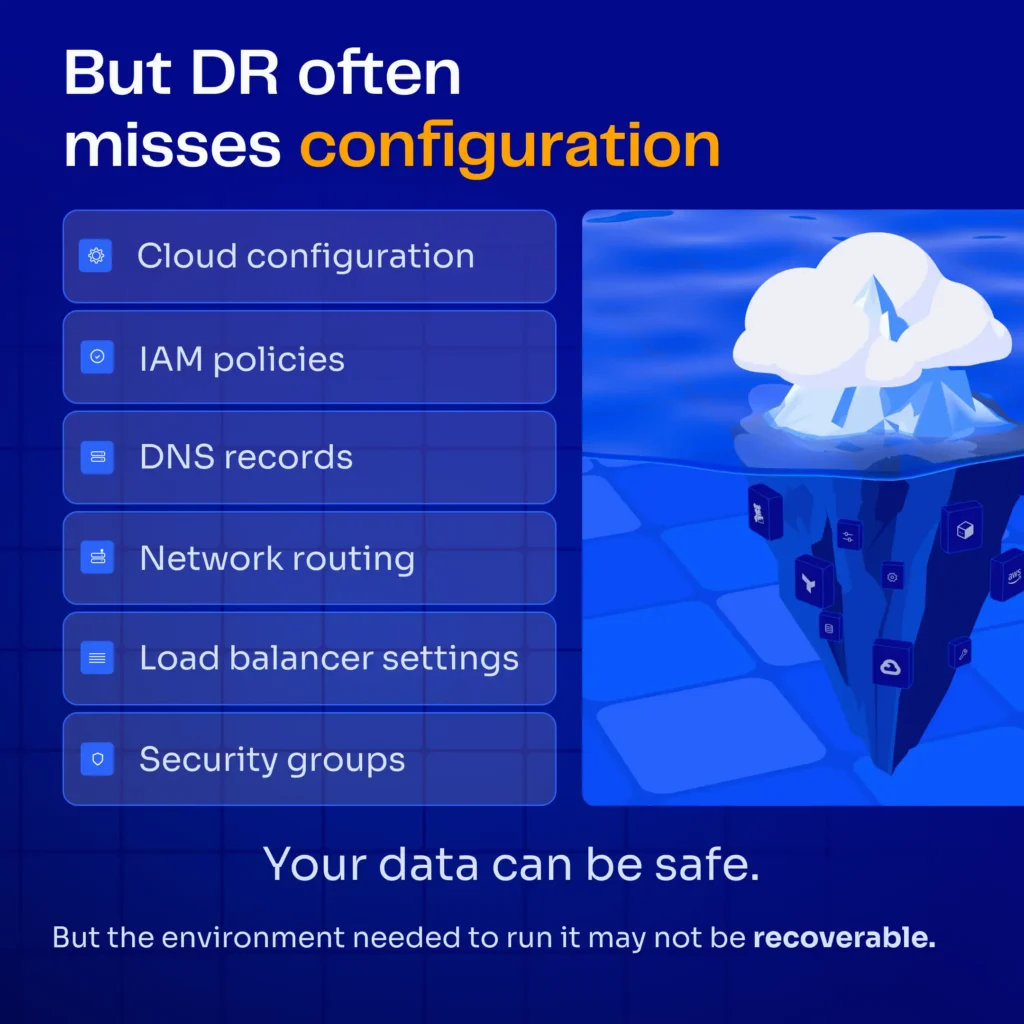
Modern environments are not just databases, servers, storage, and applications. They are made of constantly changing configuration. IAM policies define who can access what. DNS records decide where traffic goes. Security groups determine which systems can talk. Load balancers, routing rules, SaaS settings, monitoring policies, and third-party dependencies all decide whether the environment can actually operate. Gartner notes that cloud-native applications now depend on a broader set of components than traditional IaaS, including PaaS services, certificates, networking, load balancers, APIs, namespaces, policies, security, and more.
Your data can be safe, but the environment needed to run it may not be recoverable.
That is the blind spot inside many DR plans. They protect the visible layer of disaster recovery, but they do not protect the operational configuration underneath it. And during a real incident, the hidden layer becomes the problem.
The DR Iceberg Is the Missing Layer
The DR Iceberg, or Disaster Recovery Iceberg, is the hidden layer of cloud, SaaS, identity, network, and security configuration that traditional disaster recovery plans often miss, even though recovery depends on it.
It is not a replacement for backup. It is the part backup does not fully cover.
Traditional DR asks whether the organization can restore data and workloads. The DR Iceberg asks whether the organization can restore the configuration required to operate.
That distinction matters because recovery is not only about bringing assets back. It is about bringing back a working environment. A restored database does not help if applications cannot reach it. A recovered workload does not help if identity policies block access. A secondary region does not help if DNS, routing, or security rules are wrong. Gartner describes this problem clearly: when IaC is incomplete or not current, teams may face significant reconstruction work in a disaster recovery scenario.
Half a recovery is still a failure.
What Sits Below the Waterline
Below the waterline is the configuration layer most recovery plans do not treat as a first-class recoverable asset.
This includes cloud configuration, IAM policies, DNS records, network routing, load balancer settings, security groups, SaaS configuration, identity settings, observability rules, and system dependencies.
These are not minor details. They are the operating instructions for the environment.
They also change constantly. Some changes happen through Infrastructure as Code. Some happen manually in cloud consoles. Some happen inside SaaS admin panels. Some happen during incidents, when teams move fast and documentation comes later. Some happen through automation. Some may happen through over-permissioned AI agents acting faster than human review can follow.
The result is a dangerous gap. The DR plan may know where the data lives. It may know which region should fail over. It may even have a clean application recovery sequence. But it may not know what the surrounding environment looked like five minutes, five hours, or five days before the incident.
That is The DR Iceberg.
Quiet during normal operations. Expensive during recovery.
Recovery Slows Down When Configuration Becomes a Mystery
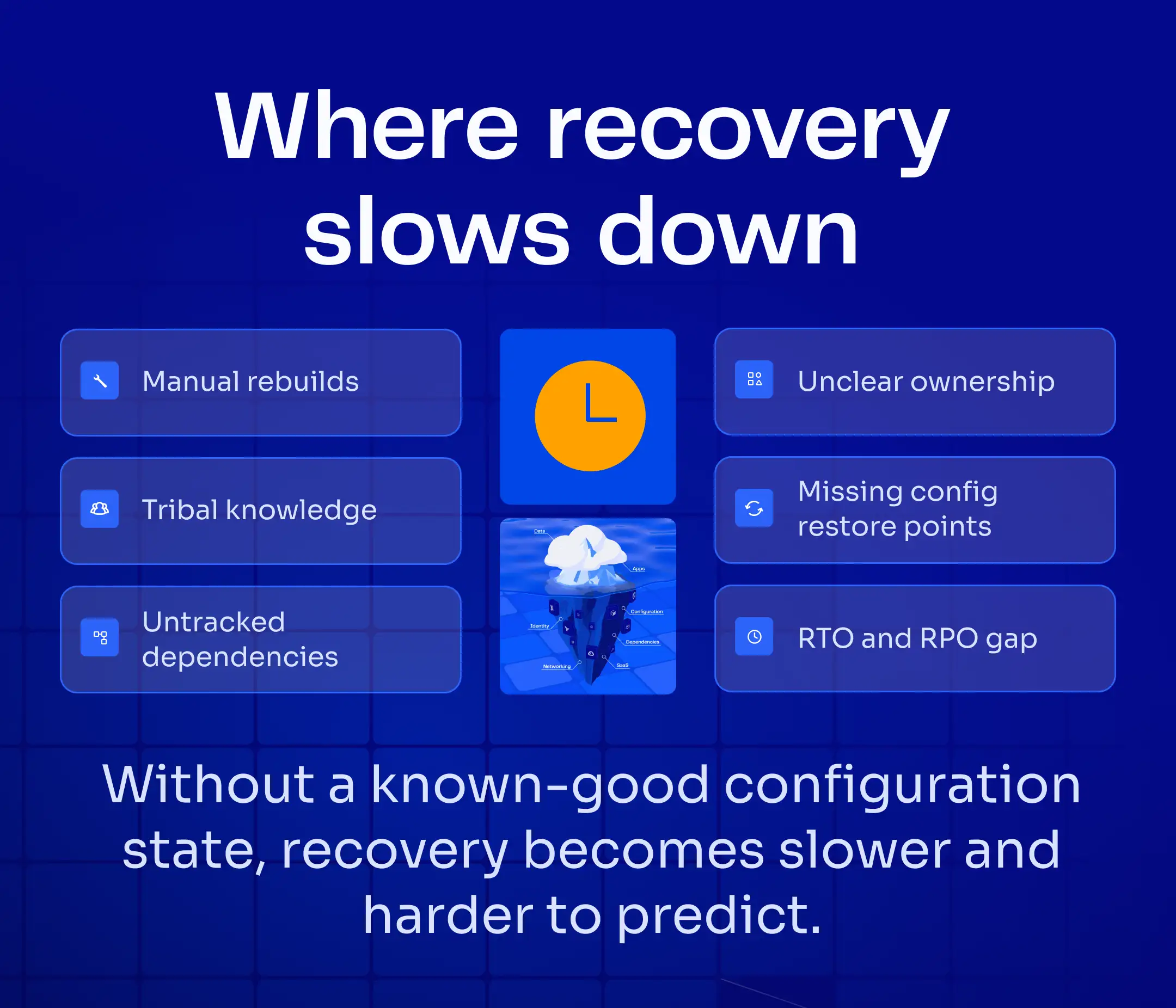
When configuration is lost, deleted, drifted, or changed without a trusted recovery point, teams do not simply restore. They investigate.
They try to answer basic operational questions under pressure. What changed? What depends on it? What was the last known-good state? What should be restored first? Can we roll this back without breaking something else?
These questions are hard enough on a normal day. During an outage, ransomware event, failed deployment, unauthorized change, or AI-agent mistake, they become business-critical.
Logs may be incomplete. Tickets may not reflect what actually happened. Terraform may not cover every resource. SaaS settings may live outside the usual recovery process. Cloud console changes may have bypassed the systems of record entirely.
This is where disaster recovery turns into manual reconstruction.
And manual reconstruction is not a strategy. It is a gamble.
The Problem Is Not Backup. The Problem Is Incomplete Recovery.
Backup still matters. No serious resilience strategy can ignore data protection, replication, snapshots, or failover. The problem is treating backup as if it equals recoverability.
It does not.
Restoring data is one part of returning to operations. Restoring the configuration around that data is another. In a real incident, the goal is often not to restore everything at once.
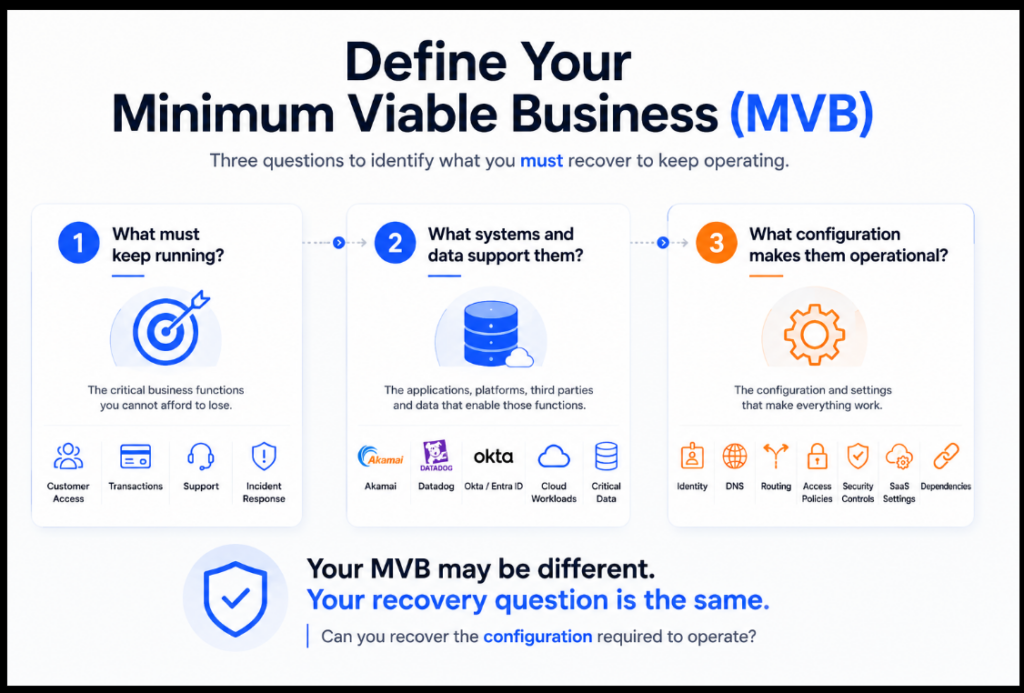
Minimum Viable Business (MVB) and DR
It is to bring back the Minimum Viable Business (MVB): the critical functions the organization needs to keep operating while broader recovery continues.
But even the minimum viable business depends on configuration. It still needs identity, DNS, routing, access policies, SaaS settings, security controls, and application dependencies to work. If those pieces are missing, outdated, or impossible to restore, the business may have its data back and still be unable to operate.
Modern recovery depends on both: the data and the environment required to use it.
Configuration Has to Become Recoverable
Reducing DR Iceberg risk starts with a simple shift: treat configuration as a recoverable asset.
That means teams need to know what exists across cloud and SaaS environments. They need recovery points for configuration, not only for data. They need version history for every meaningful change. They need to understand which accounts, services, and third-party platforms are actually DR-ready.
And when something breaks, they need a controlled way to restore known-good states.
This is not only a DevOps concern. It is not only a security concern. It is not only a cloud operations concern. It is a business continuity concern, because configuration now determines whether the business can return to operations.
A serious DR strategy should be able to answer:
- Do we know what configuration exists right now?
- Do we know what changed?
- Do we have a trusted restore point?
- Can we restore individual resources or full environments?
- Can we measure configuration recovery readiness across cloud and SaaS systems?
If the answer is no, the organization still has DR Iceberg risk.
Where ControlMonkey Fits in the Disaster Recovery Iceberg
ControlMonkey brings disaster recovery to cloud and SaaS configuration.
The platform helps teams discover what exists, back up configuration continuously, version every change, restore known-good states, and track DR readiness across cloud and third-party accounts.
In plain language, ControlMonkey gives teams a recovery layer for the configuration required to operate. That includes the parts traditional backup usually does not restore: cloud settings, identity configuration, network rules, SaaS configuration, security controls, and operational dependencies.
This matters because recovery cannot depend on memory, screenshots, old tickets, or a senior engineer who happens to know how things were wired together before the incident. ControlMonkey turns that configuration into something visible, versioned, and recoverable.
Traditional backup restores data. ControlMonkey restores the configuration required to operate.
Where Does Your DR Visibility End?
Most organizations can explain how they would restore data. Fewer can explain how they would restore the configuration surrounding it.
If DNS records were deleted, could you recover them quickly? If IAM policies changed during an incident, could you return to a trusted state? If SaaS settings drifted over time, would your DR plan know what to restore? If network routes, security groups, or load balancer settings were modified, would recovery be controlled or manual?
That is the question behind The DR Iceberg.
Not just: do we have backups?
But: can we restore the environment required to operate?
Let’s start easy – Read Only – FREE – DR Assessment
ControlMonkey helps teams understand where their disaster recovery strategy protects them and where cloud and SaaS configuration remains exposed.
A Cloud DR Readiness Assessment helps identify which configurations are DR-ready, where recovery blind spots exist, and which gaps could delay recovery during an outage, ransomware event, failed deployment, unauthorized change, or AI-agent mistake.
Know what sits above the waterline. Find what is hidden below it. Make your cloud and SaaS configuration recoverable.

A 30-min meeting will save your team 1000s of hours
A 30-min meeting will save your team 1000s of hours
Author