
Join our next Live Demo on Mar 16th!

Resource Blog News Customers Stories

Updated: Jan 26, 2026 Upd: 26.01.26

6 min read

What Is OpenTofu? Step-by-Step IaC Guide for 2025

Yuval Margules

Yuval Margules

Backend Developer

What Is OpenTofu? Step-by-Step IaC Guide for 2025

In late 2023, HashiCorp transitioned Terraform away from its established terraform opensource model to a business‑source license, causing uncertainty for many developers. In response, the community created OpenTofu, a fork of the last open-source version of Terraform, and placed it under the Linux Foundation for neutral governance

The community responded by forking the last terraform opensource version, re-branding it OpenTofu, and placing it under the Linux Foundation for neutral governance.

Currently, OpenTofu has matured into a production‑grade tool with a thriving ecosystem that proves the strength of the terraform opensource heritage boasting 4 000+ providers and 20 000+ modules installable from a public registry.

If you’re getting started opentofu with infrastructure as code (IaC) for the first time in 2025, OpenTofu should be your first choice. In fact, OpenTofu offers three big advantages:

  1. True OSS license – zero friction for side projects, client work, or commercial SaaS.
  2. Drop-in Terraform compatibility – HCL syntax, and providers still work with no compatibility issues.
  3. Community-driven roadmap – bug fixes and features land quickly without commercial blockers.

Simply put, OpenTofu gives beginners the power of terraform opensource tooling without worrying about licensing.

🟨 Learn What OpenTofu Is:
Not sure what OpenTofu is or how it fits into your infrastructure workflow. Here are more guides to learn:

Key OpenTofu Concepts for IaC Beginners

But, before getting started opentofu in a production workflow, it’s important to understand some essentials about the tool:

Providers

In OpenTofu, Providers are plugins that just as in the original terraform open-source project let the tool interact with cloud platforms like AWS or Azure. Think of them as a bridge that lets OpenTofu manage cloud resources effectively.

Essentially, when you define an OpenTofu configuration block, it communicates with the cloud provider using the provider APIs and provisions the resource for you.

For example, here’s what a provider which communicates to AWS would look like:

terraform {
  required_providers {
    aws = {
      source  = "hashicorp/aws"  # OpenTofu registry mirrors Terraform namespace
      version = "~> 5.29"
    }
  }
}

provider "aws" {
  region = "us‑east‑1"
}

The terraform block pins provider versions, while the provider block defines credentials and default regions information OpenTofu needs to plan and provision resources.

Resources

A resource is a declarative block that describes what you want. This could be an S3 bucket, EC2 instance, or VPC, anything cloud-related.

For example, you’d define a resource using the following convention:

resource "aws_s3_bucket" "demo" {
  bucket = "otf-demo-bucket"
  acl    = "private"
}

Configuration

Your configuration is defined using .tf files. If you’re familiar with Terraform, you’d have used .tf files. They essentially provide a space which you can use to define cloud infrastructure.

State

In OpenTofu, state is a file that tracks the resources you’ve provisioned in the cloud. It functions like an inventory list that helps OpenTofu detect changes and apply only the necessary updates to your cloud environment.

For instance, if OpenTofu state determines that new resources are present in your configuration which aren’t available in the cloud, it will automatically provision them for you.

This enables drift detection and safe incremental changes.

You can configure your state by defining the state definition in your terraform block:

terraform {
  backend "s3" {
    bucket         = "otf-state-bucket"
    key            = "global/s3/terraform.tfstate"
    region         = "us-east-1"
    dynamodb_table = "otf-locks"   # prevents concurrent applies
    encrypt        = true
  }
}

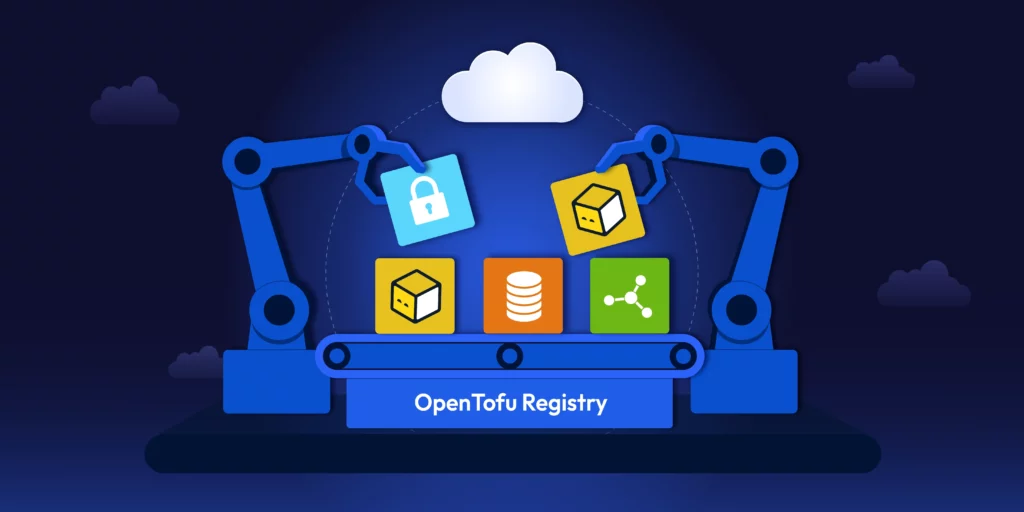
OpenTofu Registry

OpenTofu has a public registry (search.opentofu.org) which provides a catalogue of community-tested providers and reusable modules. You can search, pin exact versions, and even run tofu providers lock to generate dependency hashes for supply-chain security.

Step-by-Step Overview – How does OpenTofu fit into your infrastructure workflow?

If you’re getting started opentofu and working with IaC, you’ll follow a lifecycle as follows:

1. Write Configuration

Start by writing a configuration file, typically named main.tf. This file should define the resources you want, such as an S3 bucket, and specify their settings. Example below:

For example, you can define your provider and your resource using the following:

# main.tf 

terraform {
  required_providers {
    aws = {
      source  = "hashicorp/aws"
      version = "~> 5.29"
    }
  }
}

provider "aws" {
  region = "us‑east‑1"
}
resource "aws_s3_bucket" "demo" {
  bucket = "otf-demo-bucket"
  acl    = "private"
}

You can define your resources in a main.tf and commit it to a version control system.

2. OpenTofu Initialize

Next, initialize the providers you’ve configured in your terraform block by running tofu init. This prepares the environment for provisioning resources.

This can be done using tofu init. This will:

  1. Download the AWS provider
  2. Read your backend settings
  3. Prepare a working directory.

3. OpenTofu Plan

After you’ve initialized your backend, you can begin a deployment by first gaining an insight on what’s going to be applied on your IaC configs. This can be done by executing the command:

tofu plan

By doing so, it will generate a difference on what will be created, removed and modified in the cloud.

In your case, you’ll see resources being generated as you’ll be provisioning for the first time.

4. OpenTofu Apply

After you have reviewed the plan, you can run tofu apply. This will apply the changes on your cloud environment and will provision the defined IaC in the cloud.

5. Safely Update IaC with OpenTofu

Later you can add versioning or encryption. plan shows a minor in-place update, and apply executes it without touching other resources.

6. Introduce CI/CD

Once you’re comfortable with the manual deployment process, you can enhance your workflow by automating it through a CI/CD pipeline. This approach is particularly useful for teams working on large-scale projects.

You can configure your pipeline rules in a way that every pull request triggers a plan and only merges to main trigger an apply. A sample GitHub Actions pipeline that many teams adopt when getting started opentofu looks like this:

name: OpenTofu CI

on:
  pull_request:
    paths: ["**.tf"]

jobs:
  plan:
    runs-on: ubuntu-latest
    steps:
      - uses: actions/checkout@v4
      - name: Set up OpenTofu
        uses: opentofu/setup-opentofu@v1
      - name: Cache providers
        uses: actions/cache@v4
        with:
          path: ~/.opentofu.d/plugins
          key: ${{ runner.os }}-tofu-${{ hashFiles('**/.terraform.lock.hcl') }}
      - name: Init
        run: tofu init -input=false
      - name: Plan
        run: tofu plan -input=false -no-color | tee plan.txt

  apply:
    needs: plan
    if: github.ref == 'refs/heads/main' && github.event_name == 'push'
    runs-on: ubuntu-latest
    steps:
      - uses: actions/checkout@v4
      - uses: opentofu/setup-opentofu@v1
      - name: Init
        run: tofu init -input=false
      - name: Apply
        env:
          TOFU_CONFIRM: "true"
        run: tofu apply -input=false -auto-approve
This workflow gives you automated drift detection on every PR and a tamper‑proof audit trail in GitHub.

This workflow gives you automated drift detection on every PR and a tamper‑proof audit trail in GitHub.

Scaling OpenTofu for Teams and Environments

Once you’re getting started opentofu and comfortable with the basics, you can explore advanced workflows, such as:

1. Reuse patterns

Use OpenTofu Modules. Publish a VPC or EKS blueprint to your private registry so every micro-service team can consume it with a single block.

2. Automate plans/applies

Use CI/CD runners (e.g., GitHub Actions, GitLab, Jenkins) to call OpenTofu in plan-only mode and require a human-approved pull-request label before the apply job runs.

3. Manage multiple environments

Adopt a separate state backend per account/region pair. Tools like OpenTofu’s native -chdir= flag simplify mono-repo layouts.

3. Migrate existing Terraform code

You often just rename the binary to tofu, update provider constraints if necessary, and run tofu init.

However, you can use a more safer and guided migration approach by using ControlMonkey. It offers a 1-click migration wizard that converts your state and CI pipelines automatically onto an OpenTofu workflow.

📘🟨 More on Scaling OpenTofu

🟨 OpenTofu: Concluding thoughts

Picking an IaC framework used to be a trade-off: Open-source freedom vs. corporate support.

OpenTofu closes that gap.

It keeps Terraform’s proven workflow, removes license uncertainty, and adds a faster-moving community roadmap.

If you already have Terraform code and want to see OpenTofu in action, ControlMonkey’s 1-click migration spins up a free sandbox, converts your state, and rolls back in seconds if you change your mind. Ready to migrate from Terraform to OpenTofu? Book a demo with ControlMonkey and see how simple it can be.

Bottom CTA Background

A 30-min meeting will save your team 1000s of hours

A 30-min meeting will save your team 1000s of hours

Book Intro Call

Author

Yuval Margules

Yuval Margules

Backend Developer

Yuval is a software engineer at ControlMonkey with a strong focus on DevOps and cloud infrastructure. He specializes in Infrastructure as Code, CI/CD pipelines, and drift detection. Drawing from real-world conversations with engineering teams, Yuval writes about practical ways to automate, scale, and secure cloud environments with clarity and control.

    Sounds Interesting?

    Request a Demo

    FAQs

    OpenTofu is a community-driven, open-source fork of Terraform. It was created in response to HashiCorp’s license change and is now governed by the Linux Foundation. It retains full Terraform compatibility but operates with a true OSS license and a faster, public roadmap.

    Almost. OpenTofu is based on the last open-source version of Terraform and keeps the same HCL syntax, provider ecosystem, and core functionality. The big difference? OpenTofu is licensed under MPL (not BSL) and evolves through community contributions instead of vendor control.

    Yes. OpenTofu remains fully compatible with Terraform providers. It uses the same provider registry structure and HCL syntax. Your existing Terraform modules and cloud configurations should work without any code changes.

    OpenTofu offers the same Terraform experience but with a true open-source license (MPL), no usage restrictions, and a community-driven roadmap backed by the Linux Foundation. It’s vendor-neutral and production-ready.

    Resource Blog News Customers Stories

    Updated: Oct 20, 2025 Upd: 20.10.25

    6 min read

    OpenTofu CI CD Guide: AI-Powered Automation to the Rescue

    Yuval Margules

    Yuval Margules

    Backend Developer

    OpenTofu CI CD Guide: AI-Powered Automation to the Rescue

    OpenTofu CI CD workflows make Infrastructure as Code practical and scalable for DevOps teams. By expressing infrastructure in code, you can automate, version, and test cloud resources within your deployment pipeline. OpenTofu delivers Terraform-compatible IaC that fits seamlessly into existing CI/CD setups—without licensing fees or vendor lock-in. It’s transparent, community-driven, and supports straightforward migration from Terraform for faster adoption.

    Embedding OpenTofu into a Git-centric CI/CD flow is a game-changer, but, let’s be real getting the first pipeline green can still feel daunting.For many teams,the complexity of integrating IaC modules into build-and-deploy stages, plus the time it takes to see a green pipeline, can be overwhelming. Pairing OpenTofu with AI-driven automation platforms like ControlMonkey (which hook directly into CI/CD runners) may offer a promising direction for teams seeking to simplify IaC workflows. OpenTofu’s open-source flexibility combined with AI-based smart automation platforms can make IaC adoption faster and more practical for teams.

    Why OpenTofu CI CD Pipelines Remain Challenging for Teams

    Picture this: your team is eager to ship on every commit, but the pipeline keeps failing because you’re staring at a wall of infrastructure configs, wrestling with syntax, and wondering why your cloud resources aren’t behaving. Sound familiar? The learning curve for IaC tools can be difficult, especially for teams new to managing infrastructure at scale. Analyzing existing infrastructure, architecting IaC modules, and incorporating best practices require specialized skills. Add in the time it takes to wire these configs into a build-test-deploy pipeline, and it’s no wonder some teams hesitate. Then, there’s the fear of misconfigurations leading to costly outages and downtimes.

    OpenTofu is a top contender among all IaC tools in the terraform opensource landscape.It’s free to use. You can experiment without breaking the bank or getting locked into a vendor’s ecosystem. However, organizations must invest significantly into converting existing infrastructure to code, training teams on IaC, building pipelines and automation around IaC to manage infrastructure, and implementing observability, alerting, and policy enforcement for infrastructure to ensure a smooth opentofu adoption. Due to these challenges, many teams shelve “IaC-first CI/CD” and leave it in the backlog..

    Overcoming OpenTofu CI CD Barriers with AI Automation

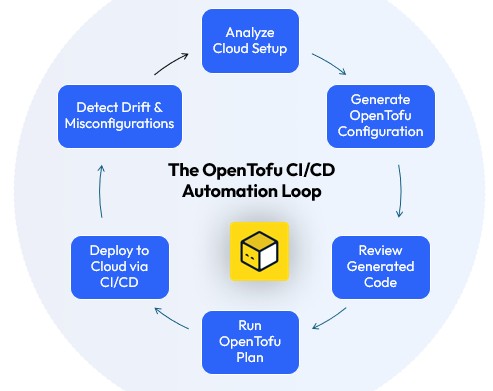
    Now, let’s talk about the secret sauce AI-powered automation. Imagine you’re managing a cloud environment. Traditionally, you’d comb through cloud resources and figure out how to bolt them onto your Jenkins or GitHub Actions workflow. Then, you bake them in OpenTofu modules by coding OpenTofu configurations with best practices in mind. That’s a recipe for burnout.AI can step in to scaffold OpenTofu modules, commit them to Git, and open a pull request that your CI system can test automatically.. For example, tools like ControlMonkey can analyze your cloud setup and generate HCL code that’s ready to be deployed, cutting manual effort by hours.

    But it doesn’t stop there. AI can handle tedious tasks such as drift detection spotting when your actual infrastructure deviates from your code. Say your team manually tweaks a security group in the AWS console (we’ve all been there); AI tools can flag that drift and suggest fixes, keeping your setup consistent. Plus, policy checks? Injected as an extra stage in your CI pipeline.. No more late-night scrambles to ensure compliance before a deployment.

    Smart Tooling: A Practical Path

    Pairing OpenTofu with automation platforms can accelerate opentofu adoption and overall IaC adoption. Platforms like ControlMonkey plug into CI/CD orchestrators (GitHub Actions, GitLab CI, Jenkins) and support Terraform today, OpenTofu with minimal tweaks, though direct integration is not officially documented. For instance, a dev team at a mid-sized startup can point an AI tool at their existing cloud resources, and it’ll generate OpenTofu modules tailored to their setup, no need to start from scratch.

    Governance gets easier, too an AI-driven platform can lint every OpenTofu commit inside the CI pipeline, flagging any unencrypted buckets and even suggesting fixes. It is also important to understand what all this enables for organizations. Compliance is one of the critical areas that add true business value. Automation platforms can help enforce security practices aligned with frameworks like HIPAA and NIS2, which may support compliance efforts when used with IaC tools such as OpenTofu, cutting audit prep time from weeks to hours.

    This approach also frees teams to focus on what matters delivering features. By automating infrastructure tasks, OpenTofu and smart tooling reduce the time spent on managing infrastructure. It lets developers prioritize application logic. This terraform opensource combination also scales. OpenTofu’s modular design, combined with AI-driven workflows, keeps things organized and repeatable, helping you manage a single VPC or a multi-cloud setup.

    Benefits of CI-CD: Faster Pipelines, Fewer Rollbacks

    So, what’s in it for your team? First, you get to a passing CI build faster. AI tools accelerate IaC onboarding by generating configuration templates, potentially reducing setup time from weeks to days depending on team experience and environment complexity. Second, fewer mistakes. Automation catches errors before they eventually turn into outages or downtime. Third, you get control. OpenTofu is flexible. You can decide how to structure your code best, the providers you use, how you store your code, and how you configure backends. Pairing OpenTofu with smart tooling lets you scale infrastructure practices without the operational overhead.

    Conclusion: Scaling OpenTofu CI CD with Confidence

    IaC doesn’t have to be a headache. OpenTofu’s open-source approach lowers the entry barrier in the terraform open-source ecosystem, and AI-powered automation takes care of operationalizing IaC adoption. Together, they help teams adopt IaC faster, reduce errors, and scale operations across multiple environments without manual intervention, making open-tofu adoption a clear win. Book a demo with ControlMonkey to see how our platform can streamline your OpenTofu journey and bring intelligence to your infrastructure management.

    Bottom CTA Background

    A 30-min meeting will save your team 1000s of hours

    A 30-min meeting will save your team 1000s of hours

    Book Intro Call

    Author

    Yuval Margules

    Yuval Margules

    Backend Developer

    Yuval is a software engineer at ControlMonkey with a strong focus on DevOps and cloud infrastructure. He specializes in Infrastructure as Code, CI/CD pipelines, and drift detection. Drawing from real-world conversations with engineering teams, Yuval writes about practical ways to automate, scale, and secure cloud environments with clarity and control.

      Sounds Interesting?

      Request a Demo

      Resource Blog News Customers Stories

      Updated: Oct 20, 2025 Upd: 20.10.25

      5 min read

      OpenTofu vs Terraform: IaC Comparison for DevOps Teams

      Yuval Margules

      Yuval Margules

      Backend Developer

      OpenTofu vs Terraform: IaC Comparison for DevOps Teams

      Governed by the Linux Foundation, OpenTofu is a vendor-neutral, fully open-source infrastructure-as-code (IaC) platform created by the community as a successor to HashiCorp’s Terraform. OpenTofu was initiated in response to HashiCorp’s change of Terraform’s license from the Mozilla Public License (MPL) to the Business Source License (BSL). As organizations utilize cloud infrastructure and automation, OpenTofu aims to give teams an open, scalable IaC platform, and early adopters report stable production use. When evaluating opentofu vs terraform, teams benefit from OpenTofu’s full compatibility with Terraform, letting them tap the same provider ecosystem and community know-how.

      Feature-by-Feature: Opentofu vs Terraform – Performance, Usability, Extensibility

      CategoryTerraformOpenTofu
      PerformanceProven in large-scale production deployments and backed by a vast plugin ecosystemComparable performance, with community-driven optimizations that match Terraform at scale
      UsabilityRich documentation, extensive tutorials, and a mature community though the breadth of features can challenge newcomersThe community-driven project aims to lower the onboarding barrier for new users
      ExtensibilityExtensive plugin ecosystem and robust provider supportCompatible with Terraform modules and supports the same providers.
      IntegrationExcellent support for integrating with tools like Jenkins and GitHub ActionsDesigned to drop-in to existing Terraform workflows and CI/CD pipelines (e.g., GitHub Actions

      Early community benchmarks comparing Opentofu vs terraform show comparable performance for both tools at all scales. Terraform’s commercial add-ons (e.g., Terraform Cloud) bundle governance features, while OpenTofu users can integrate similar controls via open-source or third-party options. OpenTofu’s focus on community-driven development allows it to be agile and more user-focused. While OpenTofu uses the same syntax as Terraform, new IaC users may face a steeper learning curve due to relatively limited documentation and IDE tooling compared to Terraform.

      Licensing and Community – Open-Source vs. Controlled Ecosystems

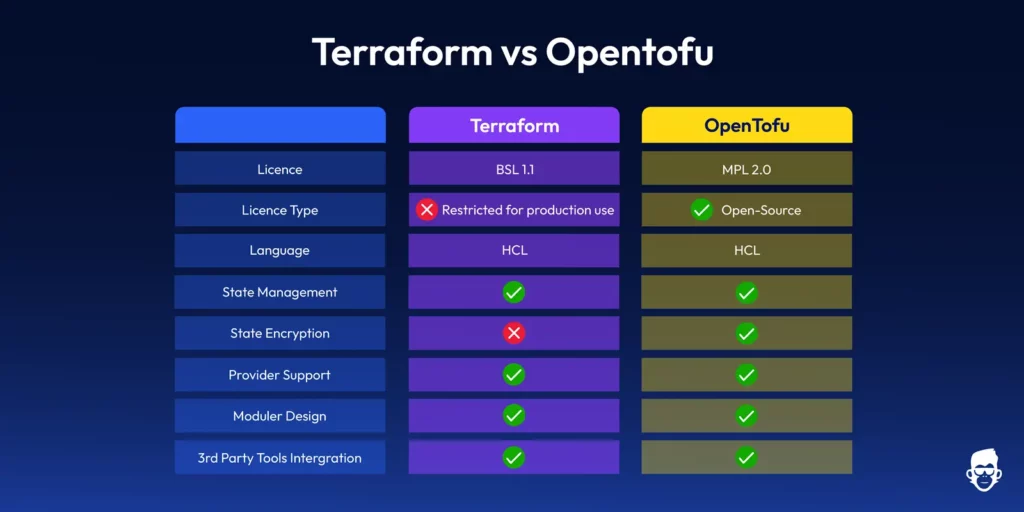
      In the opentofu vs terraform debate, the biggest divider is licensing model.HashiCorp backs Terraform, which is licensed under the Business Source License (BSL) from version 1.6 onward. Earlier versions (up to 1.5) remain under the Mozilla Public License (MPL 2.0). Which offers an open-source approach but has a commercial version (Terraform Cloud) with premium features and support. OpenTofu is stewarded by the Linux Foundation and released under the Mozilla Public License 2.0 (MPL-2.0), ensuring neutral governance and free use. This fully open model of transparency gives users full control over the tool, from code contributions to updates and modifications.

      HashiCorp curates the Terraform ecosystem and offers an official SaaS platform (Terraform Cloud), and OpenTofu gives a space where community contributions drive the tool’s evolution.

      Featured image showing automation magic wand for ControlMonkey’s solution to migrate legacy infrastructure to Terraform and OpenTofu with IaC modernization.

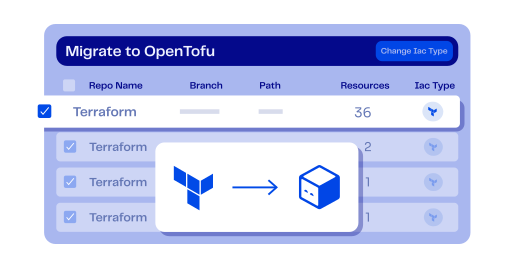
      Just in case you want to migrate – Controlmonkey can 1-Click Migrate you from Terraform to OpenTofu. Learn More in our next Product Showdown

      OpenTofu vs Terraform? Choosing the Right Tool for Your Team

      • Terraform: A natural fit if your workflows already rely on the wider HashiCorp stack (Vault, Consul, Terraform Cloud) or if you prefer a single-vendor SaaS for policy and governance. Commercial support and bundled features reduce lift in regulated environments.
      • OpenTofu: Best when you prioritise MPL-2.0 licensing, vendor neutrality, and the freedom to self-host or customise. API compatibility with Terraform means you can adopt it without rewriting modules or pipelines.

      Pros and Cons – Strengths and Trade-Offs of Each Tool 

      CategoryTerraformOpenTofu
      Pros– Mature tool with a large user base. – Extensive provider support. – Reliable integrations with CI/CD tools. – Enterprise-ready (with Terraform Cloud).– Fully open-source with transparent development. – Agile and responsive to community needs. – Easier to adopt for new users. – Seamless compatibility with Terraform.
      Cons– Commercial version introduces complexity. – Difficult for beginners due to the steep learning curve.– Smaller community compared to Terraform. – Fewer integrations and support options.

      Long-Term Strategy – Futureproofing Your Infrastructure Workflows

      Terraform and OpenTofu provide the essential tools to build scalable, repeatable infrastructure. However, the futureproofing of your infrastructure workflows may depend on your team’s strategy:

      • Terraform: When your company requires enterprise-level support in the long term run, Terraform Cloud and Enterprise, can provide solid governance, security, and operational tools.
      • OpenTofu: OpenTofu is an ideal provision infrastructure solution for DevOps engineers who must maintain their open-source environment. OpenTofu provides flexibility through its MPL-2.0 open-source license, allowing teams to modify and extend the codebase while remaining vendor-neutral. However, it lacks some of the integrated governance and collaboration features found in Terraform Cloud or Enterprise.

      Conclusion – Making an Informed, Practical Choice for Your Team

      The terraform vs opentofu decision ultimately hinges on your team’s priorities and appetite for open-source governance.. Terraform is a very established tool in the IaC environment, offering maturity, support, and scalability. On the other hand, OpenTofu offers a refreshing open-source alternative with a strong focus on community collaboration and flexibility. If your team values community-driven development, full transparency, and minimal vendor lock-in, OpenTofu might be the better choice. Terraform is reliable if you use it at an enterprise level and need a tool with wide support.

      If your team is evaluating OpenTofu vs Terraform, let ControlMonkey streamline your migration and daily workflows. Book a demo today.

      Bottom CTA Background

      A 30-min meeting will save your team 1000s of hours

      A 30-min meeting will save your team 1000s of hours

      Book Intro Call

      Author

      Yuval Margules

      Yuval Margules

      Backend Developer

      Yuval is a software engineer at ControlMonkey with a strong focus on DevOps and cloud infrastructure. He specializes in Infrastructure as Code, CI/CD pipelines, and drift detection. Drawing from real-world conversations with engineering teams, Yuval writes about practical ways to automate, scale, and secure cloud environments with clarity and control.

        Sounds Interesting?

        Request a Demo

        FAQ Section

        OpenTofu is entirely open source under the Mozilla Public License 2.0 (MPL-2.0)

        OpenTofu is compatible with Terraform and is capable of sharing the same provider and modules.

        Conversely, there is no separate enterprise offering for OpenTofu, unlike Terraform Cloud.

        Many small teams appreciate OpenTofu’s lightweight, community-centric model, i.e., community-maintained and open-source software users. However, complete documentation and Terraform support make it a reasonable choice for already established teams that are familiar with its ecosystem.

        It is possible to migrate from Terraform to OpenTofu since OpenTofu supports Terraform’s providers and modules. Migration is generally straightforward for Terraform users because OpenTofu supports the same state files, providers, and modules.

        Resource Blog News Customers Stories

        Updated: Oct 08, 2025 Upd: 08.10.25

        8 min read

        Meet OpenTofu: The Terraform Opensource Alternative

        Yuval Margules

        Yuval Margules

        Backend Developer

        Meet OpenTofu: The Terraform Opensource Alternative

        For those that do not know, the terraform opensource project OpenTofu is a fork of HashiCorp Terraform that preserves the familiar declarative syntax and workflow of Terraform while introducing a truly open-source terraform license (Mozilla Public License 2.0) and a vendor-neutral home under the Linux Foundation.

        Launched in late 2023, it has matured rapidly: it now counts about 3,900 providers, around 23,600 modules, and a GitHub community that ships new features roughly every 3–6 months. OpenTofu 1.9 and the just-announced 1.10 beta deliver capabilities such as:

        1. Provider iteration
        2. Resource exclusions
        3. State encryption

        These features address long-standing requests frequently raised by Terraform users in community forums and issue trackers.

        In fact, hundreds of individuals and more than 100 companies signed the OpenTF Manifesto when it was published in September 2023, pledging to maintain an open-source Terraform alternative. Additionally, in April 2025 the Cloud Native Computing Foundation (CNCF) accepted OpenTofu as a Sandbox project, confirming its momentum in the cloud-native ecosystem and guaranteeing that its direction is set in the open and steered by the community rather than any single vendor.

        New to OpenTufo – Learn More:

        Why OpenTofu is the Leading Terraform Open-Source Alternative

        The IaC landscape is rapidly evolving. This includes:

        1. Multi-cloud architectures
        2. Platform engineering
        3. AI-driven automation

        All of this demands tools that teams can extend and audit. Therefore, OpenTofu, this terraform opensource alternative, provides a permissive license and transparent governance. This ensures:

        1. Transparency – every line of code, discussion, and roadmap item is public, reducing vendor lock-in risks.
        2. Flexibility – anyone can fork, patch, or embed OpenTofu in bespoke pipelines, something increasingly important as organizations build internal developer platforms.
        3. Future-proofing – licenses cannot be unilaterally changed; the project’s Linux Foundation and CNCF status guarantees that the community will always have write access and release rights.

        By doing so, anyone can actively contribute to OpenTofu to ensure it caters to the communities needs.

        Industry commentary—such as InfoQ’s coverage of recent OpenTofu releases—highlights the project as an emerging IaC option for 2025, alongside AI helpers and multi-tool orchestration.

        Key Features of OpenTofu: The Terraform Opensource Alternative

        At its core, OpenTofu remains fully Terraform-compatible, proving that a robust terraform open-source solution can match proprietary tools.However, as a leading open-source terraform alternative, it brings extra power and flexibility. Some of its core features that helps team scale IaC efficiently are:

        Provider & Module Ecosystem

        OpenTofu has a lot of providers and modules which are directly inherited from the terraform opensource public registry and extended by the community under an open-source license.

        For those that aren’t familiar, providers are tiny adapters that translate declarative HCL into live API calls. By doing so, you can automate AWS, Azure, GCP, Kubernetes, SaaS tools such as Datadog or Cloudflare, even on-prem hardware, with one consistent language.

        Then comes an OpenTofu Module. Modules sit a layer higher, packaging best-practice patterns—VPC baselines, serverless stacks, data-lake blueprints—into reusable building blocks. You can build your own modules with your organization wide practices or you can leverage the already published modules in the Terraform Registry.

        Remote State Backends

        IaC only scales when multiple engineers can collaborate safely. So, OpenTofu supports a wide array of remote backends like:

        1. S3 plus DynamoDB locks
        2. GCS with Cloud KMS
        3. Azure Blob
        4. PostgreSQL
        5. Consul KV

        Storing the state remotely guarantees that every plan works from the same source of truth. Additionally, you can leverage optimistic locking to prevent two pipelines from racing to update the same resource.

        State Encryption

        State files often hold sensitive data such as:

        1. Database passwords
        2. IAM tokens
        3. IP ranges

        Therefore, OpenTofu lets you encrypt them client-side before they leave the developer laptop or CI runner.

        Note: This is not supported in Terraform.

        You can supply keys from AWS KMS, Azure Key Vault, GCP KMS, or any executable that returns a 256-bit secret, meaning even if someone gains access to your object-store bucket they see only ciphertext.

        The same mechanism secures plan files, thus, closing a common audit gap in pull-request workflows. Because encryption is native, not a plug-in, it travels with you across backends and eliminates dependence on proprietary secrets managers, satisfying strict compliance regimes without extra tooling.

        Provider for each Iteration in Terraform Opensource Tools

        Multi-account and multi-region deployments used to require boilerplate or external wrappers such as Terragrunt.

        However, OpenTofu’s provider-level for_each solves that by letting you declare a single provider block and dynamically clone it across a set or map.

        Child modules receive the correct alias automatically, so a networking module in each region picks up the right credentials and endpoint with zero extra variables.

        This pattern drastically reduces copy-paste, keeps monorepos readable, and unlocks platform-engineering patterns where a central team governs account scaffolding while application squads deploy independently.

        Exclusions in OpenTofu for Terraform Opensource Users

        Complex rollouts sometimes demand surgical precision—perhaps a new database layer is delayed or a risky feature toggle needs to stay dark. The tofu plan -exclude=…and -exclude-file= flags let you omit any resource, module, or provider from a plan without altering source code.

        On the other hand, -target-file= gives you a positive allowlist for blue/green or canary releases. Because these switches operate only at plan time, the underlying configuration remains canonical, preventing drift while still giving operators temporary flexibility.

        100% CLI Compatibility

        OpenTofu was designed as a drop-in replacement, giving terraform open-source advocates the exact same everyday commands init, plan, apply, and more without rewriting pipelines.

        1. init
        2. plan
        3. apply
        4. destroy
        5. fmt
        6. state
        7. workspace operations

        This protects existing knowledge, scripts, and training material, minimizing migration risk.

        Under the hood, OpenTofu refactored provider loading and added schema caching; maintainers report planning-time speed and memory improvements in large monorepos, although formal benchmarks have not yet been published.

        Step-by-Step Overview – a typical OpenTofu workflow

        Although every organization tailors its pipelines, most OpenTofu usage follows four high-level stages:

        1. Author configuration – engineers describe resources, variables, and modules in .tf files stored in version control.
        2. Initialize a backend – the tofu init command initializes the backend and preps your TF files for a deployment
        3. Create a plan – the tofu plan command evaluates desired state versus current state, producing an execution plan that can be peer-reviewed in pull requests.
        4. Apply changes – tofu apply executes the approved plan, calling the required provider APIs while locking state remotely.
        5. Iterate & refactor – refactoring modules, splitting workspaces, and using drift-detection bots keep infrastructure continuously in sync with declared state.
        6. Destroying – the tofu destroy command will help with cleanup operations to help you remove resources that you no longer need.

        As you can see, the OpenTofu workflow is similar to the Terraform workflow as OpenTofu inherits Terraform’s lifecycle and its workflow.

        OpenTofu is actively being used in organizations worldwide to manage provision cloud resources across multiple clouds with multi-person teams.

        Some of its key use cases include:

        1. Enterprise MigrationsIn April 2025, Fidelity announced its migration from Terraform CE to OpenTofu, citing licensing certainty and smoother governance as key drivers.
        2. CI/CD PipelinesGitHub-native GitOps products such as Terrateam now advertise first-class support for OpenTofu alongside Terraform, enabling plan/apply workflows entirely inside pull requests.
        3. Platform EngineeringCloudflare maintains an official provider, and community members have published Buildkite modules,demonstrating that OpenTofu can power multi-tenant platform layers and self-service portals at scale.
        4. Start-ups & SMBs – Start-ups & SMBs – Early-stage companies adopt terraform open-source tools like OpenTofu to avoid license fees and future audit surprises, often pairing it with Terragrunt, Spacelift, or Harness for policy enforcement and cost guardrails.
        5. Community Ecosystem – KubeCon EU now features an “OpenTofu Day,” underscoring its role in the wider cloud-native toolchain for Kubernetes clusters, GitOps controllers, and secrets managers

        Terraform Opensource + OpenTofu: Removing Infrastructure Complexity

        When you leverage tools like OpenTofu in your CI pipelines, you gain lots of benefits. Some of these benefits include:

        1. Governance & Compliance – policy-as-code engines (OPA, Sentinel replacements like Conftest) can inspect OpenTofu plans in CI, blocking non-compliant resources before they ever reach production.
        2. Visibility & Drift Detection – SaaS platforms such as ControlMonkey continuously compare the committed state with the live cloud footprint, flagging manual changes and suggesting remediations.
        3. Scaling & Multi-team collaboration – standardized modules, workspaces, and provider iteration let platform teams expose safe building blocks while still delegating resource ownership to application squads.
        4. Cost & Security Hygiene – automated pull-request comments surface cost estimates, security misconfigurations, and tagging violations early, shrinking feedback loops and engineering toil.

        So, if you’re looking to migrate your Terraform workloads onto OpenTofu, the process is simpler than you think.

        It is as simple as replacing the Terraform binary, updating your CI references, and switching registry URLs. To find out more about this, check this migration guide by ControlMonkey.

        Conclusion: Why OpenTofu is the Future of Terraform Open-Source

        OpenTofu proves that a modern DevOps tool can be open source, enterprise-grade, and innovative all at once.

        By combining Terraform-level compatibility with community-driven features and CNCF stewardship, it delivers the transparency engineers demand and the roadmap freedom enterprises require.

        Organisations from large enterprises like Fidelity to small start-ups have started adopting OpenTofu for CI/CD pipelines and multi-cloud platform work.

        So, consider migrating to OpenTofu using this comprehensive guide by ControlMonkey and also use it to help automate your IaC workflows. As an open-source Terraform project backed by the CNCF, OpenTofu empowers teams to future-proof their infrastructure stacks without vendor entanglement.

        Bottom CTA Background

        A 30-min meeting will save your team 1000s of hours

        A 30-min meeting will save your team 1000s of hours

        Book Intro Call

        Author

        Yuval Margules

        Yuval Margules

        Backend Developer

        Yuval is a software engineer at ControlMonkey with a strong focus on DevOps and cloud infrastructure. He specializes in Infrastructure as Code, CI/CD pipelines, and drift detection. Drawing from real-world conversations with engineering teams, Yuval writes about practical ways to automate, scale, and secure cloud environments with clarity and control.

          Sounds Interesting?

          Request a Demo

          FAQs

          Terraform was originally open-source under the MPL 2.0 license. However, in 2023, HashiCorp moved Terraform to a business license. OpenTofu emerged as a fully open-source fork, maintaining compatibility under the MPL 2.0 license and backed by the CNCF.

          OpenTofu was created after HashiCorp switched Terraform’s license from open-source to the Business Source License (BSL) in 2023. The change limited how Terraform could be used commercially. To keep a fully open-source version of Terraform alive, the community forked it into OpenTofu under the original MPL 2.0 license.

          Yes. OpenTofu is licensed under MPL 2.0, which makes it fully open-source. It’s run by the Linux Foundation and backed by the CNCF, ensuring that it stays community-led and free from vendor control.

          Resource Blog News Customers Stories

          Updated: Jan 26, 2026 Upd: 26.01.26

          8 min read

          Top 7 OpenTofu Errors and How to Prevent Them

          Yuval Margules

          Yuval Margules

          Backend Developer

          Top 7 OpenTofu Errors and How to Prevent Them

          If you’re diving into OpenTofu to manage your infrastructure, you’re in for a treat—it’s powerful, flexible, and open-source without the vendor lock-in. But with that flexibility comes complexity, and even small missteps can lead to critical OpenTofu errors in production.

          What Are the Most Common OpenTofu Errors?

          As I meet with customers and prospects, I hear more and more teams expressing concerns about vendor lock-in. Many are migrating to OpenTofu—and while that’s a smart move, it often introduces a new set of challenges. Not because teams lack expertise, but because scaling Infrastructure as Code always comes with edge cases that are easy to miss.

          In those conversations, five errors come up again and again. These aren’t rare bugs—they’re common issues that even mature teams run into. If you’re running OpenTofu in production, these are the ones I recommend watching out for:

          The Top 7 OpenTofu Errors DevOps Teams Should Watch For:

          1. Provider Version Conflicts – Mismatched or misreferenced provider blocks that break deployments.
          2. Misconfigured Backends – Using local state or skipping locking, leading to lost or inconsistent state.
          3. Poor Module Structure – Monolithic modules, inconsistent file layout, and hardcoded values.
          4. Variable Mismanagement – Missing defaults, no validation, and unclear naming.
          5. Environment Drift and Workspace Sprawl – Manual changes, untracked environments, and hidden infrastructure risk.

          Let’s break each one down—and how to fix them before they become blockers.

          🟨 Related OpenTofu & Errors:

          1️⃣ Provider Version Conflicts

          Provider version mismatches or redundant provider blocks can cause conflicts. Maybe you’ve got one module pulling aws ~> 4.0 and another demanding aws ~> 5.0. Or worse, you accidentally reference the Terraform registry with fully qualified provider names.

          terraform {
            required_providers {
              aws = {
                source  = "registry.terraform.io/hashicorp/aws"
                version = "~> 5.0"
              }
            }
          }

          OpenTofu recognizes provider addresses in the format hostname/namespace/type where hostname resolves by default to registry.opentofu.org which is the public OpenTofu repository when using OpenTofu. However, if you are migrating from Terraform, you may have defined the hostname as registry.terraform.io, which explicitly points to Terraform Registry, which violates the T&C of Terraform Registry when used with OpenTofu.

          How to Avoid Provider Errors in OpenTofu

          • Reference OpenTofu Registry: Remove references to the Terraform registry with fully qualified provider or module names. Stick to the OpenTofu registry instead. However, you can use third-party registries based on your requirements.
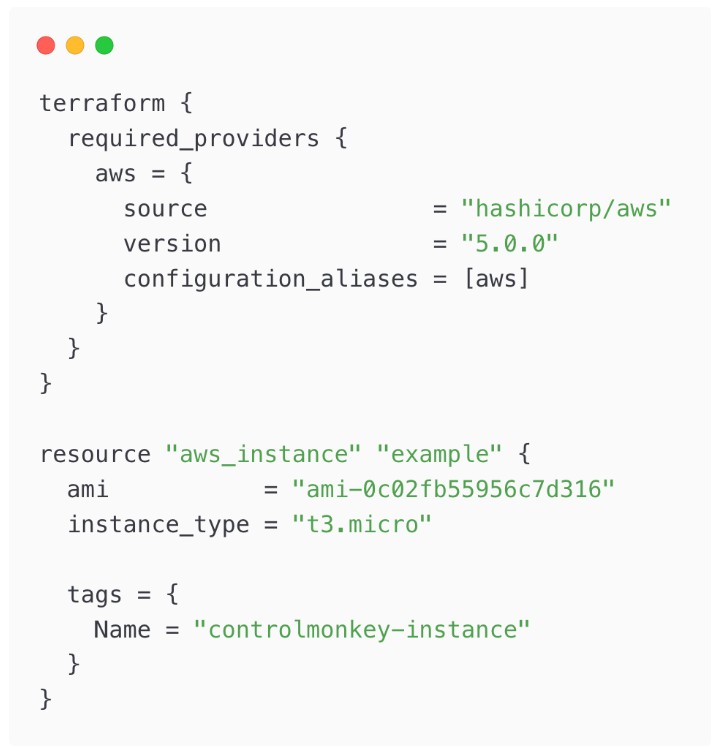
          • Lock Versions: Pin your provider versions in the required_providers block. Here’s a quick example:
          terraform {
            required_providers {
              aws = {
                source  = "opentofu/aws"  # hashicorp/aws works as well
                version = "5.0.0"
              }
            }
          }
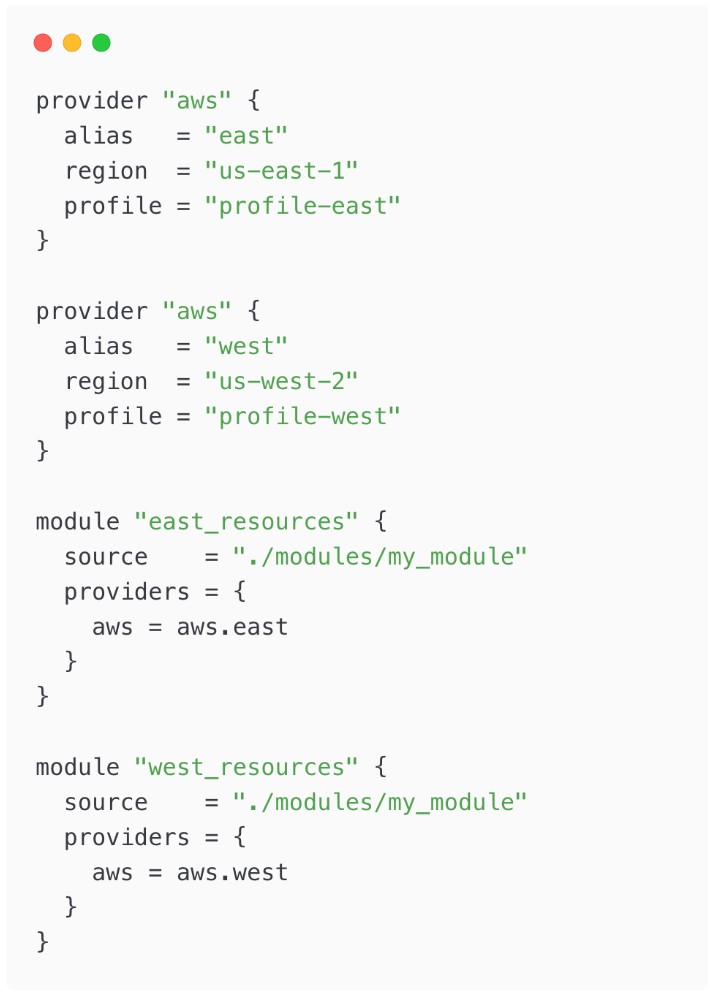
          • Use shared provider configurations: To make the modules portable, it is best practice to define the provider configurations within your configuration instead of within the module itself. Let’s look at an example;

          You can use an alias in the provider block to manage multiple provider configurations. This comes in handy when you want to deploy to multiple regions.

          Root Module: 

          Child Module: 

          2️⃣ Remote State and Locking Best Practices

          The state file is OpenTofu’s memory of your infrastructure. OpenTofu uses the state file to track resources created and plan changes when OpenTofu configurations change.

          One of the most common mistakes is developers starting with using a local state. Local state files get lost, overwritten, or cause conflicts in team settings. Another mistake is not enforcing a locking mechanism for the state.

          Remote State and Locking in OpenTofu

          • Use remote state with locking: Use a remote backend like S3 or a vendor-neutral backend with locking to keep things consistent. Here is an example of an OpenTofu backend with S3 native locking (Supported from v1.10.0 onwards)
          terraform {
            backend "s3" {
              bucket         = "controlmonkey-state-backend"
              key            = "statefile"
              region         = "us-east-1"
              encrypt        = true
              use_lockfile   = true
            }
          }
          • Implement access control: You need to manage who has access to the state file and, by extension, control who can execute terraform against your infrastructure with the state file. Your state may contain sensitive data. If using AWS S3, you can use IAM Policies to manage access.

          3️⃣ Module Mistakes with Module Design

          Modules should be well structured to make your OpenTofu code scalable and manageable.

          A few of the most critical mistakes are;

          • Creating monolithic or “god modules”, which try to provision an entire application. Monolithic modules cause tight coupling between resources, which is hard to test and debug.
          • Poor and inconsistent file structures. In one module, there are separate files for different concerns (variables.tf, main.tf, output.tf ), but in another module, everything is written in the main.tf .
          • Mixed abstraction levels within a module. Mixing low-level infrastructure (like individual security group rules) with high-level concepts (like complete applications) within the same module creates confusion and reduces reusability.
          • Using hardcoded values in modules reduces reusability.

          Avoiding OpenTofu Errors with Module Design

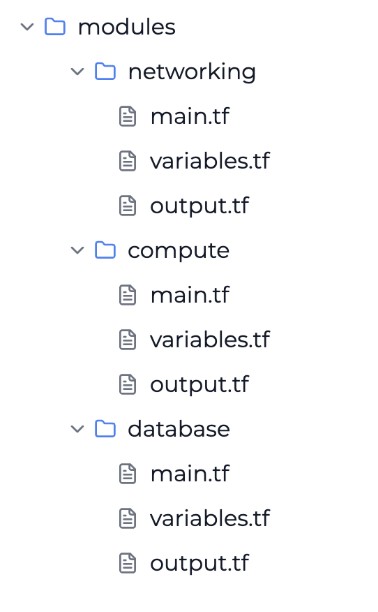
          • Follow the Single Responsibility Principle: Modules should focus on doing one thing well. For example, separate your networking, compute, and database modules.
          • Be consistent with file naming and structure: main.tf for resources, variables.tf for inputs, outputs.tf for outputs, and versions.tf for provider requirements.
          • Parameterize modules: You can refer to the variable instead of hardcoding within the module.
          # Root Module (./main.tf)
          module "web_server" {
            source        = "./modules/compute"
            instance_type = "t2.micro"
          }
          
          # Compute Module (./modules/compute/main.tf)
          resource "aws_instance" "web" {
            instance_type = var.instance_type  # Refer the instance type
            # Other Configurations
          }

          4️⃣ How to Prevent Errors in OpenTofu Variable Usage

          Unclear or conflicting variable inputs lead to confusion. Without defaults or validation, someone might pass a bad value (or nothing), and your deployment crashes. When working with variables, you should always follow best practices.

          # Confusing variable definitions
          variable "x" {        # Unclear name
            type = string
          }
          
          variable "count" {    # Conflicts with built-in
            type = number
          }

          How to Prevent Errors in OpenTofu Variable Usage

          • Use descriptive, consistent naming conventions
          • Provide sensible default values for your variables
          • Implement input validation rules
          • Group related variables in a single file for clarity (Best practice: use variables.tf)

          Here is a well-defined variable with sensible defaults and validation:

          variable "instance_type" {
            type        = string
            default     = "t3.micro"
            description = "EC2 instance type for the web server"
            validation {
              condition     = contains(["t3.micro", "t3.small"], var.instance_type)
              error_message = "Instance type must be t3.micro or t3.small."
            }
          }

          5️⃣ Preventing Drift in OpenTofu Environments

          As your infrastructure grows, it’s easy to lose track of different environments and workspaces. Untracked workspaces or drifting environments can spiral out of control. You end up with a prod workspace that is different from actual deployment or a dev environment no one remembers creating.

          The drifts can happen when developers make hotfixes directly from the console or APIs. Untracked workspaces also lead to orphaned resources and deployment issues that are hard to debug.

          Preventing Drift in OpenTofu Environments

          • Use clear workspace naming: Have a pattern such as <environment-name>-<region> when you create workspaces. Example: tofu workspace new prod-us-east-1
          • Automate deployments with CI/CD pipelines to enforce consistency.
          • Use drift detection tools: OpenTofu’s tofu plan is a good starter. You can adopt tools such as ControlMonkey for advanced drift detection and remediation.
          if you reached this far – Find Free Downloadable PDF Version

          6️⃣ Module Registry Conflicts –  Wrong Source

          One of the most common mistakes we see during OpenTofu migrations is teams continuing to reference the Terraform Module Registry. They use fully qualified module names like hashicorp/vpc/aws out of habit – and that’s a problem. Incorrect module references lead to failed runs, missing dependencies, or license violations that block production workflows.

          The risk of referencing Terraform modules breaks compatibility with OpenTofu. This causes failed runs, unresolvable dependencies, and governance issues.

          How to Fix It

          • Audit all module source paths. Replace terraform.io or hashicorp/ sources with OpenTofu-compatible ones.
          • Host your own module registry or pull from registry.opentofu.org or a third-party OpenTofu-compliant registry.
          • Use relative paths (e.g., ./modules/vpc) where possible to reduce external dependencies.

          7️⃣ Legacy Pipelines Still Use the Terraform Binary

          You’ve moved to OpenTofu, but some of your automation hasn’t. Legacy CI/CD pipelines, GitHub Actions, or container builds may still be calling terraform—even if your team thinks they’ve switched. Terraform has been the default for years. It’s easy to miss places where the binary is still being referenced, especially in older scripts or infrastructure tooling.

          You think you’re running OpenTofu, but in reality, some environments are still using Terraform. This leads to inconsistent behavior, misaligned state, and audit failures.

          How to Fix this OpenTofu mistake?

          • Check all automation (CI configs, scripts, Dockerfiles, runners) for the word terraform.
          • Replace with tofu and verify versioning is consistent across environments.
          • Validate by outputting the tofu version during every run.

           Conclusion: How to Avoid OpenTofu Errors

          There, you will find five common OpenTofu mistakes and how to avoid them. Lock your providers, set up remote backends, structure modules correctly, manage variables carefully, and keep your environments consistent. You’ll build robust, scalable OpenTofu workflows.

          OpenTofu gives you freedom – but ControlMonkey gives you control. Book a demo to see how we help teams eliminate errors, reduce toil, and accelerate delivery with automated OpenTofu governance.

          Version History:

          • 30.6.2025 – Original publication date
          • 02.07.2025 – Two new Errors and Mistakes added
          • 02.10.2025 – PDF Addition
          Bottom CTA Background

          A 30-min meeting will save your team 1000s of hours

          A 30-min meeting will save your team 1000s of hours

          Book Intro Call

          Author

          Yuval Margules

          Yuval Margules

          Backend Developer

          Yuval is a software engineer at ControlMonkey with a strong focus on DevOps and cloud infrastructure. He specializes in Infrastructure as Code, CI/CD pipelines, and drift detection. Drawing from real-world conversations with engineering teams, Yuval writes about practical ways to automate, scale, and secure cloud environments with clarity and control.

            Sounds Interesting?

            Request a Demo

            FAQs

            Yes. Most Terraform modules work in OpenTofu without changes. Just make sure you’re not referencing the Terraform Registry directly in your provider blocks, and check that any tooling you’re using supports OpenTofu.

            infrastructure as Code introduces complexity at scale: multiple regions, shared modules, evolving provider versions. Even mature teams hit issues like provider mismatches, drift, or backend misconfigurations, especially when scaling quickly.

            Treat your Infrastructure as Code like application code. That means version pinning, input validation, CI/CD enforcement, and real-time drift detection. OpenTofu gives you flexibility, but without automation and governance, even small mistakes can lead to major outages.


            ControlMonkey helps teams build those guardrails into every stage of their infra pipeline.

            Resource Blog News Customers Stories

            Updated: Aug 20, 2025 Upd: 20.08.25

            6 min read

            OpenTofu Modules Guide: Reuse and Standardize IaC

            OpenTofu Modules Guide: Reuse and Standardize IaC

            Infrastructure as Code (IaC) has become the backbone of scalable cloud operations. But without standardization, teams risk ending up with duplicated scripts, inconsistent configurations, and slow rollouts. That’s where OpenTofu modules come in. OpenTofu – a community-driven fork of Terraform—lets DevOps teams build reusable, modular infrastructure stacks that are easy to version, scale, and maintain.

            Much like the Terraform Registry the OpenTofu Registry helps teams discover and share standardized modules across environments. It’s designed to accelerate IaC adoption by making best-practice modules easily accessible—without reinventing the wheel.

            In this guide, you’ll learn what OpenTofu modules are, how to structure them, and why they’re critical for clean, efficient IaC workflows.

            Introduction to OpenTofu Modules – Basic Definition and Purpose

            Any configuration directory containing the OpenTofu configuration file is a module. For example, the configuration directory is called aws-instance in our local machine, and this directory has OpenTofu configuration files that are used to create an EC2 instance in AWS. Since we can run OpenTofu commands from within the directory directly, this configuration is known as the root module.

            Modules can call another module, which allows resource configurations to be packaged and reused. Modules are reusable blocks of configuration that define a specific piece of infrastructure or application configuration. A module will usually contain input variables, configuration logic, and output values to allow users to manage and configure infrastructure in a standardized way. Modules can declare infrastructure elements such as virtual machines, networks, databases, etc. Because the infrastructure is composed of modules, you can keep your codebase organized and easy to manage. The modular approach allows you to use the same setups across multiple environments with the aim of avoiding duplicated code.

            Here’s a real-world use case. Create a reusable module to provision virtual machines across environments. Instead of copying the same code every time that you provision a virtual machine, you can use this module multiple times and parameterize the input for every environment.

            Benefits of OpenTofu Modules: Faster Deployments & Clean Code

            Using OpenTofu modules provides lots of benefits that contribute to cleaner code and faster deployments. Some of the key advantages include:

            • Standardization ensures consistency across environments. OpenTofu modules standardize configurations across environments by embedding best practices.
            • Less duplication means writing infrastructure code once instead of copying and pasting. Avoid code duplication by using modules with customizable parameters. This approach minimizes configuration errors and keeps your codebase maintainable.
            • Easier collaboration allows developers to write code and manage their own modules, and the rest of the team members can use them in their own work.
            • Environment-specific customization is you can make parameterizable modules with input variables to reuse the same module across many environments with different configurations. You can, for example, use a virtual machine module with different sizes or regions for the devstaging, and production environments.

            How Modules Work in OpenTofu – Structuring and Referencing Them

            OpenTofu modules are structured in source files that establish infrastructure resources. They are composed in HashiCorp Configuration Language (HCL) and contain logic to configure the resources. To use OpenTofu modules, import them in your main configuration file by specifying the source. Modules can be imported from files on a local computer, from a Git repository, or the OpenTofu Registry.

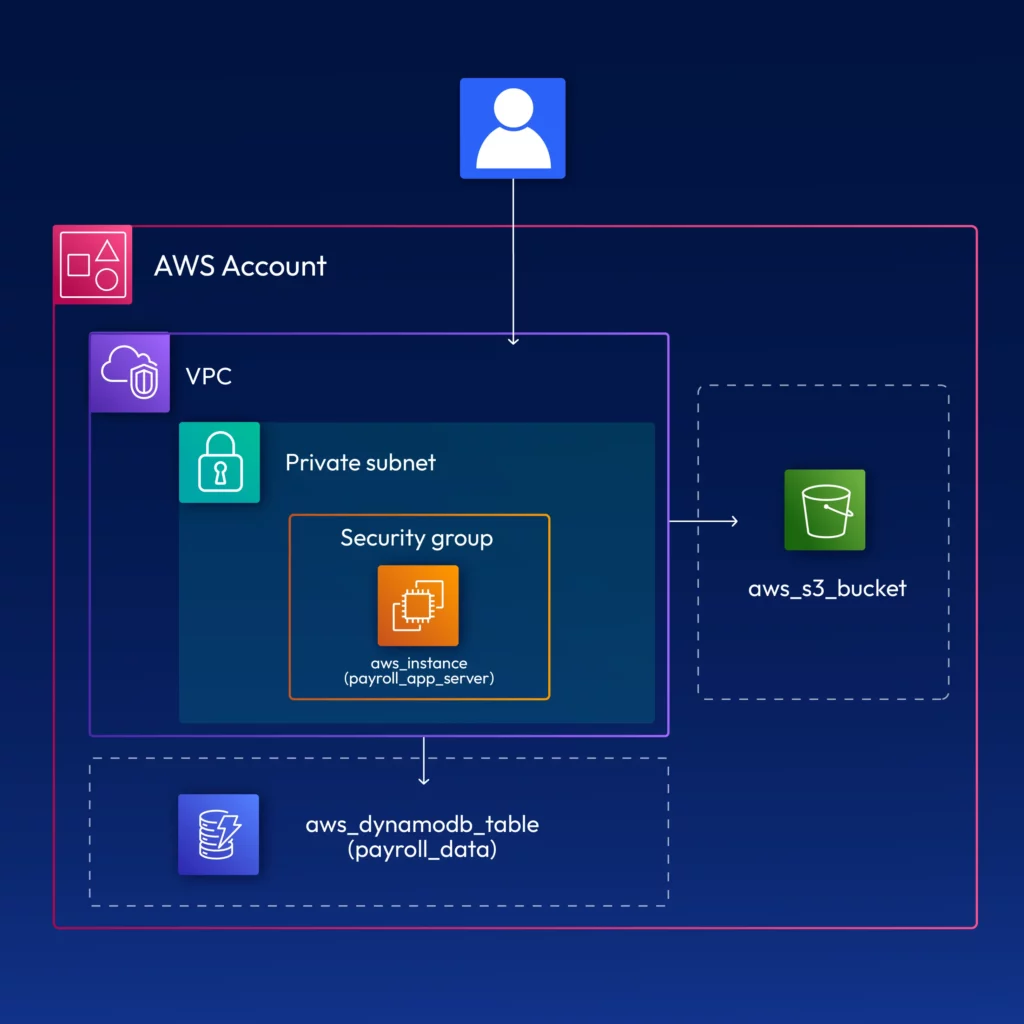
            For example, ABC company has payroll software and wants to implement it in different countries and regions. Each country will have its instance of software deployed on the AWS cloud using the same architecture. It has a single EC2 using the custom AMI to host the application server. DynamoDB NoSQL DB will be used to store the employee and payroll data. The S3 bucket stores the pay stubs, tax forms, and other documents. So, we need to create a reusable OpenTofu module and use it to deploy the same stack of resources in different regions.

            Architecture diagram for the example:

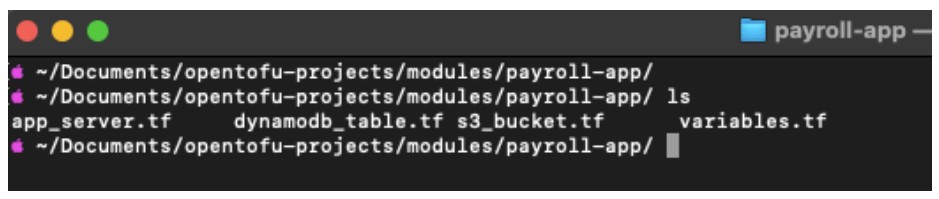
            Create a new directory for the module codes. This is where the place to store all our reusable modules. Inside this, we have the reusable block for all the required services like EC2, S3, and Dynamodb.

            AWS instance configuration (app_server.tf):

            resource "aws_instance" "app_server" {
              ami           = var.ami
              instance_type = "t2.medium"
              tags = {
                Name = "${var.app_region}-app-server"
              }
              depends_on = [
                aws_dynamodb_table.payroll_db,
                aws_s3_bucket.payroll_data
              ]
            }

            S3 bucket configuration (s3_bucket.tf):

            resource "aws_s3_bucket" "payroll_data" {
              bucket = "${var.app_region}-${var.bucket}"
            }

            DynamoDB table configuration (dynamodb_table.tf):

            resource "aws_dynamodb_table" "payroll_db" {
              name         = "user_data"
              billing_mode = "PAY_PER_REQUEST"
              hash_key     = "EmployeeID"
            
              attribute {
                name = "EmployeeID"
                type = "N"
              }
            }

            Variables Configuration (variables.tf):

            variable "app_region" {
              type = string
            }
            variable "bucket" {
              default = "flexit-payroll-alpha-22001c"
            }
            variable "ami" {
              type = string
            }

            Deploy the application stack in the us-east-1 region using the following structure. After creating another directory, us-payroll-app, and inside the directory, create a main.tf file.

            $ mkdir /root/opentofu-projects/us-payroll-app
            main.tf provider.tf

            Module configuration in main.tf:

            module "us_payroll" {
              source      = "../modules/payroll-app"
              app_region  = "us-east-1"
              ami         = "ami-24e140119877avm"
            }

            Use the OpenTofu commands below to create resources using the OpenTofu module.

            tofu init
            tofu plan
            tofu apply

            Best Practices for Using Modules

            Naming Conventions 

            Modules and resources should be given clear, descriptive names. This will allow anyone who utilizes the module to immediately understand what the module does. For example, name your modules according to the infrastructure component they deploy, like vm-module or networking-module.

            Versioning

            Pin your module versions to avoid breaking changes during upgrades.

            module "vm" {
              source  = "OpenTofu/controlmonkey-vm-module/ec2"
              version = "1.0.0"
            }

            Module Structuring

            Structure your modules in function-wise directories. For example, you can have a separate network, compute, storage directories, etc. Every module must be independent and manage one resource or a set of resources.

            Inputs and Outputs

            Keep input variables dynamic. Avoid hardcoded values—use variables to enable flexibility. Make them variables instead and allow users to customize them. In the same way, record the output of your module so that users are aware of what information is available for them after using the module.

            Conclusion – Build Faster and Smarter with Reusable OpenTofu Modules

            OpenTofu modules simplify cloud infrastructure deployment and management. Using standardized, reusable modules, you can reduce duplication, speed up the deployments, and enhance team collaboration. With access to a large library of existing pre-build modules in OpenTofu Registry, you can get started quickly and build smarter, more efficient infrastructure.

            Ready to modularize your infrastructure with OpenTofu and Terraform? Try ControlMonkey to automate deployment, enforce policies, and eliminate drift—at scale. – an IaC automation platform that brings automation deployments and can support you on that journey.

            Bottom CTA Background

            A 30-min meeting will save your team 1000s of hours

            A 30-min meeting will save your team 1000s of hours

            Book Intro Call

              Sounds Interesting?

              Request a Demo

              OpenTofu Modules – what we see customers asking

              An OpenTofu module is a reusable, self-contained configuration block that defines a specific piece of infrastructure—like a virtual machine, network, or storage bucket. Modules help standardize deployments, reduce duplication, and improve maintainability across environments.

              Yes. OpenTofu is compatible with the HashiCorp Terraform Registry, so you can use existing Terraform modules without modification. This makes transitioning from Terraform to OpenTofu simple and seamless.

              You can find reusable OpenTofu modules in the OpenTofu Registry or use any public Terraform-compatible registry. Modules can also be stored in private Git repositories or internal directories for custom implementations.

              Resource Blog News Customers Stories

              Updated: Jan 20, 2026 Upd: 20.01.26

              5 min read

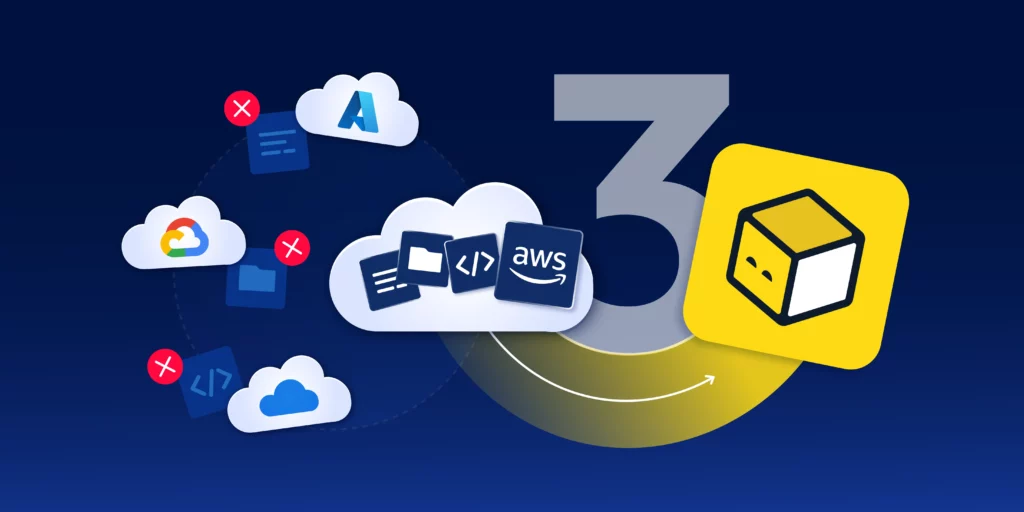
              OpenTofu Multi-Cloud: 3 IaC Challenges It Solves Across AWS, Azure & GCP

              OpenTofu Multi-Cloud: 3 IaC Challenges It Solves Across AWS, Azure & GCP

              Managing infrastructure as code (IaC) across multiple cloud providers is complex. That’s why many teams are exploring OpenTofu Multi-Cloud setups to simplify configuration, reduce drift, and improve repeatability across AWS, Azure, and GCP.  This is where OpenTofu comes into play. OpenTofu is a fork of Terraform with a strong focus on open governance. It streamlines multi-cloud IaC by providing a unified syntax, reliable state management, and modular abstraction.

              With that in mind, let’s explore three common challenges of multi-cloud IaC and how OpenTofu helps solve them.

              Challenge #1: Multi-Cloud Resource Inconsistencies in IaC

              Each cloud provider (AWS, Azure, GCP, etc.) uses its own resource naming conventions, attribute names, and configuration structures. This leads to:

              1. Duplicate effort: Your DevOps team would have to write separate IaC code for each provider, even when the underlying functionality is the same (e.g., spinning up a VM or configuring a storage bucket).
              2. Typos and misconfigurations: Switching between AWS and Azure resource blocks can introduce simple mistakes, such as using instance_type in one provider block and size in another, depending on the provider configurations.
              3. Steep learning curve: our DevOps team needs to memorize provider-specific attributes, which can slow down onboarding and even increase the chance of errors.

              🟨 How OpenTofu Solves Multi-Cloud Resource Conflicts  

              Consistent HCL syntax: OpenTofu uses OpenTofu Configuration Language. With this scripting language, your infrastructure definitions remain the same on a high level. For instance, You always write:

              resource "<PROVIDER>_<RESOURCE_TYPE>" "<NAME>" {
                # provider-specific attributes here
              }

              Doing so helps reduce cognitive load when switching between AWS, Azure, and GCP.

              • Interpolation and expressions: OpenTofu leverages the same interpolation syntax (e.g., var, local, length(), lookup()). With this, you can write generic logic to handle differences—like choosing the right AMI ID or machine image—based on a single variable or map, rather than hardcoding cloud-specific details.

              Challenge #2: Managing Multi-Cloud State Files and Environments

              In a multi-cloud environment, each provider might require its own state file. So, if you aren’t careful, you can end up with:

              1. State sprawl: Dozens of local or remote state files, each tied to different accounts, regions, or environments. Keeping track of which state belongs to which deployment becomes a headache.
              2. Drift and conflicts: Without isolation, concurrent teams may accidentally overwrite each other’s state files, leading to resource drift or plan/apply failures.
              3. Environment confusion: It’s easy to apply changes to the wrong environment (e.g., staging vs. production) if the state is not properly isolated.

              🟨 OpenTofu State Management for Multi-Cloud Infrastructure 

              Remote backends: OpenTofu supports remote backends, which let you store your state in a remote location, thus ensuring effective collaboration.

              It supports backend types like S3, Azure Blob, and GCS.

              By centralizing the state in a remote backend, you get:

              1. Versioned state history (rollbacks, audits)
              2. Team-wide locking (avoid simultaneous writes)
              3. Encryption at rest and in transit for security

              State isolation per provider: Using different backend blocks, you can configure multiple backends within a single project directory. For example:

              backend "s3" {
                bucket = "my-aws-state"
                key    = "aws.${opentofu.workspace}.tfstate"
                region = "us-west-2"
              }
              
              backend "azurerm" {
                storage_account_name = "my-azure-state"
                container_name       = "tfstate"
                key                  = "azure.${opentofu.workspace}.tfstate"
              }

              This makes it easy to keep AWS and Azure states in their respective storage services while maintaining a clear naming convention.

              Challenge #3: Modular Reuse in Multi-Cloud IaC with OpenTofu

              Reusing code through modules is a good approach to avoid duplication. However, when you’re trying to build generic multi-cloud modules, you run into issues like:

              1. Provider-specific settings: A load balancer in AWS (aws_lb) has different arguments than an Azure load balancer (azurerm_lb), making it hard to write a single module that works for both.
              2. Conditional logic complexity: Embedding if-else statements or count checks for provider-specific attributes can clutter module code.
              3. Testing and validation: Verifying that a module works for all supported providers requires multiple test configurations, increasing maintenance overhead.

              🟨 Building Cross-Cloud Modules Using OpenTofu  

              Module inputs and maps: You can pass a map of provider-specific arguments into a module and use conditionals inside the module to select the correct resource. For example:

              module "compute" {
                source = "./modules/compute"
                provider = var.cloud_config["provider"]
                config   = var.cloud_config
              }
              You can define your module to function as follows:
              resource "aws_instance" "vm" {
                count         = var.config["provider"] == "aws" ? 1 : 0
                ami           = var.config["ami"]
                instance_type = var.config["instance_type"]
                # ...
              }
              
              resource "azurerm_virtual_machine" "vm" {
                count               = var.config["provider"] == "azurerm" ? 1 : 0
                name                = var.config["name"]
                location            = var.config["location"]
                resource_group_name = var.config["resource_group"]
                # ...
              }

              Accordingly, you can define modules that provision a multi-cloud environment based on your inputs. Doing so creates abstraction for the consumer as they don’t need to know the complexity behind the scenes, thus providing a unified API to provision multi-cloud infrastructure.

              OpenTofu for Multi-Cloud: Final Thoughts

              Multi-cloud IaC can be challenging due to distinct resource definitions across cloud providers, fragmented state files, and the need for reusable modules across providers.

              By using OpenTofu, it addresses these challenges by providing:

              1. Consistent OpenTofu syntax for all clouds, which reduces the learning curve.
              2. Robust state management with remote backends, workspaces, and provider-specific isolation.
              3. Modular abstraction using inputs, maps, and dynamic blocks, enabling one module to serve multiple providers.

              By leveraging OpenTofu, teams can:

              1. Simplify their multi-cloud operations
              2. Reduce configuration drift
              3. Accelerate deployments.

              In addition to this, consider using ControlMonkey to streamline your OpenTofu workflows. If you’re ready to streamline your infrastructure workflows and manage AWS, Azure, and GCP workloads, why not try ControlMonkey?
              ControlMonkey seamlessly integrates with OpenTofu to help you maintain compliance, track drift, and automate policy enforcement—so you can focus on building, not debugging.

              Bottom CTA Background

              A 30-min meeting will save your team 1000s of hours

              A 30-min meeting will save your team 1000s of hours

              Book Intro Call

                Sounds Interesting?

                Request a Demo

                What we customers asking about OpenTofu and Multi-Cloud

                OpenTofu is a community-driven fork of Terraform, offering near-identical syntax and workflow compatibility. The key difference is its open governance model, which gives enterprises more control and transparency. For multi-cloud use cases, OpenTofu provides the same HCL-based approach but with an ecosystem committed to long-term openness—making it ideal for teams who want Terraform-like functionality without vendor lock-in.

                Yep. generative AI tools can assist with writing OpenTofu code, creating reusable modules, and automatically handling cloud-specific configurations. However, success depends on well-structured templates and guardrails. Tools like ControlMonkey can further enhance this by integrating GenAI with policy enforcement and drift detection for production-grade IaC automation.

                Yes and Yes. OpenTofu’s consistent syntax, modular architecture, and support for multiple backends make it a strong fit for managing infrastructure across AWS, Azure, GCP, and more. It enables platform teams to abstract cloud-specific differences while maintaining a unified workflow – critical for scaling multi-cloud IaC operations.

                Cookies banner

                We use cookies to enhance site navigation, analyze usage, and support marketing efforts. For more information, please read our. Privacy Policy