
I’ve spent the last few days evaluating cyber resilience platforms against a single question: after an incident, what does this thing actually bring back?
TL;DR
- The best cyber resilience platform on the market is ControlMonkey for the cloud configuration layer, as our platform continuously backs up and recovers the cloud and SaaS configurations (VPCs, IAM, security groups, DNS, identity provider settings) that data backup leaves exposed.
- Cohesity Data Cloud, Rubrik Security Cloud, and Commvault Cloud are the three enterprise data protection leaders, all carrying current analyst recognition, and all three now reach into identity recovery, though the exact directory coverage differs by vendor across Active Directory, Entra ID, and Okta.
- The remaining six are specialists worth knowing but easy to miscategorize: HPE Zerto Software does continuous data protection for VMs, AvePoint protects SaaS and Microsoft data, Semperis Ready1 coordinates crisis response, Continuity2 manages business continuity programs, StorageGuard audits the security posture of your backup systems, and Veeam Cyber Secure is a services program wrapped around Veeam Data Platform.
What are the 10 best cyber resilience platforms in 2026?
The best cyber resilience platform in 2026 is ControlMonkey for cloud and SaaS configuration recovery, with Cohesity, Rubrik, and Commvault leading the enterprise data protection field.
Here’s the full shortlist:
| Tool | Features | Pricing |
|---|---|---|
| #1: ControlMonkey | Versioned configuration snapshots across cloud infrastructure, SaaS, identity, network, and observability. Dependency-aware recovery to a known-good state. Configuration change history with recovery point selection. | Free Resilience Assessment. Pro and Enterprise are custom. |
| #2: Cohesity Data Cloud | SpanFS immutable storage, FortKnox cyber vaulting, RecoveryAgent recovery orchestration with embedded malware scanning, clean room recovery, Identity Resilience for Active Directory and Entra ID, and the CERT incident response team at no extra cost. | Falcon Go from $59.99/device/year. 15-day free trial. |
| #3: Rubrik Security Cloud | Preemptive Recovery with continuous indexing and application dependency mapping, Rubrik Cloud Vault, cloud-native protection for AWS, Azure, and Google Cloud, and Identity Resilience across AD, Entra ID, and Okta. | Capacity-based, measured in front-end or back-end TB depending on the product. Quote only. |
| #4: Commvault Cloud | Cleanroom Recovery in an isolated cloud environment, Threatwise cyber deception, Cloud Rewind for rebuilding cloud-native application environments, Cleanpoint clean recovery point identification, and Arlie AI. | Custom pricing. |
| #5: AvePoint Confidence Platform | Multi-SaaS backup across Microsoft 365, Entra ID, Dynamics 365, Power Platform, Salesforce, and Google Workspace. Backup Express for high-speed workload recovery. Opus lifecycle management. Maestro AI classification. | Custom pricing. |
| #6: Semperis Ready1 | Out-of-band crisis coordination hub with incident bridges, live status dashboards, role-based team builder, action logging, and NIST-aligned playbooks that keep running when identity systems are down. | Custom. Free license for qualifying Semperis identity customers. |
| #7: Continuity2 (C2 Meridian BCMS) | Important Business Services identification, impact tolerance setting, dependency mapping, severe-but-plausible scenario testing, business impact analysis, and an IT disaster recovery module. | From £22,500 in year one via UK G-Cloud, banded by staff count. |
| #8: StorageGuard | Agentless security posture scanning of storage and backup systems from Dell, NetApp, Rubrik, Cohesity, Commvault, and Veeam. Configuration baseline drift detection. Immutability validation. Fix Now remediation. | $3,000 per system for a one-time scan. From $230 per system per month. |
| #9: Veeam Cyber Secure | Dedicated security advisor, quarterly assessments mapped to NIST CSF 2.0 and MITRE ATT&CK, incident response toolkit, Coveware cyber extortion retainer, and a ransomware expenses warranty of up to $5M. | Custom pricing. Requires Veeam Data Platform. |
| #10: HPE Zerto Software | Journal-based continuous data protection with checkpoints 5 to 15 seconds apart, real-time encryption detection, the Cyber Resilience Vault, and non-disruptive failover testing. | Per protected VM. Quote only. Free 14-day license. |

Interested in how that works?
Join us in our bi-weekly live demo, where we’ll walk you through how leading enterprises bring resilience, governance, and compliance to their large-scale cloud environments.
Cyber Resilience Solution #1: ControlMonkey
ControlMonkey offers the best cyber resilience platform for the cloud configuration layer, as it continuously discovers, snapshots, and recovers cloud and SaaS configurations from versioned known-good states.
That means when ransomware, an account takeover, or a bad change alters your environment, you recover the configuration required to operate, not just the data.
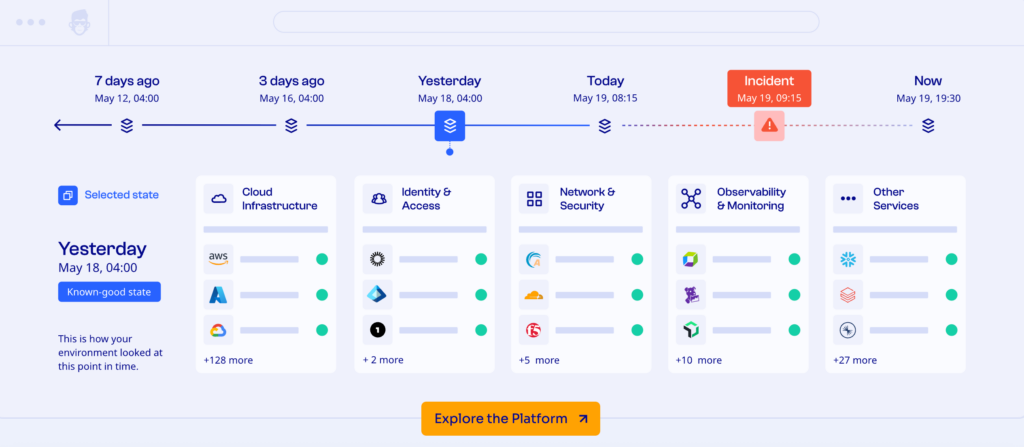
While traditional backup platforms restore files, databases, and workloads, modern incidents increasingly disrupt the configuration that makes systems reachable: IAM policies, security groups, VPCs, DNS records, routing tables, identity provider assignments, and observability dashboards.
Restoring data into a broken configuration doesn’t restore operations.
That’s the disaster recovery gap we designed our platform to close, and it’s why teams at Block, Comcast, Intel, and Veolia run ControlMonkey.
Here are some of their favorite capabilities:
Configuration backup across cloud, SaaS, identity, network, and observability
Our platform connects with read-only access through native APIs and captures the configuration state of your environment on a continuous basis, storing each capture as a versioned recovery point.
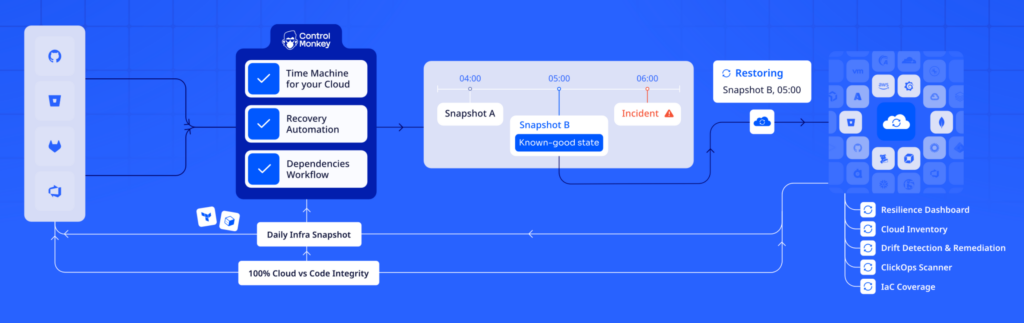
Coverage runs to more than 50 supported environments across AWS, Azure, and GCP and the third-party stack around them, and that includes the layers most recovery plans skip: identity providers such as Okta, Microsoft Entra ID, OneLogin, Ping Identity, and JumpCloud.
For example, here’s how you can restore identity access fast with ControlMonkey:
Network and edge configuration comes in too, covering DNS, CDN, routing tables, and firewall rules.
Observability configuration is part of it as well, so Datadog dashboards and monitors are backed up with everything else.
We capture resources whether or not they’re managed by IaC, which matters because incomplete IaC is one of the main reasons recovery plans fail when they are finally tested.
ClickOps happens, console changes happen, and automation and AI-assisted workflows with real permissions alter things nobody documented. All of it lands in the snapshot anyway.
💡 HoneyBook reached 100% coverage of its critical cloud and SaaS configurations, including Cloudflare and Datadog. Their DevSecOps lead put it simply: “Cloudflare and Datadog configurations are backed up and fully recoverable.”
Dependency-aware configuration recovery to a known good state
Configuration restore is where most tools quietly hand the problem back to you.
You get an export or a diff, and the ordering problem lands on whoever picked up the page: a subnet cannot come back before the VPC that contains it, and an application assignment is meaningless until the identity group it points at exists again.
ControlMonkey sequences that for you.
You select a known-good recovery point, choose the scope, whether that’s a single resource or a full environment, and our platform restores it with dependencies handled in the right order.
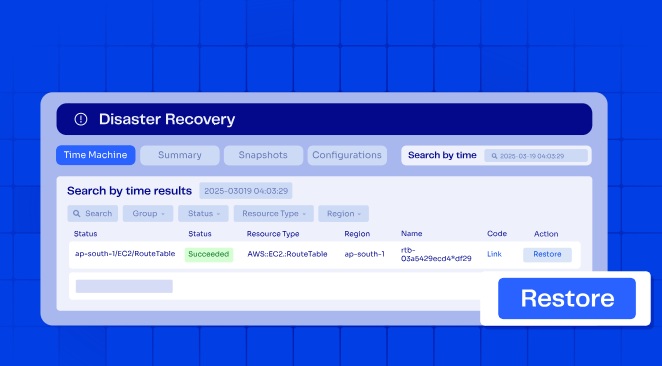
That’s genuine disaster recovery orchestration for the configuration layer, and it removes the two things that turn a two-hour incident into a two-day one:
- Guesswork about what the working state looked like.
- Manual rebuilds under pressure.
For routine fixes, you can keep a human approval step in the path, and for severe incidents the whole restore can execute without one.
Configuration change history and recovery point selection
Choosing the wrong recovery point is its own failure mode, as a restore that reaches too far back wipes out three weeks of legitimate work, while one that stops too late reinstates the change that caused the incident.
Snapshot Changes Over Time gives you the configuration change history to make that call properly, and KomoAI helps surface the risky deltas between states so you can see what moved before you commit to a restore.
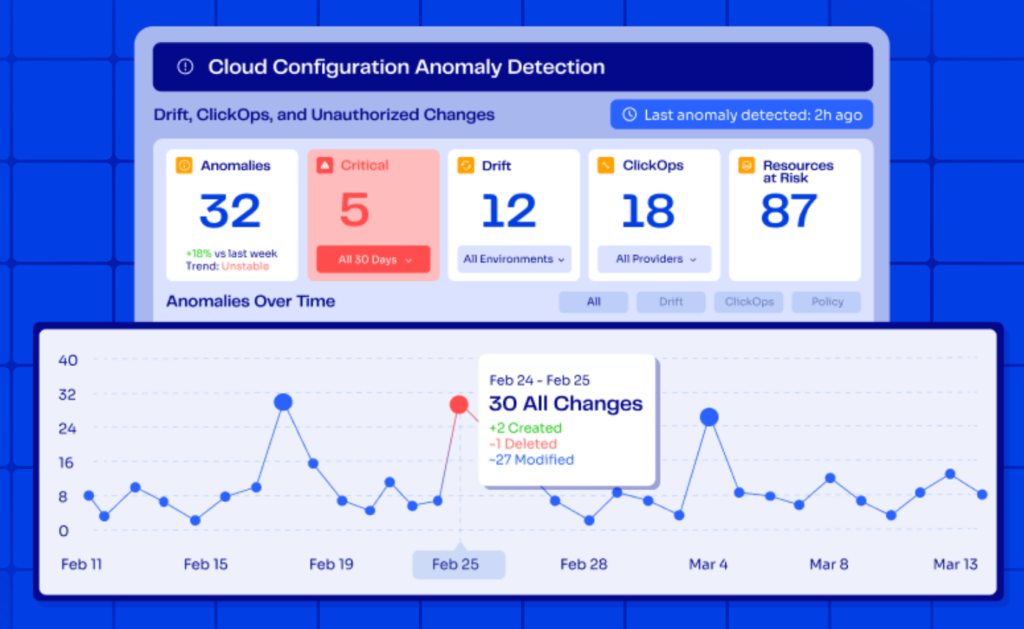
Each captured state also serves as the configuration baseline that drift detection measures live infrastructure against, and the ClickOps Scanner surfaces which changes arrived through channels your process never covered.
Backup scheduling covers daily snapshots and policy-based ones where you need something tighter, and the whole history becomes versioned evidence.
How does ControlMonkey complement cyber resilience platforms?
We aren’t trying to replace your backup platform, and I’d be skeptical of any vendor that told you otherwise.
Data backup and EDR tools protect data, workloads, and endpoints.
The argument I’m trying to build on here is that ControlMonkey protects the cloud and SaaS configuration layer that recovery depends on.
They’re complementary, not competitive. We extend recovery beyond data backup without duplicating any of it.
In practice, that means Rubrik or Veeam Data Platform restores the database, and we restore the IAM policy, the security group, and the DNS record that let anything reach it.
Where platforms already cover identity configuration, and several now do, we take the cloud infrastructure, network, and observability configuration that identity tooling was never built to reach.
Teams that already run network backup solutions have the device layer covered, and that matters, but a device config archive stops at the edge of the rack.
Our platform picks up the broader cloud infrastructure configuration behind it, so operational risk drops across networks, identity, and cloud accounts at the same time.
Network security policy backup for firewall rules and security groups runs through the same workflow, along with network visibility into what is actually protected today.
Data Backup Correlation ties it together by mapping your backup coverage, retention, recovery points, and RPO targets against configuration recoverability, so you can see which gap to fix first.
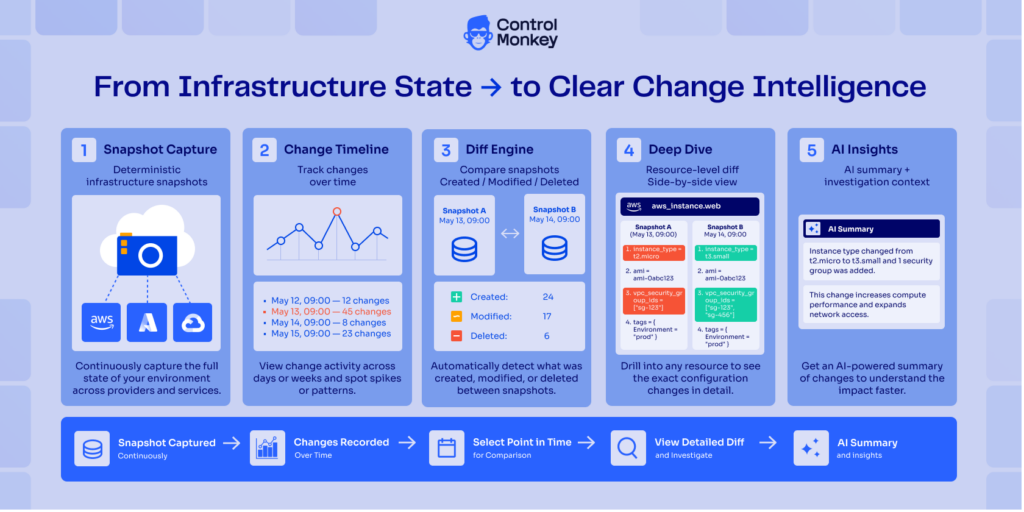
Here’s how the full disaster journey looks with ControlMonkey:
Pricing
ControlMonkey offers three plans:
- Free Resilience Assessment: $0, for teams that want to understand cloud and SaaS recovery risk before buying. Includes cloud and SaaS configuration discovery, a resilience score, recovery gap insights, drift detection in detection-only mode, and an assessment review with our team.
- Pro: Custom pricing for mature platform teams operating at scale across cloud providers. Covers up to 50,000 cloud assets and 50,000 protected resources, and adds Snapshot Changes Over Time, drift detection with remediation, the ClickOps Scanner, RBAC, and specialized support.
- Enterprise: Custom pricing for complex, large-scale environments, with custom asset and protected resource scopes.pport.
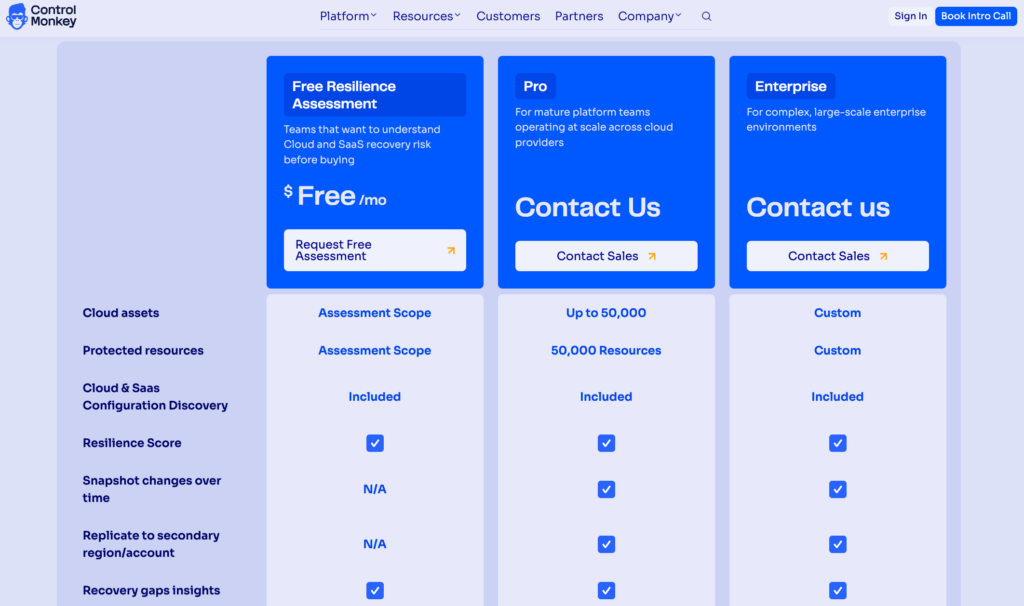
Replication to a secondary region or account and a self-hosted agent option are available on paid plans.
Pros & Cons
✅ Recovery to versioned known-good configuration states after incidents or misconfigurations.
✅ Covers cloud infrastructure, SaaS, identity, network, and observability in one recoverable view.
✅ Continuous capture with configuration change history and drift visibility.
✅ Dependency-aware recovery of individual resources, configurations, or full environments.
✅ Free Cloud DR Assessment runs read-only with no agents and no production impact.
❌ We don’t cover the data side of backup. Files, databases, and application data stay with whichever backup platform you already run, and ours works alongside it.
❌ If you only need one thing protected, we’re the wrong purchase. A team looking to back up Cisco Meraki alone, or Cloudflare alone, should buy a point solution and skip the platform entirely.
Cyber Resilience Solution #2: Cohesity Data Cloud
Cohesity Data Cloud protects and recovers data across on-premises, cloud, and SaaS environments, layering cyber vaulting, threat scanning, identity recovery, and rehearsed recovery workflows on top of backup.
It is built for large enterprises with sprawling data estates that want protection, detection, and recovery under one platform, with the vendor’s own responders on call.
Cohesity Data Cloud Features
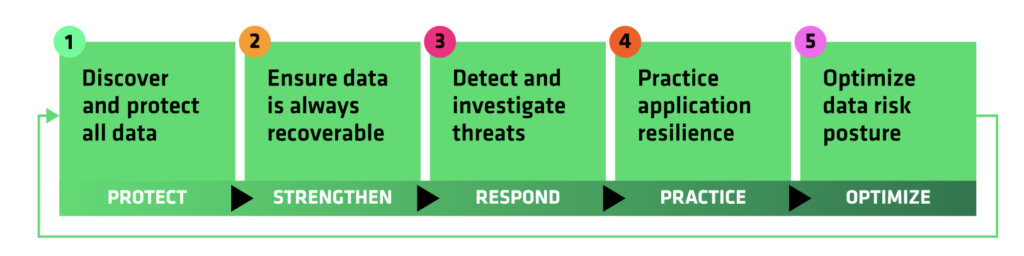
- RecoveryAgent orchestration with scanning built into the workflow: Recovery blueprints run as automated, rehearsable workflows with malware scanning embedded in the recovery path, which addresses the reinfection problem where a clean restore quietly reintroduces the payload.
- FortKnox cyber vaulting and SpanFS immutability: Backups land on Cohesity’s own scale-out file system with immutable snapshots, and FortKnox holds an isolated SaaS vault copy off the primary platform entirely.
- CERT, an incident response team attached to the product: The Cyber Event Response Team engages before an attack and stays through it, running benchmarking and tabletop exercises up front and working beside your incident response firm once something is live.
Cohesity Data Cloud Pricing
There is no published list price.
Quotes come through Cohesity directly or through a reseller, and a 30-day free trial is available first.
Cohesity Data Cloud Pros & Cons
✅ Cohesity’s Cyber Event Response Team is included at no additional cost and coordinates directly with IR firms including Unit 42, Arctic Wolf and Sophos.
✅ Identity Resilience treats Active Directory and Entra ID recovery as their own workload, with clean-room forensic validation before you restore into production.
✅ Very wide workload coverage across on-premises, cloud, and SaaS sources.
❌ Identity recovery covers Active Directory and Entra ID but not Okta, and Cloud rebuild is scoped to Terraform-provisioned environments and select AWS workloads rather than the full third-party SaaS control plane.
Cyber Resilience Solution #3: Rubrik Security Cloud
Rubrik Security Cloud, previously sold as Rubrik Cloud Data Management, runs multi-cloud backup, identity security, and ransomware recovery from one platform, with backups Rubrik designs to be immutable, so they cannot be encrypted or deleted by an attacker who reaches the environment.
It is best for enterprises whose central worry is identifying a clean recovery point fast after an attack, and who can absorb per-terabyte licensing.
Rubrik Security Cloud Features
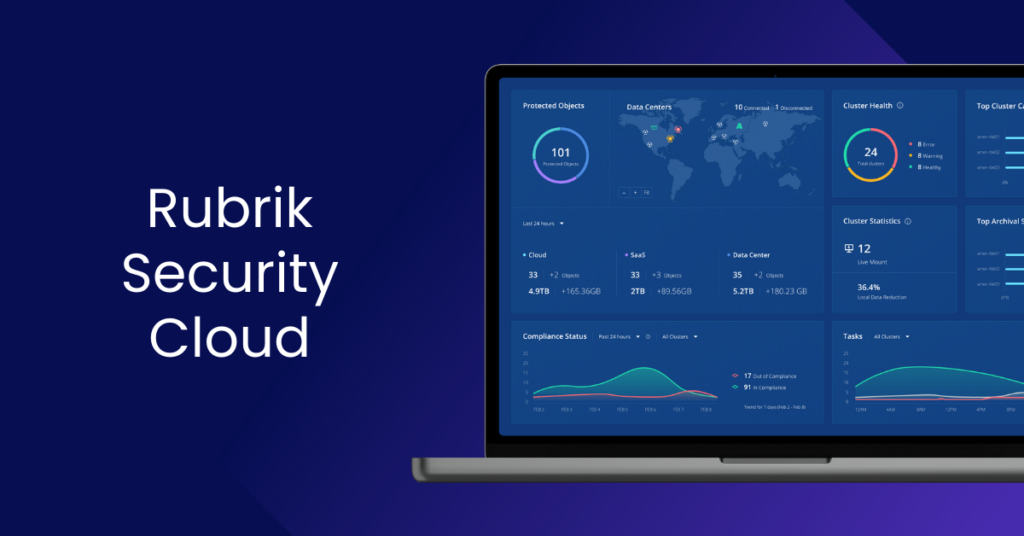
- Preemptive Recovery: Rubrik indexes content, maps application dependencies, and tracks identity access during standard backup runs, so the dependency and access picture is already built by the time an incident forces you to use it.
- Rubrik Cloud Vault: A managed, isolated, immutable off-site archive that extends Rubrik’s zero trust model into the cloud without you standing up and hardening the vault infrastructure yourself.
- Cloud-native and app coverage that keeps widening: Native protection covers AWS, Azure, and Google Cloud, then extends to Microsoft 365, Kubernetes, GitHub, Azure DevOps, Google Workspace, and Oracle Cloud Infrastructure.
Rubrik Security Cloud Pricing
Rubrik doesn’t disclose its pricing for its cyber resilience solution, so you’ll have to contact them to get a quote.
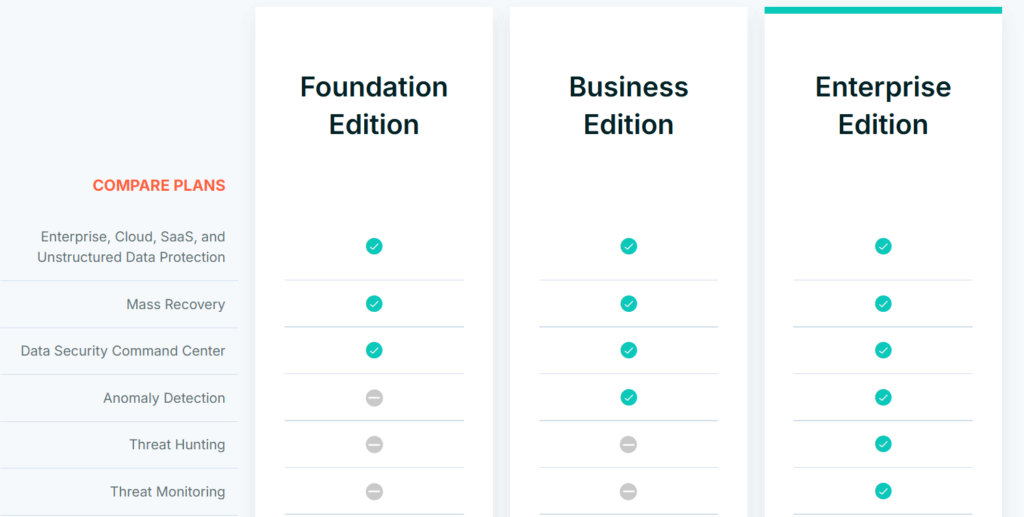
However, they’ve disclosed that there are 3 editions that you can choose from:
- Foundation Edition, which includes enterprise, cloud, SaaS, and unstructured data protection, mass recovery, and access to its data security command center.
- Business Edition, which adds anomaly detection.
- Enterprise Edition, which adds threat hunting, threat monitoring, sensitive data monitoring, threat containment, and cyber recovery simulation.
Rubrik Security Cloud Pros & Cons
✅ Identifying which recovery point is actually clean is where Rubrik is strongest.
✅ Identity Resilience monitors Active Directory, Entra ID, and Okta.
✅ Licensing that moves between SaaS applications as your estate changes.
❌ Rubrik versions identity configuration such as Okta tenant settings and Intune policies, but cloud infrastructure configuration like security group rules and route tables is not an independently recoverable unit.
Cyber Resilience Solution #4: Commvault Cloud
Commvault Cloud, now shipping as Commvault Cloud Unity, unifies data security, identity resilience, and cyber recovery, with isolated cleanroom environments for testing, forensics, and live recovery.
It suits large regulated enterprises that want the widest spread of cyber-specific capabilities on one contract and have the staff to scope and run them.
Commvault Cloud Features
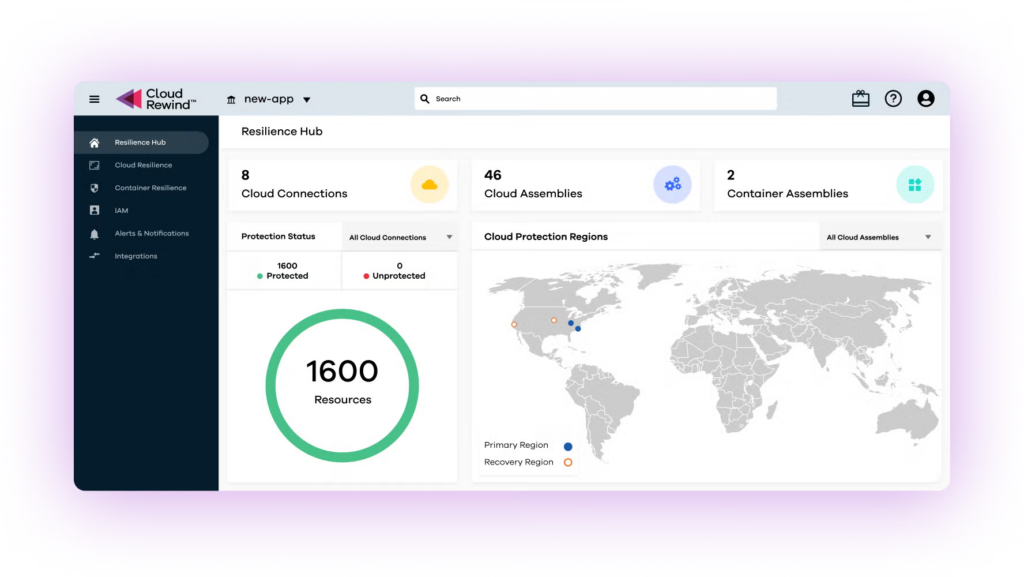
- Cleanroom Recovery: Spin up an isolated recovery environment in the cloud on demand to test recoverability, run forensics, or recover for real, with support for VMs, file systems, and full Active Directory forest recovery.
- Threatwise cyber deception: Decoys planted across the estate surface attackers moving toward backup data before encryption starts, and Commvault backs it with a dedicated professional services team.
- Cloud Rewind: Rebuilds cloud-native application environments after an incident, pushing Commvault past data restore into application reconstruction.
Commvault Cloud Pricing
Commvault keeps pricing custom. Expect a demo and a scoping conversation before you see a number.
Commvault Cloud Pros & Cons
✅ Cleanroom Recovery lets you rehearse and validate a restore in isolation without standing up parallel infrastructure.
✅ Cyber Resilience Managed Services are available if you want the program run for you and not just the software licensed.
✅ Threatwise cyber deception, which no other platform on this list ships.
❌ Cloud Rewind rebuilds cloud-native application environments including networking and security groups, but configuration held in a SaaS console such as an observability dashboard or a CDN rule set still needs another answer.
Cyber Resilience Solution #5: AvePoint Confidence Platform
The AvePoint Confidence Platform backs up and governs SaaS data across the Microsoft, Salesforce, Google Workspace, and Amazon clouds, with classification and lifecycle management attached through its Resilience Suite.
It is the first one to look at when your risk concentrates in Microsoft 365 and SaaS applications, not in a data center.
AvePoint Confidence Platform Features
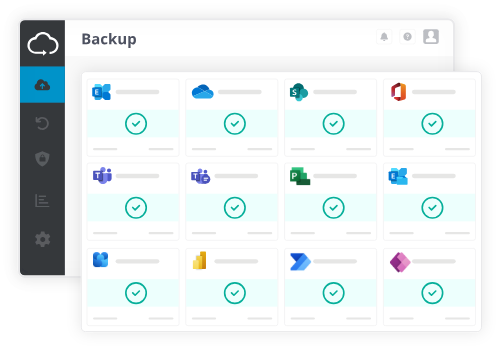
- Multi-SaaS coverage past the obvious workloads: Backup extends beyond files and mail into Entra ID, Dynamics 365, Power Platform and Dataverse, Salesforce, Google Workspace, and AWS, with granular restore so you’re not rolling back a whole tenant to recover one thing.
- Backup Express: A high-speed restore tier for major incidents, targeting whole-workload restores in minutes with bulk rollback across a tenant.
- Maestro classification feeding protection policy: AI-driven classification tags content as it’s created, and those tags drive which protection and retention policy applies, so coverage decisions follow the data’s sensitivity.
AvePoint Confidence Platform Pricing
Similar to many other tools in the market, its pricing is sales-led with no published tiers.
AvePoint Confidence Platform Pros & Cons
✅ Power Platform and Dataverse are both covered, and plenty of backup vendors stop short of them.
✅ Classification, protection, and lifecycle management in one platform.
✅ Backup copies are immutable and held apart from the production tenant, with long retention options.
❌ The solution was built for SaaS and Microsoft data. Arbitrary on-premises server workloads were never the target.
Cyber Resilience Solution #6: Semperis Ready1
Semperis Ready1 is a crisis management platform that coordinates roles, playbooks, and communications during a cyber incident, running independently of the identity systems under attack.
It is best for enterprises that already own identity recovery tooling, such as Semperis Active Directory Forest Recovery, and need the response itself organized.
Semperis Ready1 Features
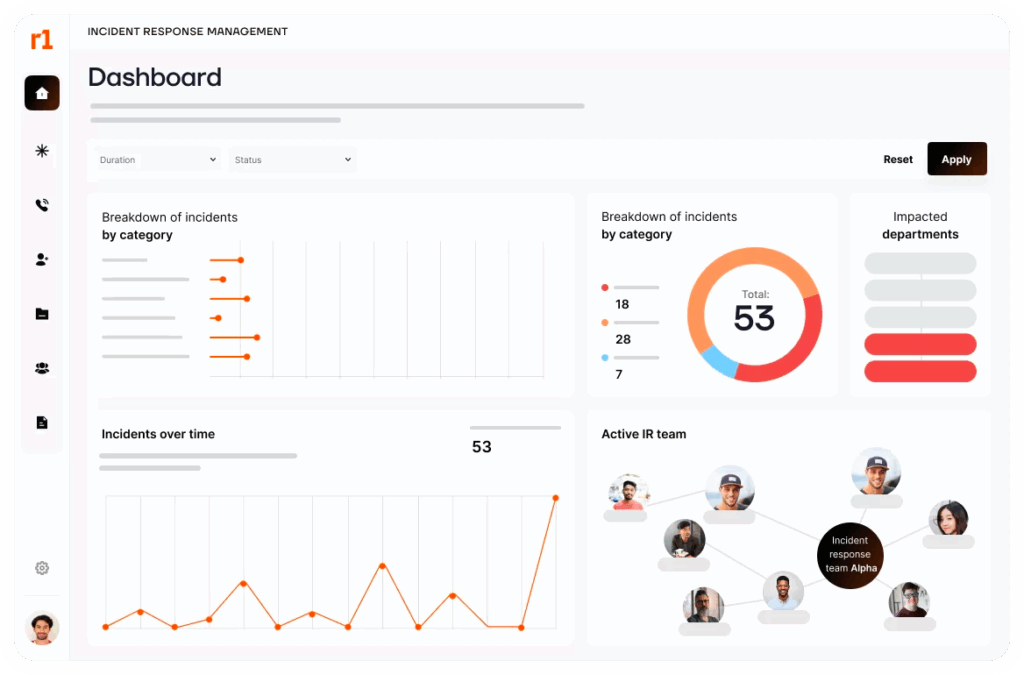
- Out-of-band by design: Ready1 runs independently of the identity systems you’re trying to restore, with its credentials held outside the directory, so a compromised domain cannot lock your response team out of their own war room. Everything else Ready1 does depends on that separation holding.
- Structured crisis modules: Status dashboards, incident bridges, a maintained phonebook, Scribe action logging, Team Builder for role assignment, and a document library, all mapped to NIST guidelines and customizable.
- Evidence for the after-action review: Detailed action logs turn post-incident analysis into a record you can hand a regulator, so nobody reconstructs the timeline out of Slack afterwards.
Semperis Ready1 Pricing
Semperis doesn’t publish standalone Ready1 pricing.
Semperis Ready1 Pros & Cons
✅ Stays reachable when the directory itself is compromised and most other tooling has gone dark.
✅ Guided tabletop exercises with gap analysis, so response plans are tested before an incident tests them.
✅ Bundled with Semperis identity recovery for qualifying customers, so it may cost nothing on top.
✅ Strong fit for regulated organizations that must evidence their response.
❌ Ready1’s remit is coordination during an identity crisis. Cloud infrastructure and SaaS configuration recovery is not part of it, and Semperis addresses identity recovery through separate products.
Cyber Resilience Solution #7: Continuity2 (C2 Meridian BCMS)
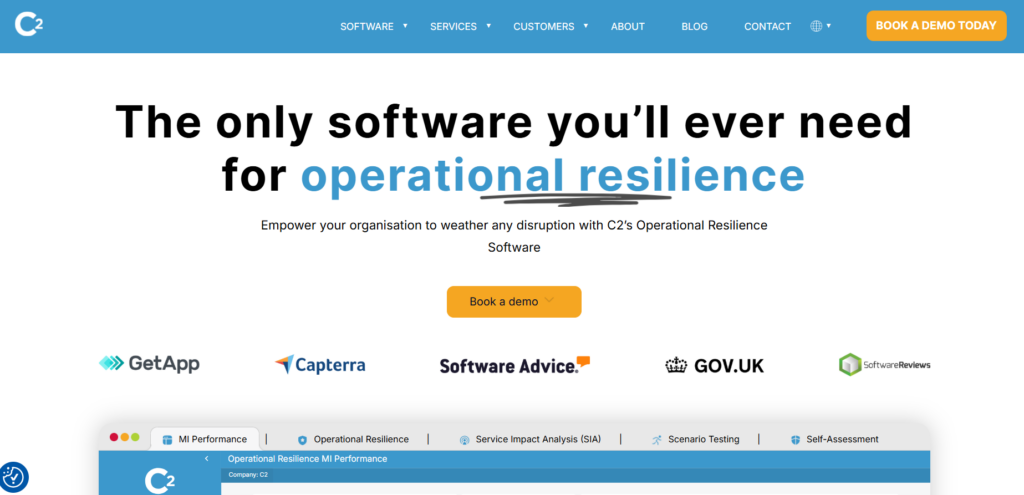
Continuity2 sells C2 Meridian BCMS, software for running a business continuity and operational resilience program end to end, from impact analysis through scenario testing to audit evidence.
It is built for regulated firms and public bodies that have to prove resilience to the FCA, the PRA, or DORA, and it never touches your infrastructure.
Continuity2 Features
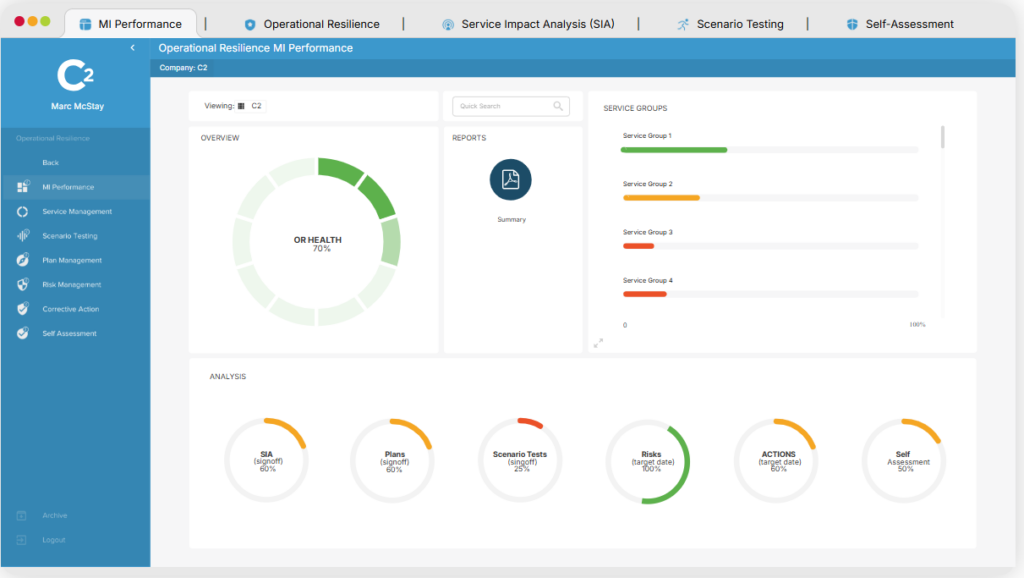
- Built directly against FCA and PRA operational resilience rules: Services are assessed for whether disruption would cause the kind of harm the regulator considers intolerable, and impact tolerances are calculated from customer harm and market share data, not typed in by hand.
- Dependency mapping tied to vulnerability reporting: Each business service is mapped against the staff, sites, third parties, and systems it relies on, drawn from controlled lists so two analysts describing the same dependency use the same label.
- Testing and its paperwork in one place: The severe but plausible scenarios regulators expect are exercised inside C2, with the resulting report and its sign-off trail attached to the test that produced them.
Continuity2 Pricing
Continuity2 publishes pricing through the UK Government’s G-Cloud Digital Marketplace, banded by staff count with unlimited users on every license:
- Up to 500 staff: £4,500 implementation plus £20,000 annually, so £22,500 in year one.
- Largest band: £16,000 implementation plus £60,000 annually, so £76,000 in year one.
- Add-on modules: Incident Management at £8,500 and IT disaster recovery at £10,000.
- Consultancy: Day rates between £500 and £950.
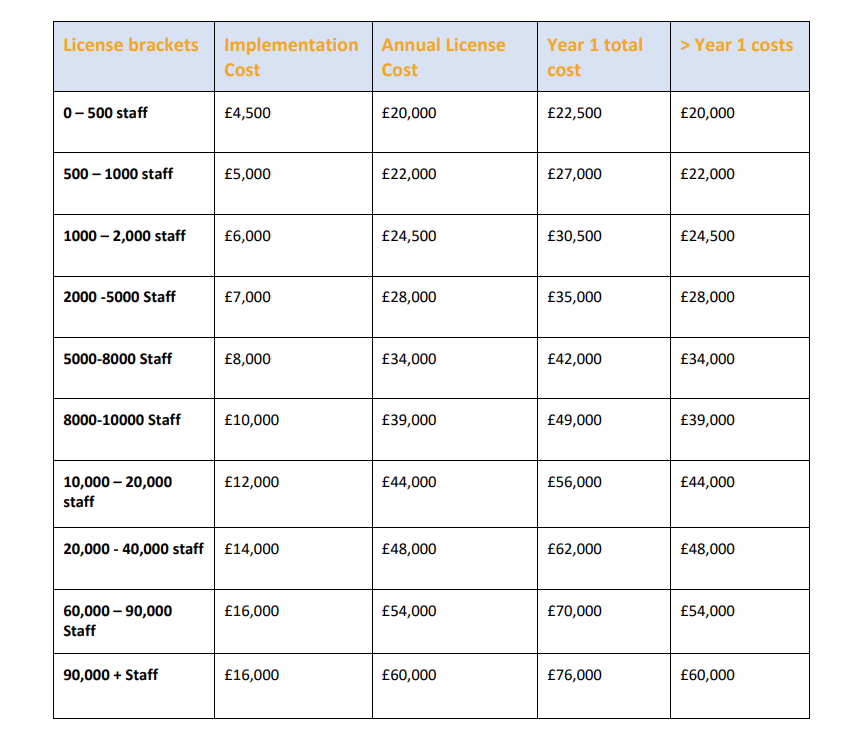
Note: That G-Cloud document is dated 2024, so you’d have to confirm current figures directly.
Continuity2 Pros & Cons
✅ ISO 22301 certified and aligned to FCA, PRA, and DORA requirements.
✅ Indicative pricing is public through G-Cloud, not locked behind a quote.
✅ Over 20 years in the field, with customers including NHS bodies, Vodafone, E.ON, and UK local councils.
❌ This is governance software. It will document, test, and evidence a recovery plan without ever executing one.
Cyber Resilience Solution #8: StorageGuard
StorageGuard from Core6 scans storage and backup systems for the misconfigurations and vulnerabilities that would compromise a recovery, checking hardening, immutability, and compliance posture without agents.
It is for security and infrastructure teams who already own a backup platform and need evidence that it is configured safely.
StorageGuard Features
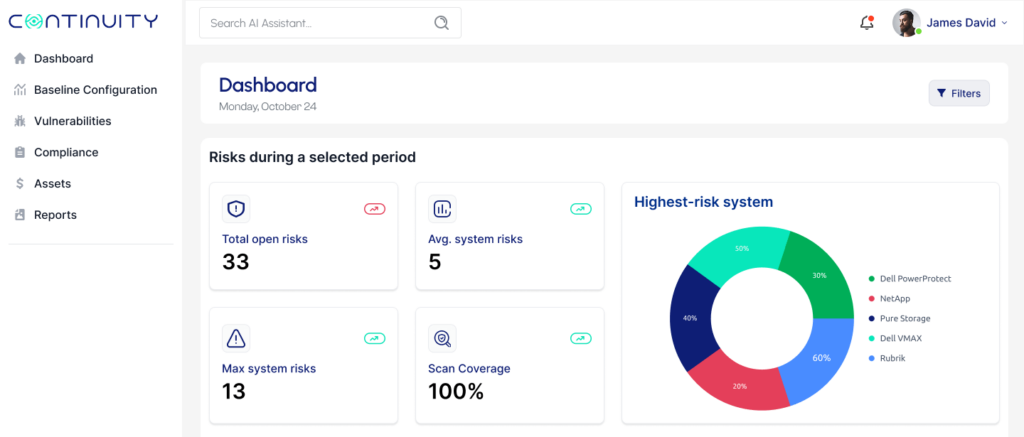
- Agentless authenticated scanning: Nothing to install, and coverage spans storage from Dell, NetApp, Hitachi Vantara, IBM, Pure, and HPE, plus the backup platforms themselves including Rubrik, Cohesity, Commvault, and Veeam.
- Immutability validation: StorageGuard checks that your immutable backup copies are actually configured to be immutable, which sounds pedantic until you find out during an incident that they weren’t.
- Fix Now remediation: Findings ship with remediation steps, and Fix Now executes the remediation procedure on the affected system directly.
StorageGuard Pricing
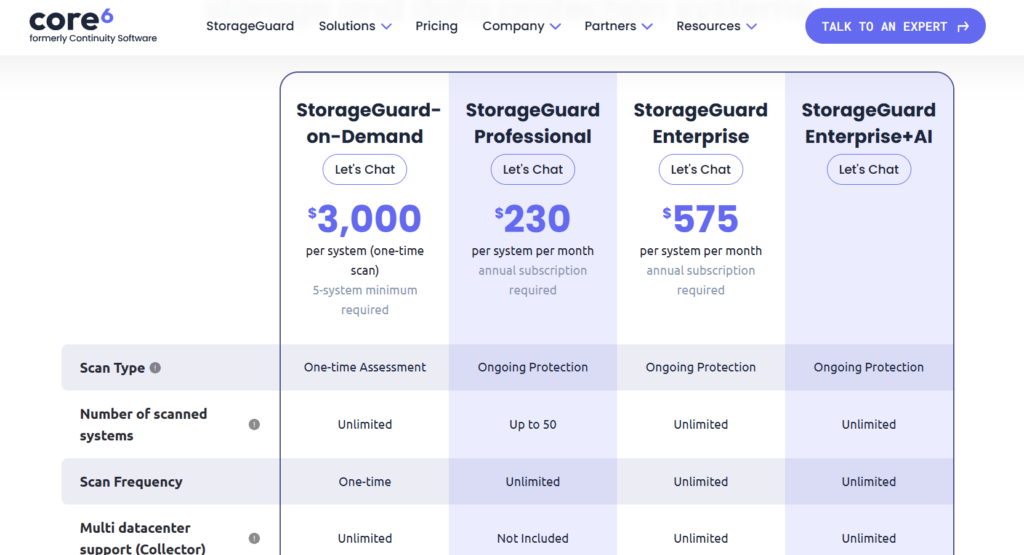
StorageGuard publishes four tiers:
- On-Demand: $3,000 per system for a single one-time scan, with a five-system minimum.
- Professional: $230 per system per month on an annual subscription, capped at 50 systems, without immutability checks or the multi-datacenter collector.
- Enterprise: $575 per system per month on an annual subscription, unlimited systems, with around-the-clock support for severity one issues.
- Enterprise with AI: Quote-only, adding the MCP server for querying findings and generating compliance reports in natural language.
StorageGuard Pros & Cons
✅ Positioned as the first security posture management product built for storage and backup systems, and nothing else here does the same job.
✅ Configuration baseline drift detection with compliance reporting for CIS Controls, NIST, ISO, PCI DSS, and NERC CIP.
✅ Agentless, so deployment friction is low.
❌ The scan boundary is your storage and backup estate. Cloud service configuration beyond those systems goes unexamined.
Cyber Resilience Solution #9: Veeam Cyber Secure
Veeam Cyber Secure is a services program, not software, wrapping a dedicated security advisor, quarterly assessments, incident response access, and warranty cover around a Veeam Data Platform deployment you license separately.
It is ideal for existing Veeam customers who want the security posture of that deployment audited by specialists and backed financially.
Veeam Cyber Secure Features
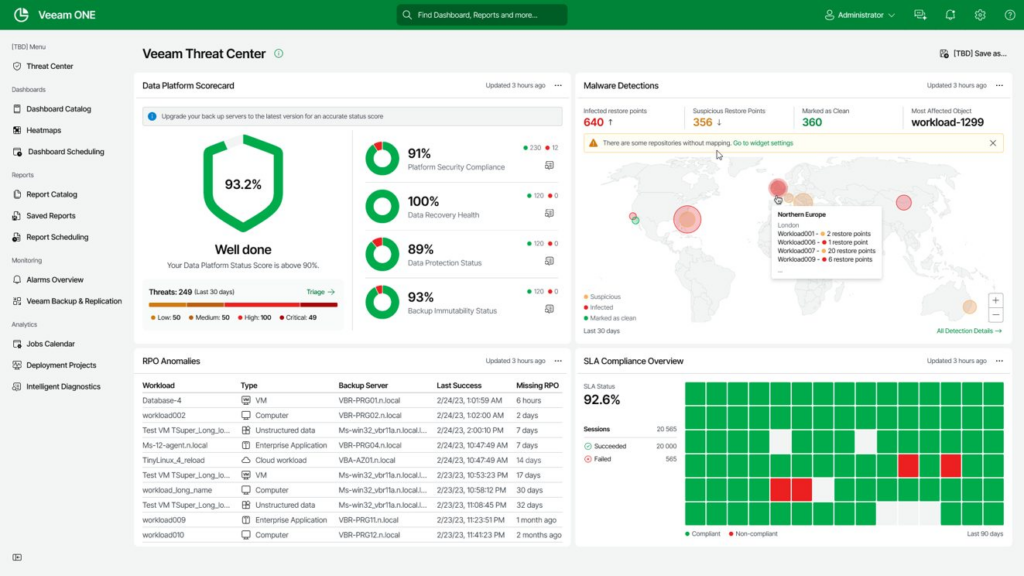
- Quarterly assessments against named frameworks: Reviews mapped to NIST CSF 2.0, NIST SP 800-53, MITRE ATT&CK, and MITRE D3FEND, with an executive report written for a CISO audience, not an engineering one.
- Coveware retainer in the Premium edition: Around-the-clock access to Coveware for triage, negotiation, decryption, and post-incident documentation, with covered incident response negotiations included in the retainer.
- Ransomware expenses warranty: Up to $5M in financial protection for verified ransomware incidents, available on Veeam Data Platform Advanced and Premium editions and on Veeam Kasten, and contingent on following the security recommendations that come out of the quarterly assessments.
Veeam Cyber Secure Pricing
Veeam doesn’t publish Cyber Secure pricing, but there are 2 displayed pricing tiers:
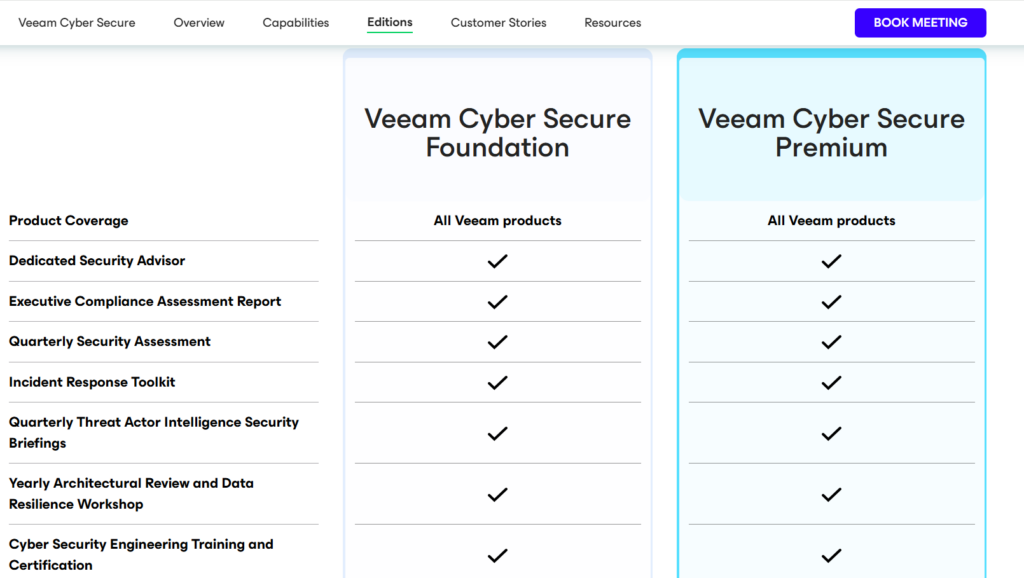
- Veeam Cyber Secure Foundation, which includes a dedicated security advisor, a quarterly security assessment, an incident response toolkit, and quarterly threat actor intelligence security briefings.
- Veeam Cyber Secure Premium, which adds Coveware cyber extortion readiness and response retainer, and up to $5M ransomware expenses warranty available for Veeam Data Platform and Veeam Kasten.
Veeam Cyber Secure Pros & Cons
✅ Incident Escalation Fast Track puts you at the front of the queue for Coveware’s expert-led response while an incident is live.
✅ A financial warranty puts the vendor’s own money behind the outcome, which no feature list does.
✅ Quarterly threat actor briefings drawn from live cyber extortion cases, covering active groups and the tactics they are using.
❌ A services layer, not a platform. The protection itself comes from Veeam Data Platform, purchased separately.
Cyber Resilience Solution #10: HPE Zerto Software
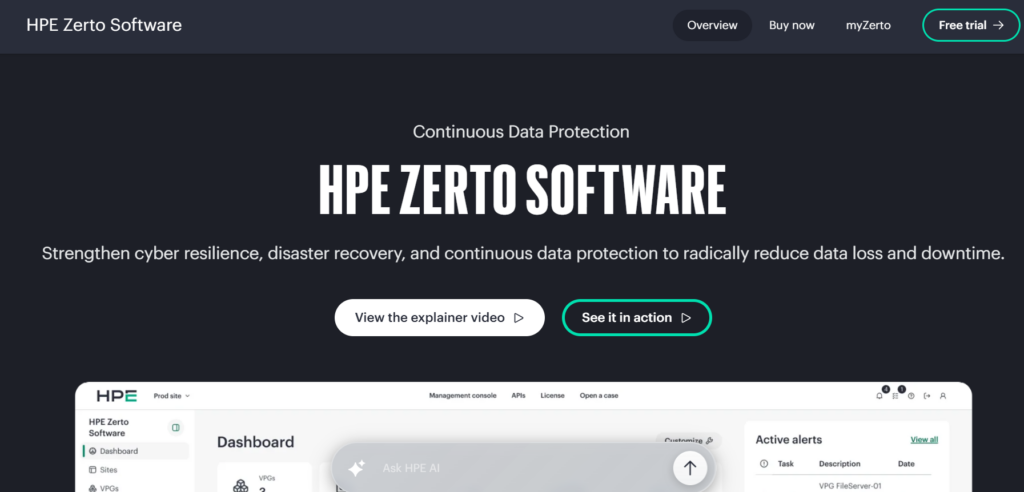
HPE Zerto Software provides continuous data protection with journal-based recovery, replicating every write so an environment can be restored to a checkpoint seconds before an incident.
It is a nice option for organizations running virtualized, mission-critical applications where minutes of downtime or data loss are unacceptable.
HPE Zerto Software Features
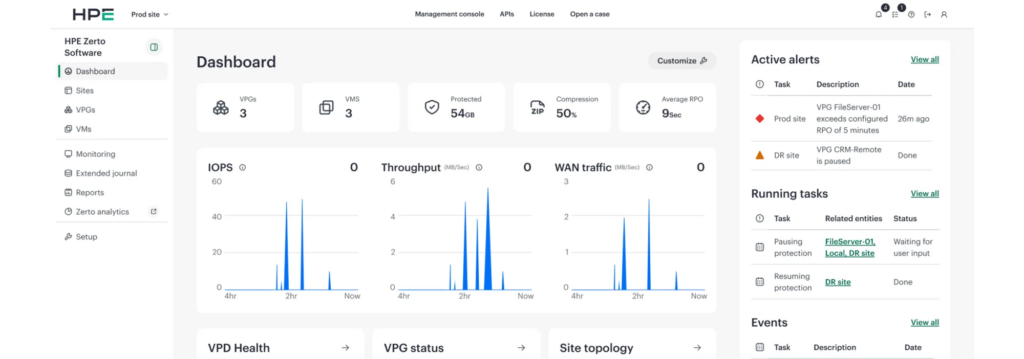
- Journal-based CDP with agentless replication: Near-synchronous replication captures every write, with checkpoints separated by 5 to 15 seconds.
- Real-time encryption detection: Zerto watches replication traffic for encryption anomalies and alerts on suspicious patterns as they happen, which turns the replication stream into an early warning channel.
- Cyber Resilience Vault: A decentralized, air-gapped, offline vault built on HPE Alletra, ProLiant, and Aruba Networking hardware for recovery when production and backup are both compromised..
HPE Zerto Software Pricing
HPE Zerto Software is licensed per protected VM as a subscription E-LTU and sold through HPE resellers.
Three edition families appear in the HPE Store:
- Enterprise Replication: The replication tier, priced per VM, with an offline subscription variant for isolated deployments.
- Enterprise Cloud Edition: Priced per VM, with a documented upgrade path to Advanced Resilience.
- Advanced Resilience Edition: The top tier, priced per VM, also available as an upgrade from Enterprise Cloud.
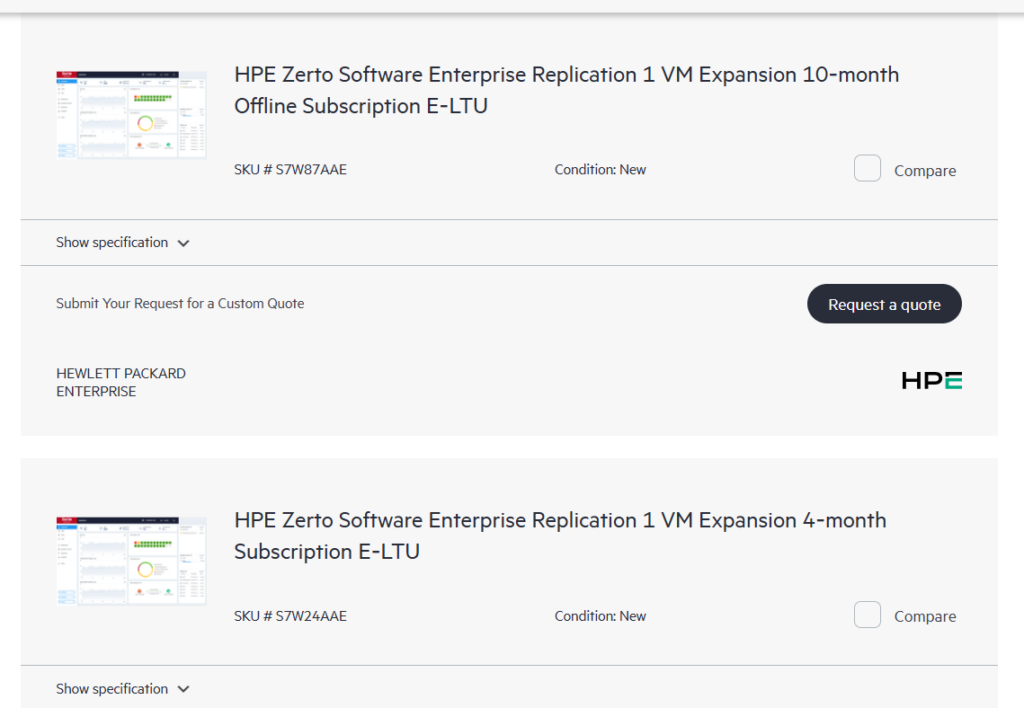
Subscription terms are quite granular, actually, running anywhere from a few months to five years, and expansion SKUs let you add VMs to a deployment mid-term.
HPE publishes no prices against any of the roughly 250 Zerto SKUs.
Each one carries a request-a-quote action, and HPE notes that prices vary by local reseller.
A free 14-day license is available before you commit.
HPE Zerto Software Pros & Cons
✅ Recovery point objectives measured in seconds, which almost nothing else on this list matches.
✅ Non-disruptive failover testing with compliance reporting attached.
✅ TenCate Protective Fabrics cut data loss from 12 hours to 10 seconds and recovery time from two weeks to under 10 minutes after deploying it.
❌ The depth is in virtualized workloads and continuous replication. For broad coverage of physical servers, large database estates, and unstructured file data, a general-purpose backup platform does more.
Recover the layer your business actually runs on with ControlMonkey
Incidents don’t end businesses because data was lost. They end them because nobody could put the environment back together fast enough to matter.
Most resilience strategies quietly decline to look at that part.
When identity assignments are gone, DNS points nowhere, security group rules have been rewritten, observability is blind, and nobody can say what the working state looked like on Tuesday, a perfect data backup buys you almost nothing.
The data survives intact while the ability to operate does not.
This is the layer ControlMonkey exists to protect.
Every permission, route, rule, dependency, and third-party setting that makes your cloud function gets captured continuously, versioned, and held ready to redeploy.
Not partially, and not reconstructed from somebody’s memory of how it used to look.
That settles the two questions that actually decide how an incident ends: whether anyone can still say what the environment looked like before it broke, and whether it can be back before customers notice it wasn’t.
What’s left is a decision, not a project. All you have to do is choose the state you want back, and the ordering is handled for you.
Our platform doesn’t top this list because it keeps more copies of your data than anyone else.
It tops it because it brings back the configuration without which none of that data does you any good.

A 30-min meeting will save your team 1000s of hours
A 30-min meeting will save your team 1000s of hours
Author