Are you looking for the top cloud disaster recovery options in 2026 to safeguard your vital infrastructure, reduce downtime, and guarantee business continuity?
In this article, I’ll cover the best cloud DR solutions in 2026 that can help you preserve your infrastructure, manage failover processes, and sustain resilient operations even during unforeseen outages.
TL;DR
- ControlMonkey’s automated infrastructure backup and one-click recovery technology make it the best cloud disaster recovery solution available.
- ControlMonkey recovers DNS, CDN, identity, network, and SaaS configuration (not the data), whereas many vendors back up your data. Since many vendors only provide a partial solution, no other vendor in the market is able to complete this task from start to finish.
- For teams seeking data-centric disaster recovery, automated failover, hybrid and multi-cloud support, or appliance-based recovery, platforms such as Acronis, Druva, Quorum, Cohesity, Zerto, and Veeam are excellent options.
- AWS Elastic Disaster Recovery, Commvault, and Rubrik Cloud Value are good choices for cloud-native, pay-as-you-go, or server-replication-first strategies if you want quick virtual machine recovery, ransomware protection, or granular backup controls. However, complete infrastructure reconstruction may require external tools.
What makes having a cloud backup recovery solution crucial?
Cloud DR solutions safeguard not only your data but your entire infrastructure.
Without it, a single incorrectly configured IAM policy, erased DNS record, or network modification can result in expensive business disruption and hours of downtime, which translates to $$$.
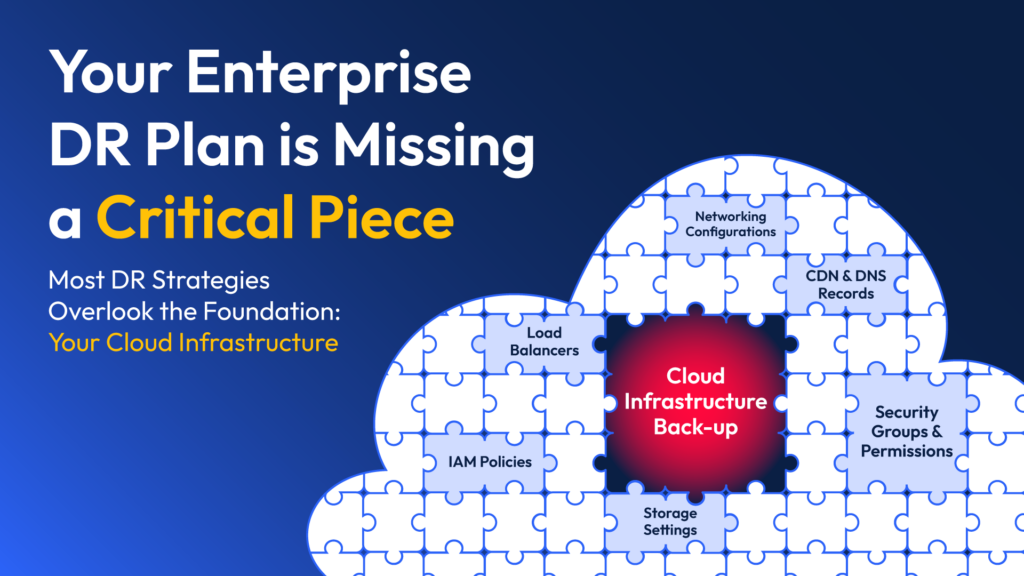
Traditional backup solutions do not protect vital infrastructure elements like VPCs, load balancers, and security policies.
They only restore files and databases.
In the event of an incident or cyberattack, an effective infrastructure disaster recovery plan guarantees business continuity, upholds SLA compliance, and permits quick recovery.
What factors to consider when evaluating cloud disaster recovery providers?
#1: Integration with your existing infrastructure
Your current cloud accounts, organizations, and regions must all work together seamlessly with your cloud disaster recovery solution.
For instance, ControlMonkey uses native cloud APIs and read-only access to find resources on AWS, Azure, GCP, and other platforms.
Inadequate integration will result in blind spots that expose vital infrastructure during recovery situations.
#2: What is protected: data vs. infrastructure configuration
Traditional backup solutions disregard infrastructure configuration and only safeguard databases and data files.
The DNS, CDN, identity, network, and SaaS configurations that keep your services operational are restored by a platform such as ControlMonkey.
This implies that to guarantee true business continuity, you can recover entire environments rather than just data.
If you don’t have a backup for your infrastructure, where will your data go?
#3: Your target RTO and RPO
The Recovery Time Objective (RTO) and Recovery Point Objective (RPO) specify the acceptable amount of data loss and the speed of recovery.
Higher SLA compliance and less revenue loss during incidents result from faster recovery.
#4: IaC coverage gaps and legacy resources
Not everything lives in Infrastructure as Code (IaC), as many critical configurations exist outside IaC, which can create dangerous blind spots for traditional disaster recovery products.
Your DR strategy fails when you need it most if these non-IaC and legacy resources are not covered.
For example, third-party SaaS platforms like Datadog, Cloudflare, and others are among the managed and unmanaged resources that ControlMonkey finds.
#5: Recovery testing and drills
A disaster recovery plan that hasn’t been tested is just documentation, not protection.
Continuous validation ensures your recovery process works when cyberattacks or misconfigurations occur.
DR readiness is a core concept here at ControlMonkey, and that’s why our platform gives you full transparency into DR readiness so that you can check recovery procedures even before accidents happen.
#6: Multi-account & multi-region availability
Today’s enterprise infrastructure is diverse and extensive in accounts and regions, and thus, your DR solution has to be capable of scaling likewise.
If your DR solution doesn’t scale with your infrastructure, it becomes shelfware that fails during real emergencies.
For example, ControlMonkey supports disaster recovery across all major cloud providers and handles complex multi-account architectures.

Review Your DR Strategy with an Expert
Not sure if your cloud infrastructure and SaaS configurations are truly recoverable?
Book a 30-minute intro call to review your DR readiness, identify blind spots, and see how ControlMonkey protects full environments – not just data.
What are the 10 best cloud disaster recovery solutions in 2026?
The best cloud disaster recovery solutions in 2026 are ControlMonkey, Acronis, and Druva.
Here’s a breakdown of our shortlisted platforms:
| Tool | Features | Pricing |
|---|---|---|
| #1: ControlMonkey | Automated daily infrastructure snapshots across AWS, Azure, and GCP, one-click recovery, SaaS configuration backup, and real-time DR readiness dashboards. | Custom pricing. |
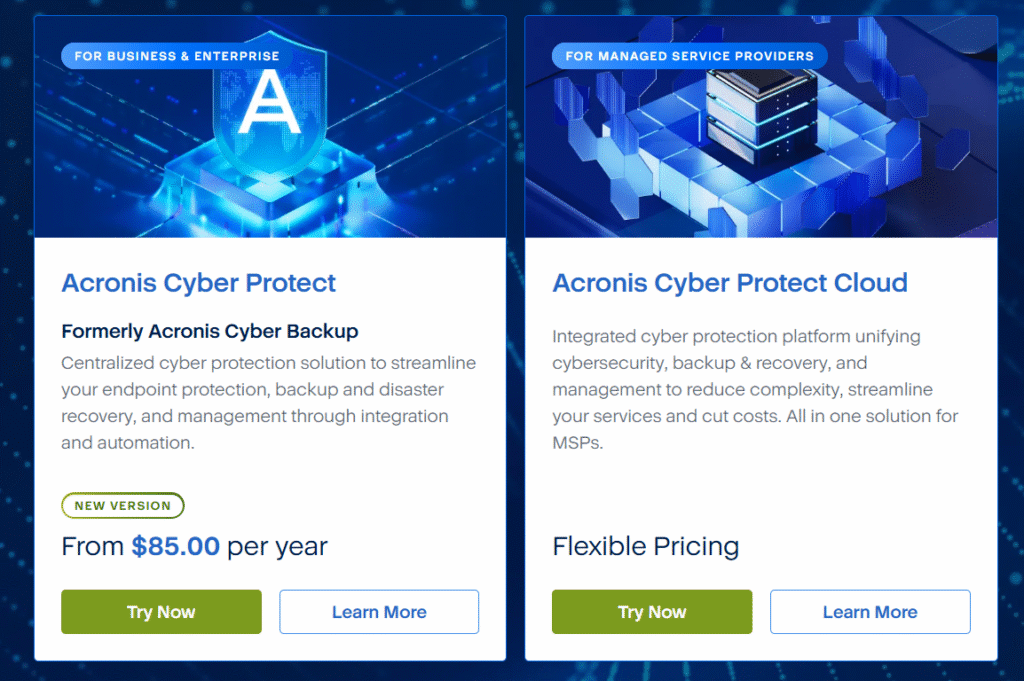
| #2: Acronis | Disaster recovery orchestration with runbooks, backup-based replication to the cloud, and unified DRaaS management. | Starts from $85/year. |
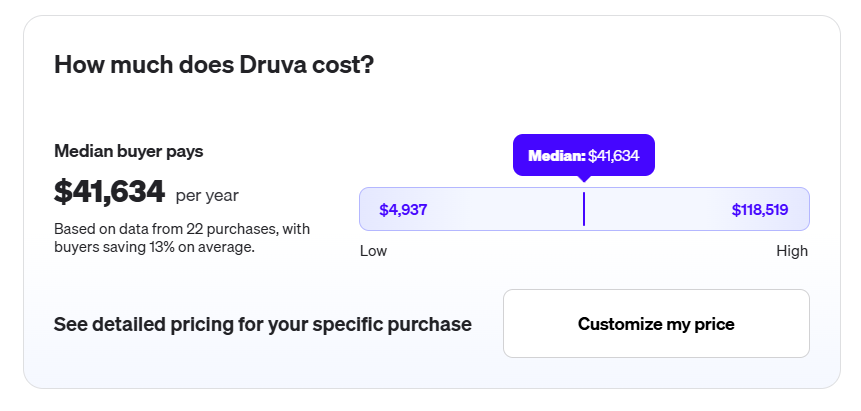
| #3: Druva | One-click failover for VMware/AWS, you can clone AWS environments, and perform failback recovery. | The median reported cost is $41,634/year. |
| #4: Quorum | Instant VM/file recovery, remote site replication, and automated daily recovery testing. | Custom pricing. |
| #5: Cohesity DataProtect | Automated failover and failback, hybrid and multi-cloud support, and immutable backups. | The median reported cost is $24,937/year. |
| #6: Zerto | Continuous data protection, automated failover and failback, and MSP support. | The median reported cost is $76,750/year. |
| #7: Veeam | Continuous replication and CDP, immutable cloud storage, network extension appliances, and automated failover plans. | Custom pricing. |
| #8: AWS Elastic Disaster Recovery | Block-level continuous replication, one-click recovery drills, and launch recovery instances across regions. | $0.028/server/hour. |
| #9: Commvault Disaster Recovery | Automated resource discovery, recovery-as-code, drift analysis, and cloud-native DR. | Starts from $0.035/instance/hour (<10,000 instances) for AWS. |
| #10: Rubrik Cloud Value | Zero-trust backup, granular RBAC, continuous workload discovery, and ransomware recovery workflows. | The median reported cost is $601,917/year. |
Cloud Disaster Recovery Solution#1: ControlMonkey
ControlMonkey offers the best cloud disaster recovery solution on the market because it delivers comprehensive infrastructure protection that traditional backup tools can’t match.
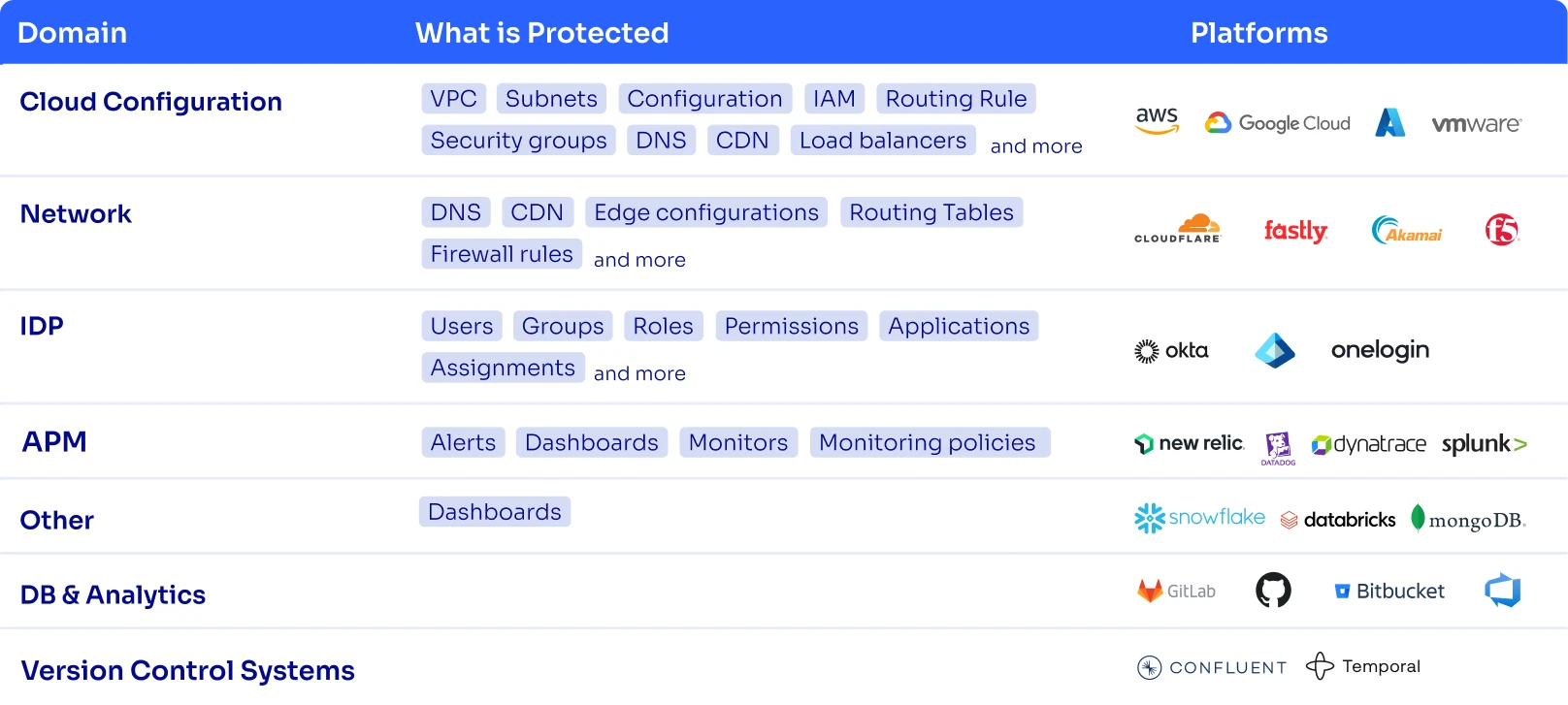
While most vendors focus on data backup, ControlMonkey restores your entire infrastructure configuration, including DNS, CDN, identity, network, and SaaS platforms to ensure true business continuity when disasters strike.
With many outages going on (Azure, AWS, Cloudflare), now more than ever, cloud infrastructure has become a priority for Cloud teams, CISOs and CIOs.
We’ve seen that organizations often discover too late that they don’t know what actually existed or that they had backups beyond their data.
Let’s go over ControlMonkey’s cloud disaster recovery features to see why companies like Intel, AWS and Comcast can’t imagine their cloud without ControlMonkey:
Automated Daily Cloud Backups
ControlMonkey continuously takes snapshots of your entire infrastructure to help you eliminate manual backup processes that leave gaps in protection.
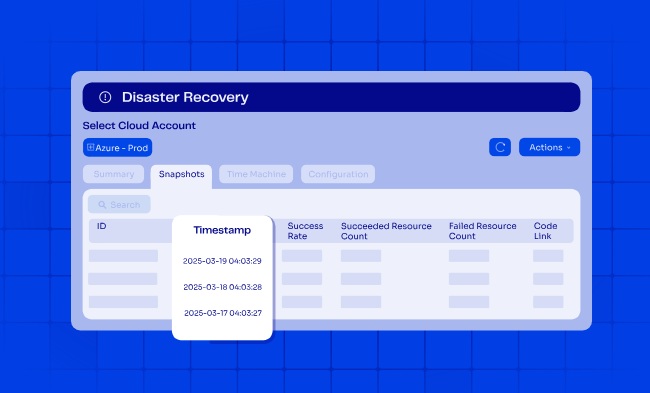
Continuously, ControlMonkey:
- Captures exact infrastructure configuration across all cloud accounts and regions
- Converts configuration into deployable infrastructure definitions that can be restored instantly
- Commits each snapshot as a versioned record in your Git repository for complete audit trails
Each snapshot represents a known-good point in time that you can roll back to with a single click.
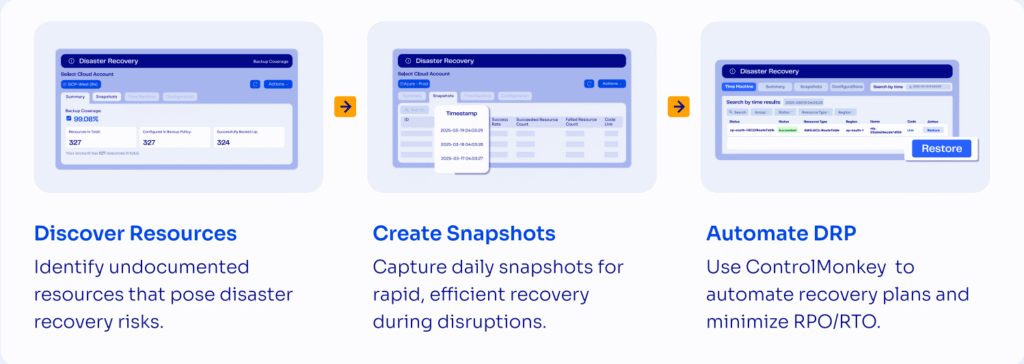
Snapshots are stored securely in the customer’s Git repository, with backup frequency ranging from an hour to a day, depending on the customer’s configuration.
Instant Cloud Infrastructure Recovery
When incidents or cyber attacks occur, we know that speed determines whether you face minutes of disruption or days of downtime.
This is why ControlMonkey’s one-click recovery system eliminates the manual fixes that keep infrastructure teams in firefighting mode.
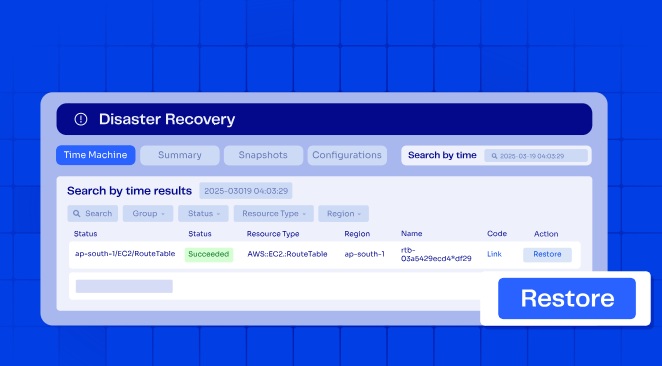
Recovery happens in three steps:
- Your team can restore individual resources or full environments using ControlMonkey’s Time Machine capability to select any previous known-good state.
- Recovery can be manual or automated, depending on severity: critical incidents trigger automatic rollbacks while routine fixes can be reviewed before deployment.
- Dependencies and ordering are handled automatically to reduce human error and prevent cascading failures during restoration.
This instant recovery capability can help you meet strict SLA targets and maintain business continuity during security incidents, misconfigurations, or accidental deletions.
Disaster Recovery SaaS Configuration
Your infrastructure extends far beyond cloud resources.
Routing rules, identity permissions, networking policies, SaaS configurations, and cloud resources change constantly, and many of these changes happen outside of Infrastructure as Code (IaC).
ControlMonkey solves the problem that traditional DR plans ignore: configuration drift in third-party platforms, which creates blind spots that leave your organization vulnerable.
While other platforms back up your cloud data, ControlMonkey protects configuration across 30+ SaaS vendors, including Datadog, Cloudflare, and more.
What would you do if hundreds of your Datadog dashboards were deleted in a cyberattack? You’d have zero visibility into your production metrics for the next 2–3 weeks.
Think about how much money, effort, and time you’ve put into building your dashboards. Do you really want to start all over again?
When a critical Datadog Dashboard gets deleted or a Cloudflare routing rule is misconfigured, ControlMonkey can restore these configurations instantly.
Want to assess your current cloud resilience posture? Check out our Free Cloud Resilience Assessment Report to identify gaps in business continuity and recoverability from accidental resource deletion or cloud outages.
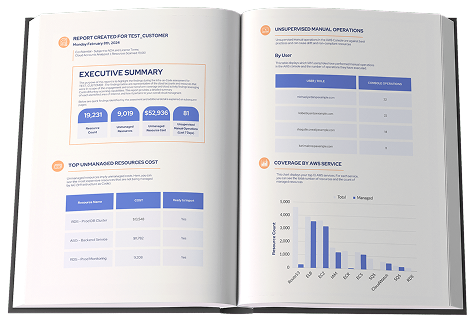
Complete Visibility Into DR Readiness
You can’t protect what you can’t see.
ControlMonkey connects using read-only access and native cloud APIs to discover every asset across your infrastructure footprint.
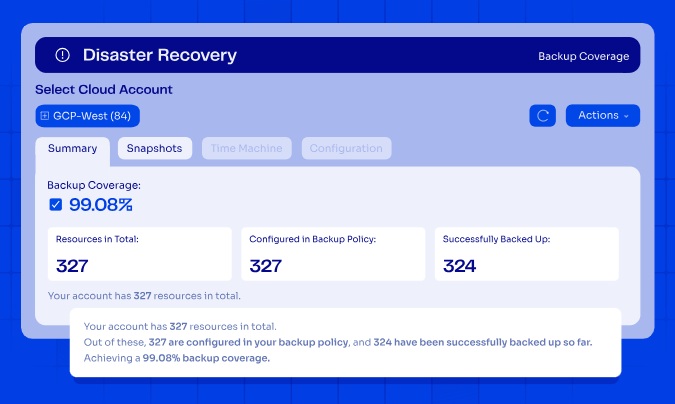
Our platform provides real-time visibility into:
- Cloud resources across AWS, Azure, and GCP with complete account and region coverage.
- SaaS and third-party configurations, including identity, APM networking, and security platforms.
- Resources managed and unmanaged by IaC, so you can identify coverage gaps before disasters strike.
With zero manual effort, instantly see what’s covered by Infrastructure as Code, what isn’t, and what’s ready for the next disaster.
This complete visibility lets teams proactively protect every asset before it’s too late, eliminating the dangerous blind spots that cause extended outages.
Audit Ready and BCP Compliance
ControlMonkey ensures your infrastructure disaster recovery strategy aligns seamlessly with your business continuity plan and compliance requirements.
Our platform continuously validates DR readiness across the organization to provide automated compliance with SOC 2, ISO 27001, PCI DSS, and other frameworks.
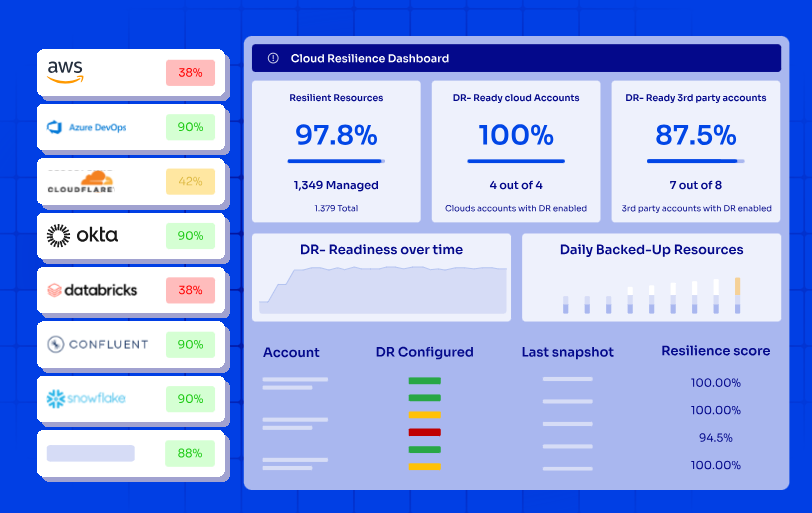
ControlMonkey provides managers and executives with a single pane of glass to continuously review cloud DR readiness through our Cloud Resilience Dashboard.
Ready to achieve 100% cloud resilience?
ControlMonkey delivers an end-to-end infrastructure disaster recovery solution that protects both cloud resources and SaaS configurations. Get automatic daily backups, instant recovery, and complete visibility, without writing custom scripts or maintaining complex DR processes.
Leaders can track progress over time, identify gaps before incidents occur, and demonstrate compliance during audits without scrambling to gather documentation.
This executive visibility transforms DR from a technical checkbox into a strategic capability that reduces business risk and ensures operational excellence.
Mini Case Study: How Block achieved 100% cloud resilience with ControlMonkey
Block, a global fintech leader processing over $240 billion annually for 55 million users, needed a disaster recovery solution that could protect thousands of multi-cloud accounts and hundreds of thousands of assets without slowing innovation.
Assaf, who leads platform engineering at Block, partnered with ControlMonkey to achieve daily automated backups across 100% of their multi-cloud infrastructure: something their team couldn’t build fast enough in-house.
ControlMonkey’s unified asset inventory, ability to generate daily backups for millions of cloud resources, and clear DR posture visibility immediately stood out.
Block significantly improved their RPO and RTO metrics while gaining complete visibility into coverage gaps between tools and the true state of their environment.
What started as a disaster recovery project evolved into a broader initiative around visibility, governance, and operational confidence.

"ControlMonkey helped us achieve the level of resilience we envisioned for our cloud infrastructure. At our scale, that’s anything but trivial. Doing this ourselves would have taken quarters of effort for just a fraction of the value we get from their platform."

Check out our video case study to learn more about what happened:
Pricing
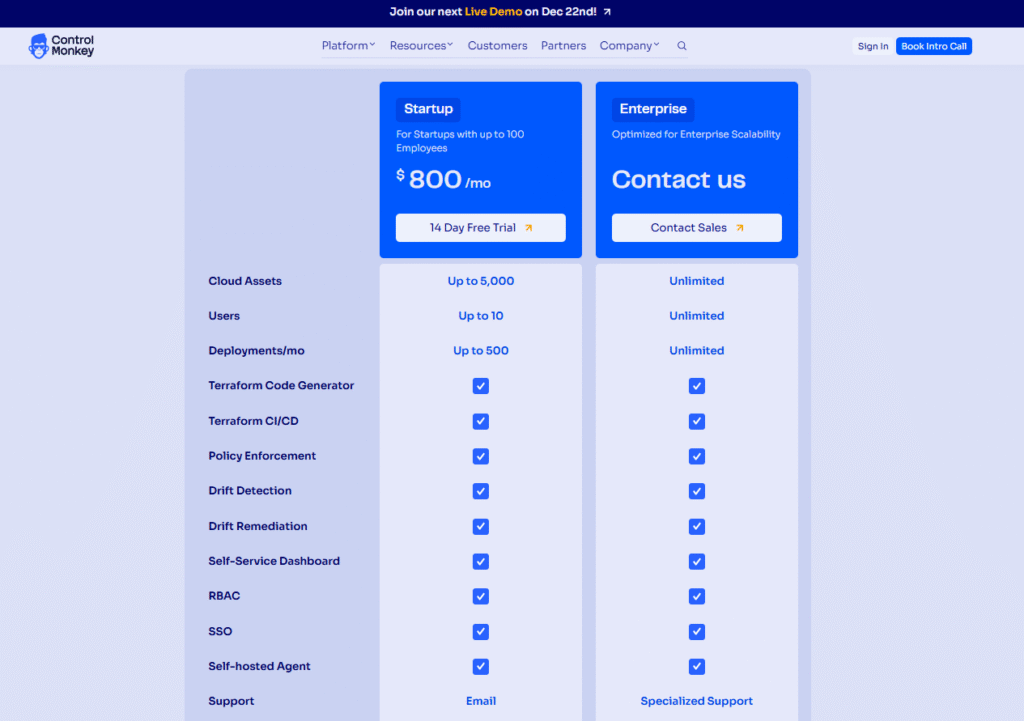
ControlMonkey offers only 2 pricing plans:
- Startup: $800 for up to 10 users, up to 5,000 cloud assets, up to 500 deployments/month, and access to our Terraform code generator, Terraform CI/CD, policy enforcement, drift detection and remediation capabilities, self-service dashboard, RBAC, and self-hosted agent.
- Enterprise: Custom pricing for unlimited cloud assets, users, and deployments, and adds specialized support.
Pros & Cons
✅ Cloud configuration backup across AWS, Azure, and GCP with automated snapshots.
✅ SaaS configuration backup from Datadog, Cloudflare, F5, Okta, and 30+ more platforms.
✅ Full visibility into DR readiness with real-time dashboards and IaC coverage mapping.
✅ Automated daily snapshots and one-click recovery minimize both RTO and RPO.
✅ Audit-ready compliance with continuous validation for SOC 2, ISO 27001, and PCI DSS.
✅ 24/7 VIP support over Microsoft Teams, Slack, email, and ticketing.
❌ Does not cover data backup, as ControlMonkey focuses on infrastructure configuration, not files or databases.
Cloud Disaster Recovery Solution #2: Acronis
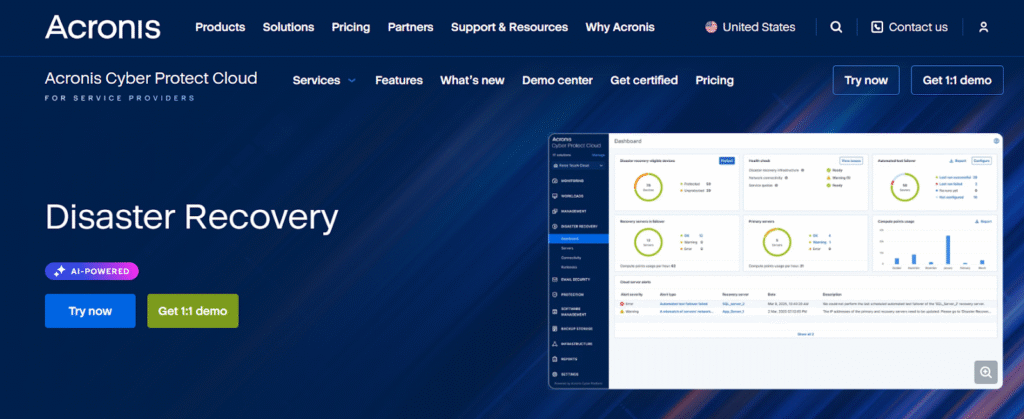
Acronis is one of the best disaster recovery solutions with its integrated platform that combines backup capabilities with automated failover orchestration.
The solution focuses on rapid recovery through backup-based replication rather than traditional replication infrastructure.
Acronis Features

- Disaster recovery orchestration with runbooks: Automates recovery workflows to restore systems in the correct sequence while handling application dependencies during failover.
- Backup-based replication to cloud: Replicates production workloads from existing backups and enables instant failover to cloud-hosted virtual machines within minutes of an outage.
- Unified DRaaS management: Single interface manages backup, disaster recovery, and cybersecurity without requiring separate platforms or vendors.
Acronis Pricing
Acronis Pros & Cons
✅ A single-console approach eliminates the need for separate backup and DR vendors while integrating cybersecurity capabilities.
✅ Flexible cloud targets (Acronis, Azure, hybrid) let you optimize for cost, compliance, or performance per workload.
✅ Automated monthly test failovers and HIPAA compliance features (audit logs, MFA, encryption) suit regulated industries.
❌ Focuses on data and application recovery rather than infrastructure configuration.
❌ Backup-based replication model may result in slower infrastructure restoration compared to ControlMonkey’s one-click rollback.
Cloud Disaster Recovery Solution #3: Druva
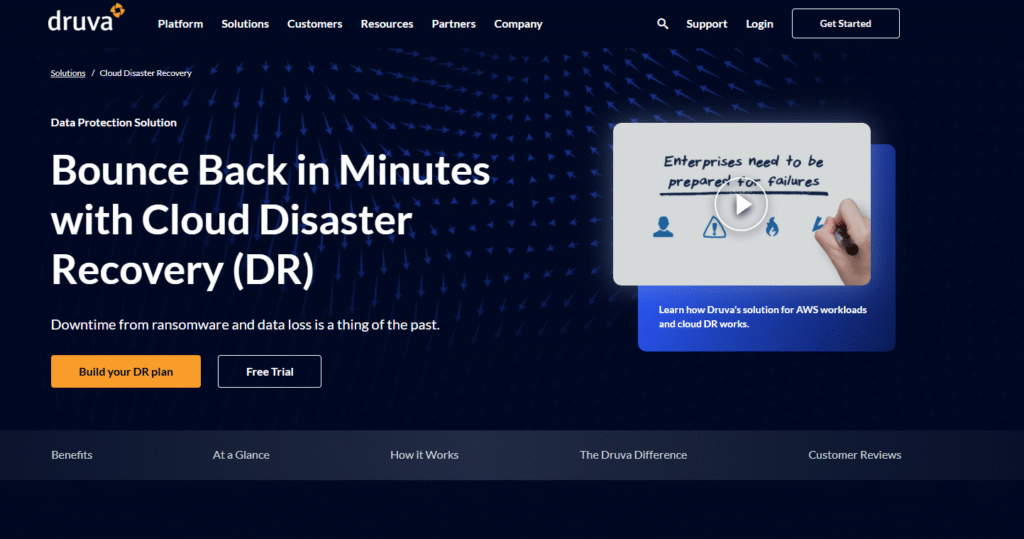
Druva offers a SaaS disaster recovery platform built on AWS infrastructure that eliminates the need for on-premises DR hardware.
The solution delivers automated failover for VMware and AWS workloads and focuses on simplicity through 100% cloud-native architecture with RPOs of one hour and RTOs measured in minutes.
Druva Features

- “One-click” recovery in the cloud: Enables simple failover of on-premises VMs to any AWS region globally with minimal manual steps.
- Clone AWS environments for DR: Duplicates complete AWS workload stacks (EC2, RDS, dependencies) to alternate regions or accounts while preserving configurations.
- Failback recovery: Returns recovered workloads to the original on-premises data centers or VMware Cloud on AWS after disaster resolution.
Druva Pricing
According to 3rd-party data from Vendr, including 22 purchases they’ve handled for Druva, the median platform cost is $41,634/year, with buyers paying up to $118,519/year.
Druva Pros & Cons
✅ 100% SaaS delivery eliminates DR hardware, software patching, and secondary site management overhead.
✅ FedRAMP-certified platform with built-in compliance (HIPAA, SOC 2).
✅ Native AWS integration across global regions with failback capabilities to on-premises or VMware Cloud on AWS.
❌ Backup-centric approach focuses on data and application recovery rather than infrastructure-as-code restoration.
❌ RPO targets of “a few hours” may not meet stringent requirements compared to ControlMonkey’s continuous drift detection and instant infrastructure state recovery.
Cloud Disaster Recovery Solution #4: Quorum
Quorum provides appliance-based disaster recovery through its onQ hardware platform that maintains ready-to-run virtual machine clones locally and replicates them to remote sites.
With 15+ years in business and zero ransomware infections since its inception in 2008, the solution focuses on one-click recovery with RTOs around 5 minutes.
Quorum Features
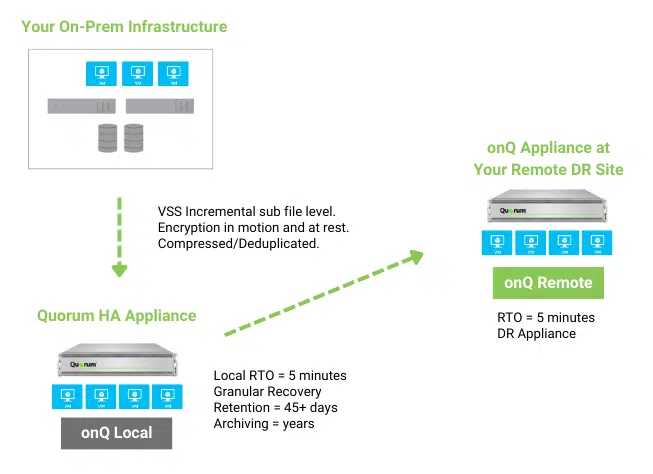
- Instant recovery of any server or file with just a few clicks.
- Remote site replication: Synchronizes encrypted, compressed snapshots from local onQ appliances to remote DR sites at user-defined intervals (as frequent as every 15 minutes for RPO).
- Automated daily recovery testing: Automatically boots every snapshot to verify recoverability.
Quorum Pricing
Quorum’s pricing is custom, so you’ll have to contact them to get a demo and a quote.
Quorum Pros & Cons
✅ Turnkey appliances deploy in hours with no specialized knowledge required, using a simple web-based console for management.
✅ Hardware powerful enough to run production workloads during disasters with up to 8 million IOPs per appliance.
✅ Immutable backups on hardened Linux with zero ransomware infections plus isolated sandbox for pre-production testing.
❌ Requires purchasing and managing proprietary hardware appliances rather than using infrastructure-as-code approaches like ControlMonkey’s state management.
❌ Focuses on VM-level recovery of applications and data rather than cloud-native configuration restoration, meaning network policies, IAM roles, and infrastructure definitions must be manually reconfigured.
Cloud Disaster Recovery Solution #5: Cohesity DataProtect
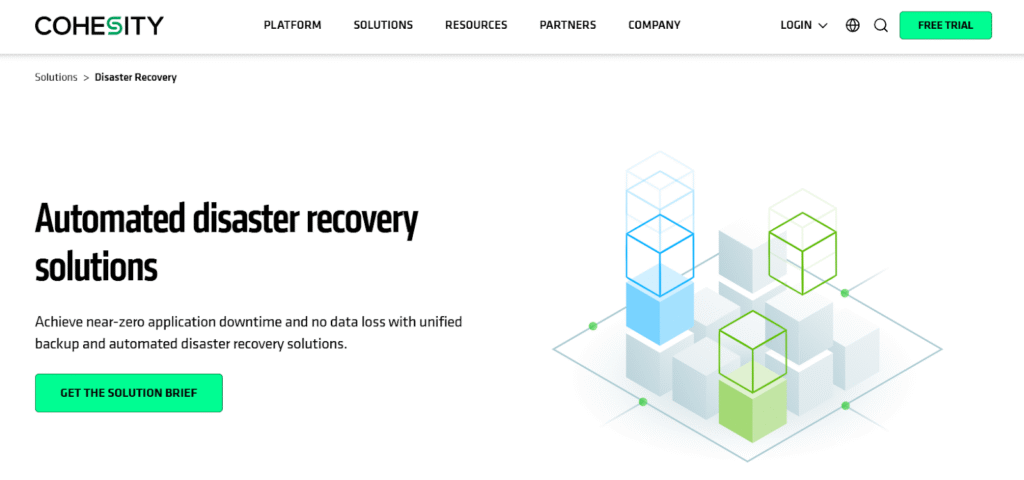
Cohesity DataProtect provides a modern, software-defined DR solution that enables fast, policy-based backups and automated failover/failback across hybrid and multi-cloud environments.
The platform eliminates siloed infrastructure through near-zero downtime and immutable backups, protecting against ransomware and site failures.
Cohesity DataProtect Features
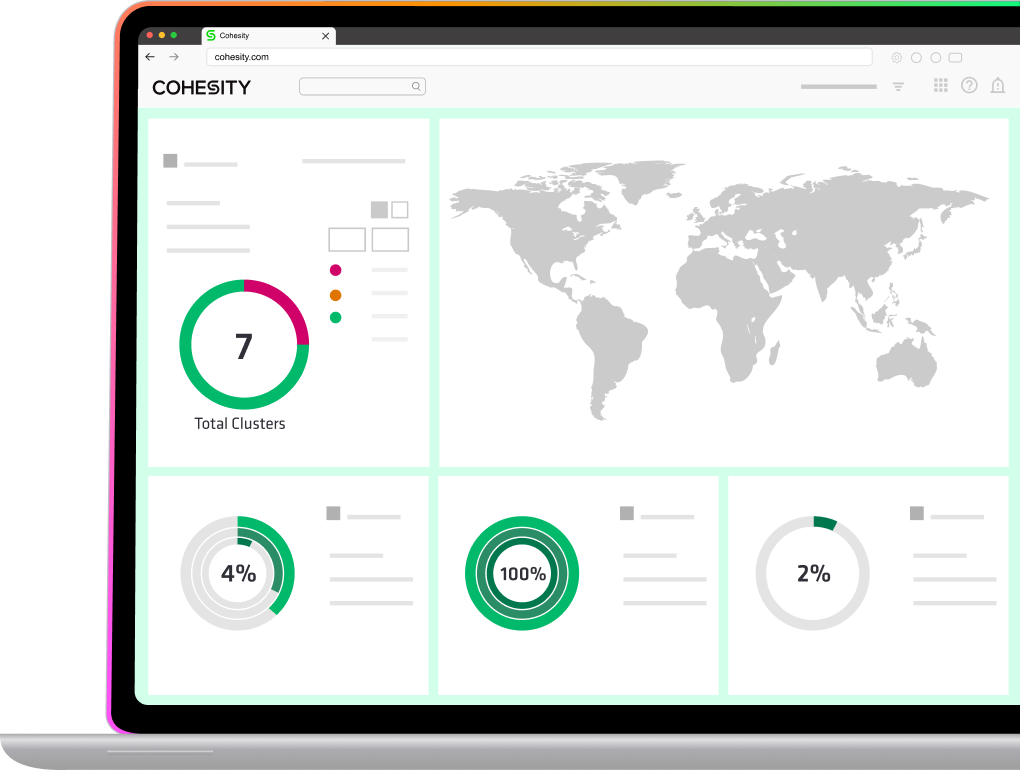
- Automated orchestration: The platform helps with DR operations through automated workflows for failover and failback.
- Hybrid & multi-cloud flexibility: Protects data across on-premises, edge, and public cloud environments (AWS, Azure, GCP) from a single control plane.
- Cyber resiliency: Immutable snapshots, air-gapped backups, and AI-driven threat analytics to ensure data can be recovered even after a ransomware attack.
Cohesity DataProtect Pricing
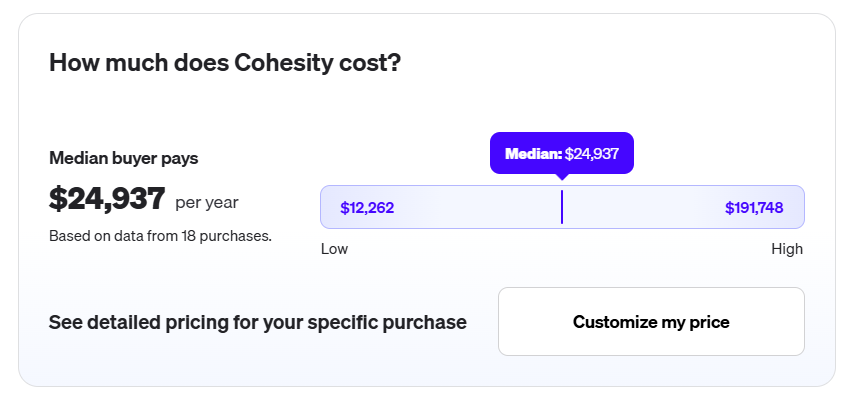
According to 3rd-party data from Vendr, the median buyer pays $24,937/year for Cohesity, with one buyer paying $191,748/year.
Cohesity DataProtect Pros & Cons
✅ Unified, scalable cloud and on-prem disaster recovery.
✅ Fast restores and SLA support.
✅ Strong security and ransomware resilience.
❌ Cohesity focuses primarily on protecting data and workloads, not cloud infrastructure configurations.
❌ Manual control of DR infrastructure configs can lead to gaps because Cohesity doesn’t auto-generate and version infrastructure-as-code recovery scripts.
Cloud Disaster Recovery Solution #6: Zerto
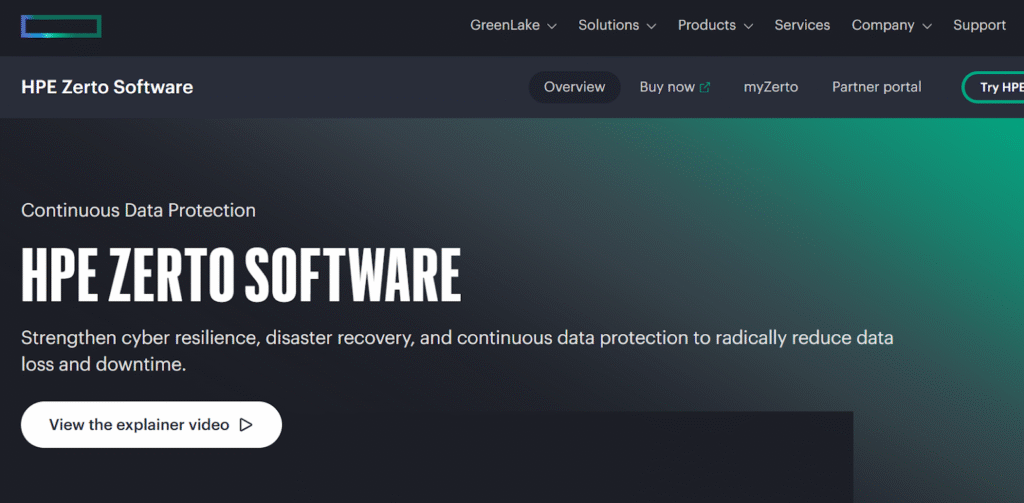
Zerto Cloud Disaster Recovery offers continuous data protection (CDP) for virtualized environments for near-instant recovery from ransomware and outages with sub-second replication.
The platform delivers automated, orchestrated failover/failback between on-premises, private clouds, and public clouds like AWS and Azure to help you reduce RTO to minutes and RPO to seconds.
Zerto Features
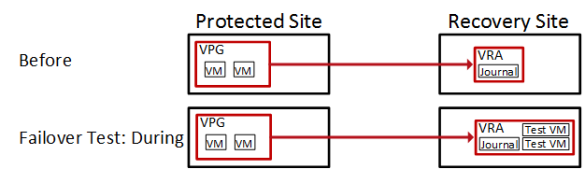
- Continuous Data Protection (CDP) that replicates data in real-time, allowing recovery from any point in time.
- Enables non-disruptive, automated testing and failover of entire applications or data centers with minimal manual intervention.
- Supports Microsoft Azure, AWS, IBM Cloud, and Oracle Cloud, as well as over 350+ managed service providers (MSPs).
Zerto Pricing
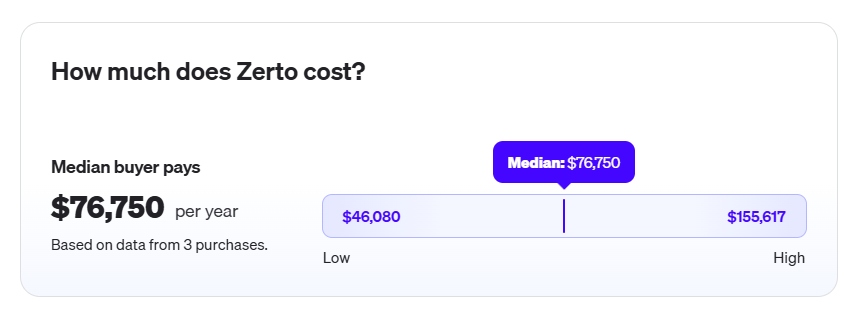
According to 3rd party data from Vendr, the average buyer is paying $76,750/year for Zero, with $46,080/year on the low end, and $155,617/year on the high end.
Zerto Pros & Cons
✅ Data is continuously replicated, so data loss is measured in seconds.
✅ Automated orchestration enables fast failover and failback.
✅ Protects workloads across different hypervisors, on-premises, and public clouds.
❌ Can be expensive to scale, with the median buyer paying $76,750/year.
❌ Limited infrastructure-as-code & config control relative to ControlMonkey-style automation.
❌ Without integrated IaC or infra versioning, recovery orchestration may require manual or separate scripting for cloud infra provisioning and rewiring.
Cloud Disaster Recovery Solution #7: Veeam
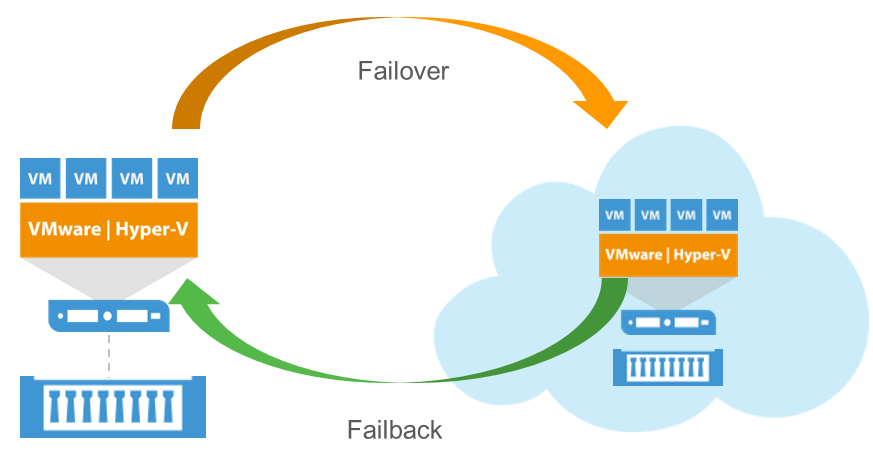
Veeam provides a suite for cloud disaster recovery (DR) designed to minimize downtime and prevent data loss through automated replication and failover to cloud environments.
Veeam Features
- Continuous data protection (CDP): The platform helps you achieve RPOs of seconds for mission-critical workloads.
- Immutable cloud storage: Uses Veeam Data Cloud Vault to store air-gapped, tamper-proof backups, ensuring clean recovery after ransomware attacks.
- Network extension appliances: Automatically “stretches” your Layer 2 network between your on-premises site and the cloud during failover to help you maintain IP connectivity without complex re-addressing.
Veeam Pricing
Veeam’s pricing is custom, so you’ll have to contact their team to get a product demo and a quote.
Veeam Pros & Cons
✅ Automated failover plans and DR testing.
✅ Native integrations with major cloud providers (AWS, Azure, GCP) for replication and recovery.
✅ Supports image-based backups, continuous replication, and near-instant restores for VMs, physical servers, and cloud workloads.
❌ Provisioning or reconfiguring cloud infra (e.g., rebuilding networks, security policies, DNS routing) typically requires external IaC tooling or scripts.
❌ The platform doesn’t inherently version or manage full cloud infrastructure configurations (network, IAM, routing, VPC, etc.) as code.
Cloud Disaster Recovery Solution #8: AWS Elastic Disaster Recovery
AWS Elastic Disaster Recovery (AWS DRS) is a cloud-based disaster recovery service for fast, reliable recovery of physical, virtual, and cloud-based servers into AWS.
The solution minimizes downtime and data loss by using continuous, block-level replication to a low-cost staging area.
AWS Elastic Disaster Recovery Features
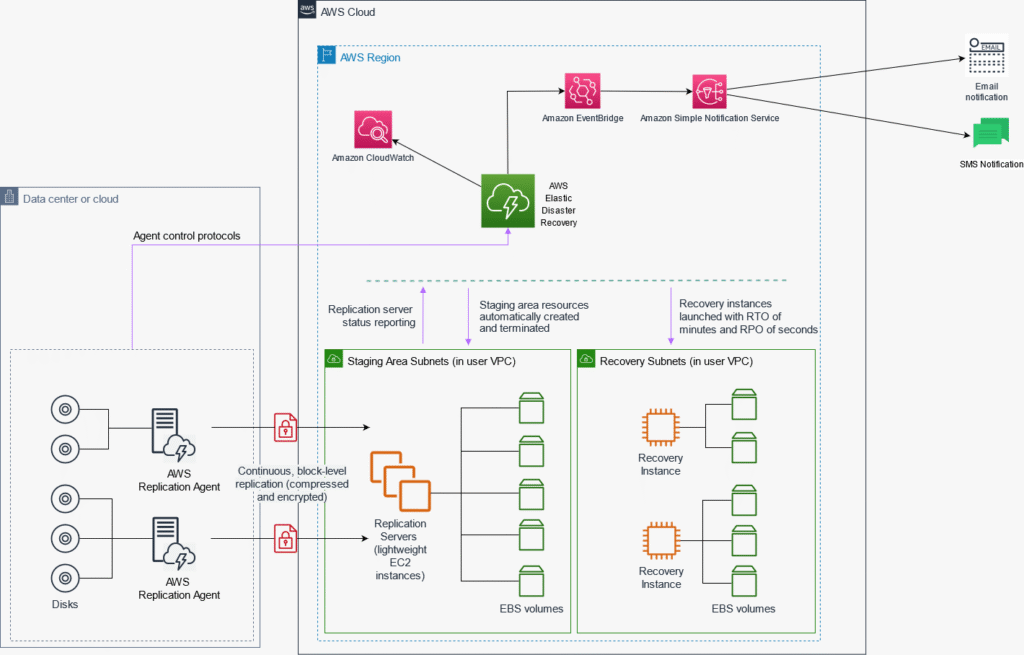
- AWS DRS maintains a 7-day history of snapshots by default, which can be critical for recovering from ransomware or data corruption, as you can “roll back” to a state before the incident occurred.
- You can launch recovery instances in a different Availability Zone (AZ) or even a different AWS Region to ensure regional resilience
- It’s possible to perform one-click recovery drills at any time without stopping replication or affecting your live production environment.
AWS Elastic Disaster Recovery Pricing
AWS Elastic Disaster Recovery’s pricing is based on an hourly rate per source server and costs $0.028/server/hour.
AWS Elastic Disaster Recovery Pros & Cons
✅ Allows you to recover servers from a previous state to mitigate issues like ransomware or human error.
✅ IT disaster recovery services that support an RPO of seconds and an RTO of minutes.
✅ You only pay for fully provisioned recovery instances during active drills or actual disasters.
❌ AWS DRS focuses on data and VM replication, but does not automatically version or restore broader AWS infrastructure configuration.
❌ Requires separate infra automation tooling for full DR automation.
Cloud Disaster Recovery Solution #9: Commvault Disaster Recovery
Commvault Cloud Rewind is a cloud-native disaster recovery (DR) and cyber-resiliency solution designed to automate the restoration of entire cloud application environments, including their data, configurations, and infrastructure.
Commvault Disaster Recovery Features
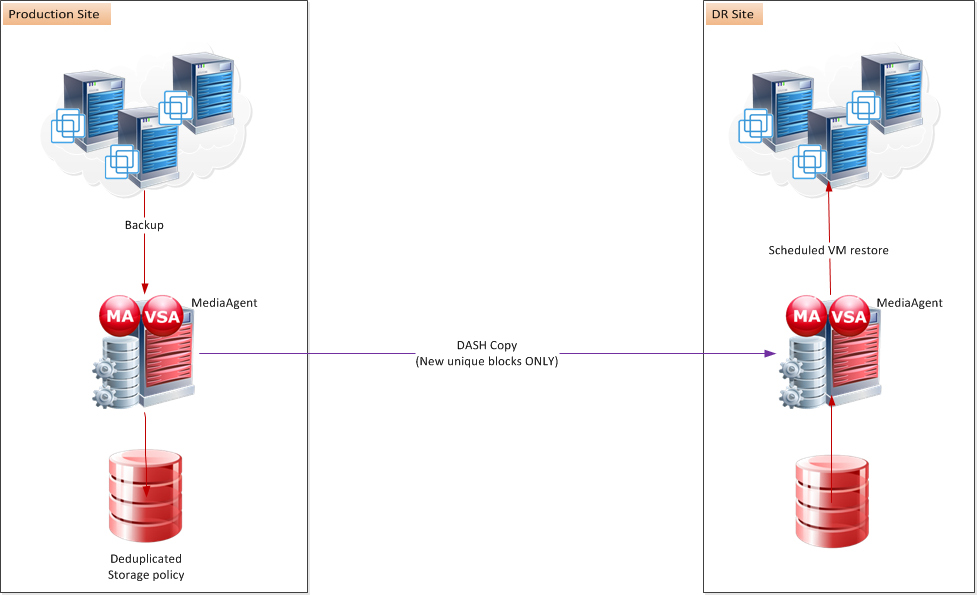
- Automated resource discovery and mapping: It continuously inventories cloud environments to help you identify all resources and their complex dependencies.
- Recovery-as-code: The platform automatically generates the code necessary to rebuild entire cloud environments.
Drift analysis: It identifies changes or “drifts” between point-in-time configurations to help you spot potential unauthorized changes that might indicate a cyberattack.
Commvault Disaster Recovery Pricing
Commvault’s pricing is based on usage costs; for example, in AWS, you’ll be charged $0.035 per instance per hour for up to 10000 instances and $0.021 per instance per hour for more than 100000 instances.
Commvault Disaster Recovery Pros & Cons
✅ Cloud disaster recovery software that replaces days of manual rebuilding with automated recovery in minutes.
✅ Recovering from ransomware by identifying a clean restore point.
✅ You can create sandboxed clones of live environments to safely test software updates or configuration changes.
❌ While strong on data and workload protection, Commvault doesn’t inherently capture, version, or regenerate full cloud infrastructure state.
❌ For cloud DR, rebuilding or reconciling environment configurations often needs external IaC tools or manual scripting.
Cloud Disaster Recovery Solution #10: Rubrik Cloud Value
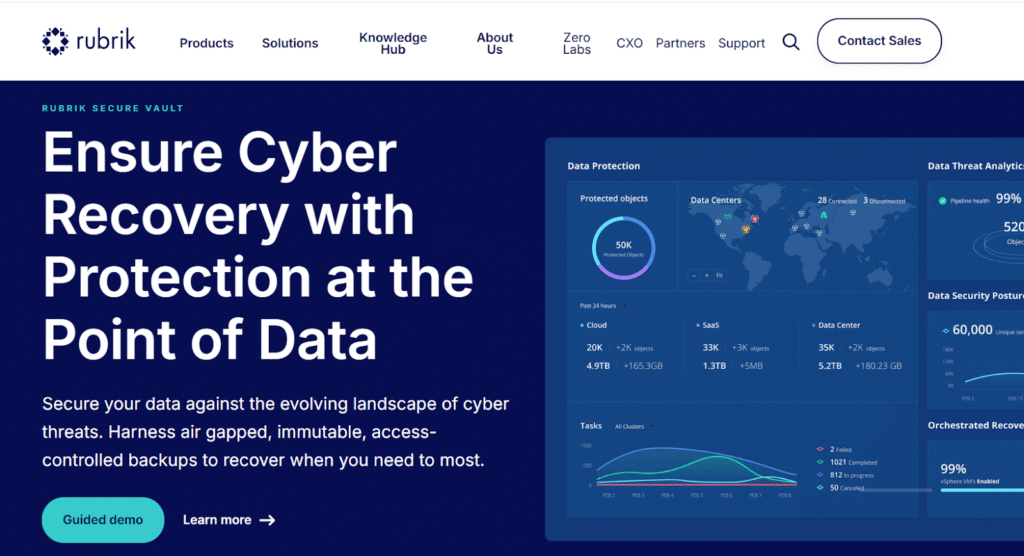
Rubrik Secure Vault is a cyber recovery and cloud disaster recovery solution designed to help you restore clean, trusted, and uncompromised data after ransomware or destructive attacks.
The platform treats backups as a security boundary, using zero-trust principles, immutability, and air-gapped storage to make recovery points resilient even when attackers directly target backup systems.
Rubrik Cloud Value Features
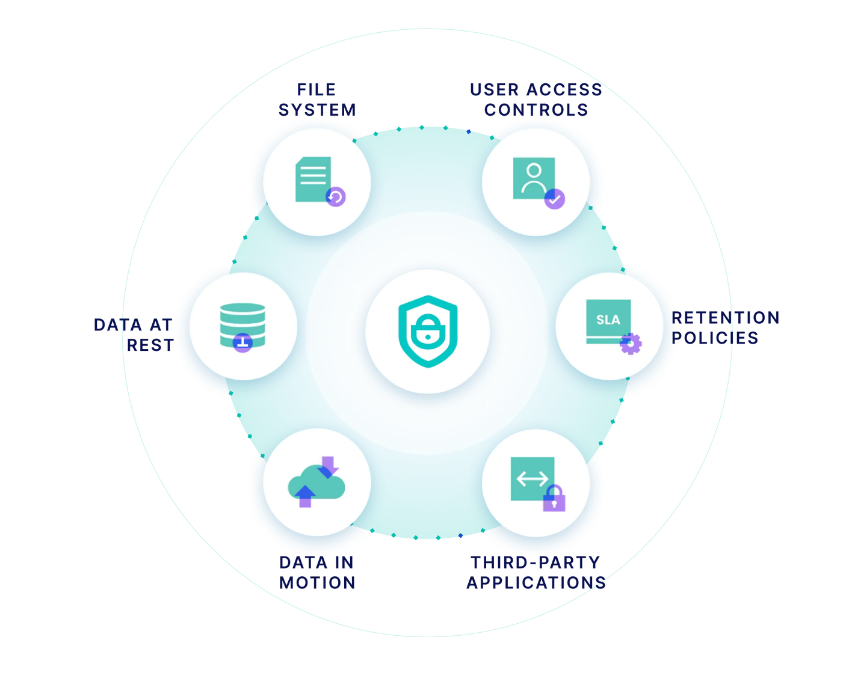
- Rubrik Secure Vault applies immutability on first backup, retention locks, encryption, and logical air gaps so recovery data cannot be modified, deleted, or encrypted by attackers.
- Granular RBAC, access isolation, and audit trails that can help you ensure only explicitly authorized identities can access or initiate recovery operations.
- Rubrik continuously discovers workloads and applies inherited security policies that define backup frequency, retention, archival, and replication.
Rubrik Cloud Value Pricing
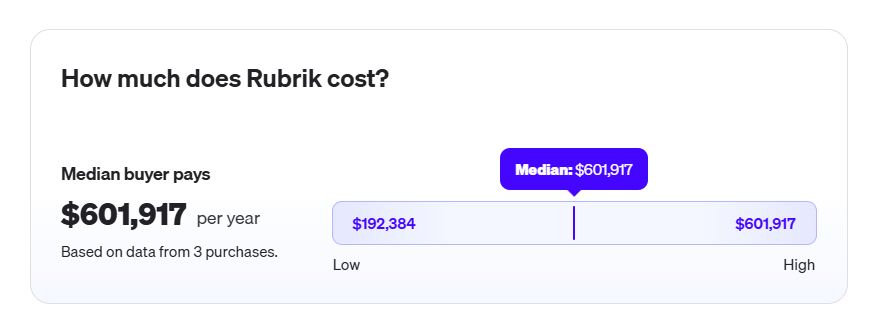
According to 3rd party data from Vendr, based on 3 purchases that they’ve handled for Rubrik, the median buyer pays $601,917/year, with the lowest one being $192,384/year.
Rubrik Cloud Value Pros & Cons
✅ Cloud DR services that guarantee clean recovery using immutable, air-gapped, zero-trust backup vaults.
✅ Strong ransomware-specific recovery workflows, including clean rooms and isolated recovery environments.
✅ Unique identity recovery coverage (Okta, AD, Entra ID) that most DR platforms completely ignore.
❌ Focuses on data and identity security more than full infrastructure-as-code recovery, so cloud environment reconstruction still relies on external IaC tools.
❌ Enterprise pricing and security scope may be excessive for teams that only need basic VM-level disaster recovery.
Ensure fast and automated recovery before it’s too late with ControlMonkey
Outages don’t fail businesses because data is lost. They fail because infrastructure cannot be rebuilt fast enough, accurately enough, or completely enough.
That’s the uncomfortable truth most disaster recovery strategies ignore.
When DNS is broken, identities are misconfigured, routing rules are missing, SaaS policies are gone, and nobody knows what the last working state looked like, data backups become irrelevant.
You may still have your data, but you’ve lost the ability to operate.
This is where ControlMonkey fundamentally changes what “cloud disaster recovery” means.
While the rest of the market is still trying to protect databases and storage volumes, ControlMonkey protects the thing that actually runs your business: your infrastructure configuration.
Every rule, permission, route, dependency, and integration that makes your cloud environment function is continuously captured, versioned, and recoverable.
Not partially. Not manually. Not someday. Always.
ControlMonkey removes the two biggest risks in disaster recovery:
- Uncertainty: Not knowing what existed or what was last working.
- Slowness: Not being able to restore it before the business feels real damage.
With automated (daily) snapshots, every environment becomes a living time machine.
You always have a known-good state. You always have a rollback point. And you never depend on fragile scripts, outdated runbooks, or tribal knowledge to rebuild your cloud from memory.
When disaster strikes, ControlMonkey doesn’t give you tasks. It gives you outcomes:
- One click to restore infrastructure.
- Automatic dependency handling.
- Zero guesswork.
- Zero firefighting.
- Zero reconstruction from scratch.
ControlMonkey isn’t the best cloud disaster recovery solution because it backs up more data. It’s the best because it protects everything that makes the cloud work.

A 30-min meeting will save your team 1000s of hours
A 30-min meeting will save your team 1000s of hours
Author