
Your cloud disaster recovery plans can fail – not because of data loss, but because critical infrastructure gets overlooked. You have your data backups in place but data backups alone don’t guarantee disaster recovery. Your data may be restored while critical cloud infrastructure, network, identity, and security configurations remain unavailable – putting SLAs and business continuity at risk.
A resilient disaster recovery plan must protect both data and configuration, with tested recovery points, RTOs, RPOs, and recovery workflows. Frameworks like SOC 2 also require organizations to demonstrate reliable, repeatable recovery – not just a plan on paper.
This is the configuration recovery gap ControlMonkey is built to close. As a Cyber Resilience Platform for Cloud Configuration Disaster Recovery, ControlMonkey makes the configuration behind cloud operations recoverable across cloud infrastructure, identity, network, observability, SaaS, and third-party systems.
TL;DR
- Data backups alone aren’t disaster recovery – your cloud, identity, network, security, and SaaS configurations need to be recoverable too.
- Define recovery time and recovery point objectives (RTO/RPO) for configuration, not just for data.
- Version and snapshot your configuration continuously, so you always have a known-good state to roll back to.
- Automate DR drills – including unannounced ones – instead of relying on runbooks nobody has tested recently.
- Configuration drift quietly erodes recovery readiness even when your backups look fine – catch it before it blocks a recovery.
- Validate recovery through testing, not assumption, especially where compliance frameworks require proof.
- ControlMonkey strengthens disaster recovery by continuously protecting and versioning critical configurations, helping teams restore known-good states and improve configuration resilience.
Why Cloud Disaster Recovery Plans Fail Without Infrastructure Recovery?
Cloud disaster recovery plans fail when they restore data but not the infrastructure and configuration required to run it. Applications depend on networks, DNS, load balancers, identity, security policies, and other cloud configurations. If these components cannot be restored to a known-good state, data may be available while services remain down.
Effective cloud disaster recovery therefore requires both data recovery and configuration recovery to meet RTOs, maintain business continuity, and ensure recovery readiness.
Unmanaged and Undocumented Cloud Resources
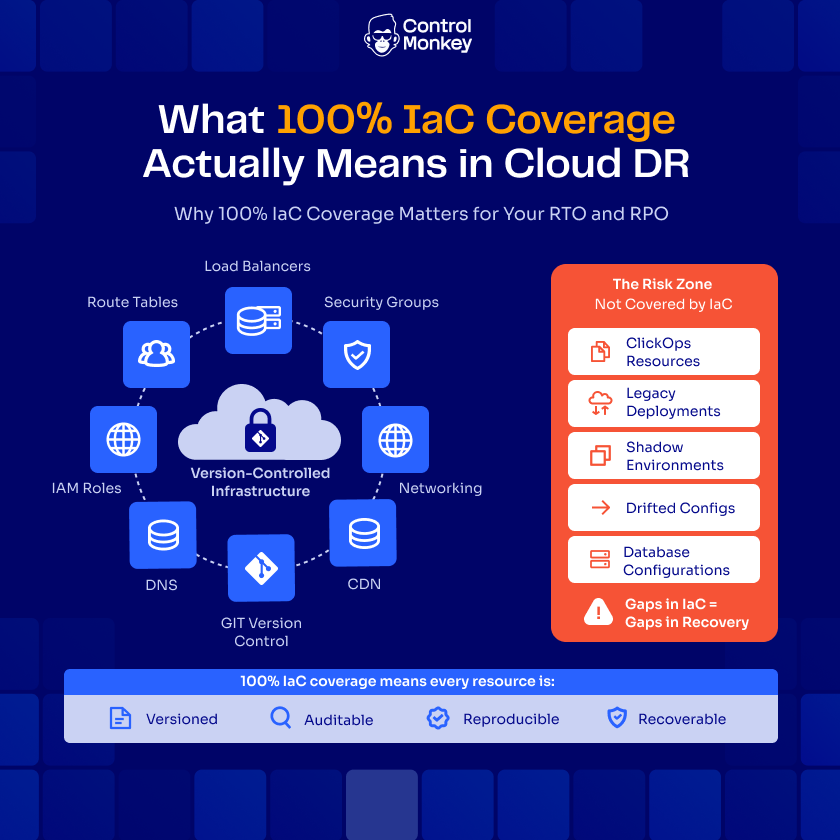
Recovery starts with knowing what actually existed. ControlMonkey continuously discovers cloud resources and third-party configurations – including resources managed and unmanaged by IaC – so teams can identify what is protected, what is recoverable, and where recovery gaps remain.
Slow Recovery and Downtime
Fragmented runbooks and scattered documentation can stall cloud-based disaster recovery efforts. Searching multiple knowledge bases for the latest script or code snippet wastes time you don’t have. Meanwhile, customers experience unavailability, revenue drops, and your reputation takes a hit.
Standardizing a single repository for processes and configurations accelerates recovery and reduces confusion.
Loss of Control
In cloud disaster recovery scenarios, environment drift can be disastrous. One environment might have the newest security rules, while another still has outdated policies. Aligning these under pressure, especially across multiple regions, is error-prone.
Enforcing infrastructure as code (IaC) from the start prevents these discrepancies, but only if your team diligently updates IaC files whenever a change occurs.
High Costs
Every minute you’re offline hits your bottom line. Beyond lost sales, you face potential SLA penalties and strain internal resources with emergency fixes.
Over time, a weak cloud disaster recovery strategy takes a bigger financial toll than investing in proper automation and documentation from the outset. Factoring in lost customer trust and additional overhead, it’s clear that DR shortcuts can turn into costly pitfalls.
The following table shows a summary of hidden DR costs:
| Cost Factor | Impact on Business |
|---|---|
| Revenue Loss | Missed transactions and sales, e.g., Google Cloud’s accidental deletion of pension accounts |
| SLA Penalties | Mandatory compensation for clients |
| Staff Overtime | Burnout, reduced morale |
| Emergency Consultants | Expensive, last-minute help |
Why Traditional Cloud Disaster Recovery Strategies Are No Longer Enough
Traditional cloud disaster recovery strategies are no longer enough because restoring data does not restore the full operating environment. Applications depend on interconnected cloud infrastructure and configurations across networking, DNS, CDNs, firewalls, load balancers, identity, and security services.
A complete cloud disaster recovery plan must combine data recovery with configuration recovery. Without a known-good state for critical configurations, replicated data may be available while applications remain inaccessible – extending recovery time, putting RTOs and SLAs at risk, and delaying business continuity.
Effective cloud disaster recovery best practices therefore protect and test both data and configuration to improve recovery readiness and overall cyber resilience.
Regulations also increasingly demand evidence that you can restore entire operations, not just data. Embracing a holistic cloud business continuity and disaster recovery plan ensures you can relaunch your applications swiftly and prove your readiness to auditors.
Governance & Policy Enforcement
To ensure your cloud disaster recovery plan is bulletproof, embed clear governance measures into your DevOps workflows. Here’s a streamlined approach:
- Define access & tagging standards: Implement role-based access control (RBAC), enforce tagging standards, and set usage policies to ensure only authorized users can spin up resources—minimizing shadow IT risks.
- Align with compliance frameworks: Integrate your policies with standards like SOC 2 to eliminate last-minute compliance scrambles during a disaster.
- Embed guardrails into your pipelines: Incorporate these rules directly into your pipelines to prevent unauthorized changes that could derail recovery efforts.
This structured strategy directly supports disaster recovery by maintaining a secure, compliant, and ready-to-recover infrastructure.
How to Run a DevOps-Ready DR Drill (Must in Your Cloud Disaster Recovery Plan)
Disaster recovery drills should go beyond checklist exercises. When executed as a DevOps playbook, they expose hidden infrastructure gaps and validate whether your environment can actually be rebuilt under pressure.
Following AWS resilience best practices, every drill should simulate real failure scenarios and validate full recovery-not just data restoration.
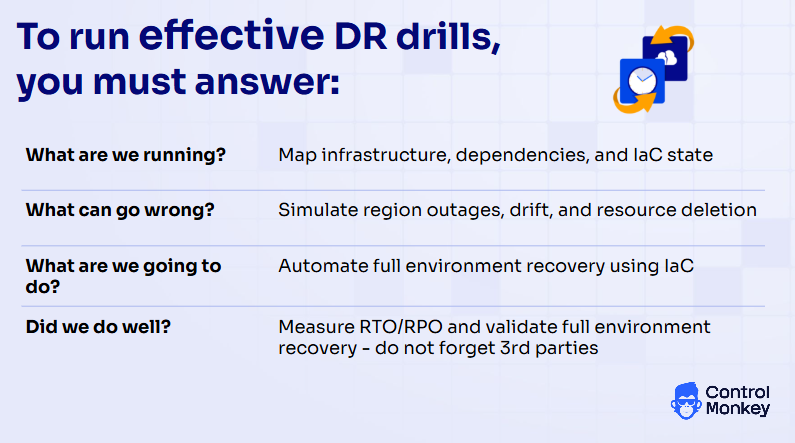
Follow these steps to ensure your simulations deliver actionable insights:
Pick a realistic failure scenario
Simulate real-world incidents such as region outages, deleted infrastructure, or configuration drift-not just planned failovers.
Main question to ask yourself: What are we running?
Run a blind test under real conditions
Execute unannounced drills to mimic production pressure and reveal gaps in automation, access, or documentation.
Main question to ask: What can go wrong?
Validate full environment recovery
Ensure your infrastructure (networks, permissions, services) can be rebuilt from scratch using IaC – not just restored from backups.
Main questions to ask:
- Did we do a good enough job?
- Do I know my RTO and RPO for XXX?
Analyze the gaps
Identify failures across runbooks, manual steps, missing configurations, or drift between environments.
Automate the fix
Convert manual recovery steps into automated workflows, ensuring future incidents can be resolved quickly and consistently.
The final question to ask: How do we make sure this never happens again?
If your team cannot recreate your full environment from code during a drill, your cloud disaster recovery plan is not production-ready.
6 Best Practices for Cloud Disaster Recovery
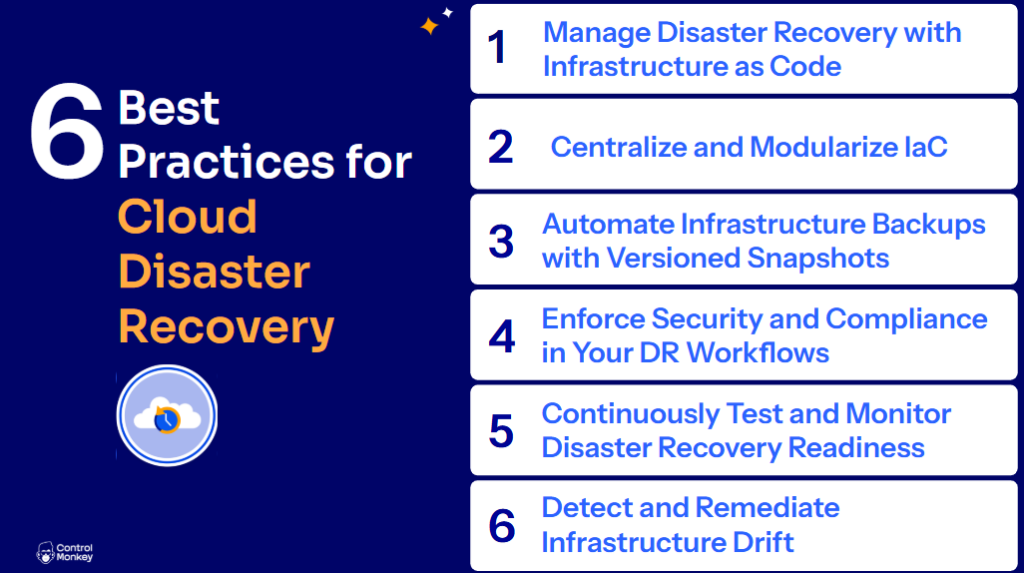
Effective cloud disaster recovery goes beyond backing up data or maintaining infrastructure code. A recovery plan also needs to protect the configurations that make your environment operational – from networking and security policies to identity, DNS, and cloud services.
These cloud disaster recovery best practices help teams maintain trusted recovery points, reduce configuration drift, test recovery workflows, and restore critical environments to a known-good state when an incident occurs.
Keep Cloud Configuration Recoverable and in Sync
Infrastructure as code (IaC) provides a repeatable way to provision cloud infrastructure, but your disaster recovery plan should not assume that the live environment always matches the code. Manual changes, configuration drift, and resources outside IaC can create gaps between the expected and actual cloud state.
Keep IaC version-controlled in Git repositories such as GitHub, GitLab, Azure DevOps, or Bitbucket, and combine it with continuous configuration versioning and drift detection. This gives teams visibility into what changed and helps maintain reliable, known-good recovery points.
ControlMonkey extends this approach by protecting cloud configuration alongside IaC, helping teams keep cloud and code aligned and restore trusted configurations when an outage, misconfiguration, or accidental change occurs.
Backup & Recovery Strategy: Create Versioned Configuration Recovery Points
Your DR strategy needs a recoverable history of how the environment was actually configured – not only the code intended to create it. Continuously capture configuration states so teams can identify the last known-good version before an outage, malicious change, failed deployment, or accidental misconfiguration.
ControlMonkey continuously captures configuration snapshots and maintains versioned recovery points, giving teams a recovery-ready configuration history they can use to understand what changed and restore trusted states.
Protect Configuration Outside IaC
IaC is an important part of cloud recovery, but it is not a complete record of the operating environment. Manual changes, SaaS configurations, third-party systems, API-driven changes, and drift can all exist outside code. A resilient DR strategy needs to discover and protect these configurations too.
ControlMonkey discovers configuration across managed and unmanaged resources, creating recoverable configuration history even where IaC coverage is incomplete.
Where to Store Your Backup Configuration
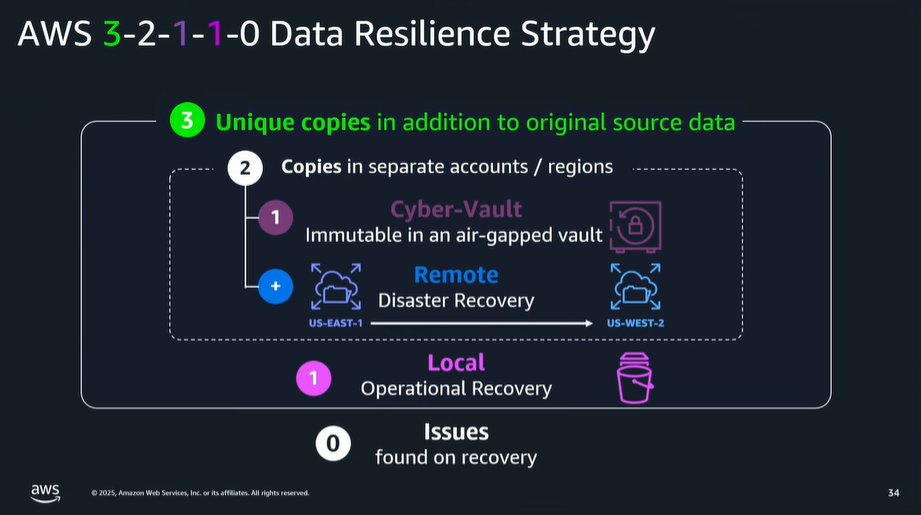
According to the AWS Resilience Framework, organizations should follow the 3-2-1-1-0 backup strategy to ensure systems can recover from outages, misconfigurations, and cyber incidents.
This model ensures your infrastructure and configuration backups are distributed, isolated, and verifiable:
- 3 Copies of Data
Maintain your primary configuration and at least two backup copies to avoid single points of failure. - 2 Different Storage Types
Store backups across different media (e.g., Git and object storage like S3) to reduce dependency on a single system. - 1 Off-Site Copy
Keep at least one copy in a separate region or account to protect against regional or account-level failures. - 1 Immutable or Air-Gapped Copy
Use immutable storage (e.g., S3 Object Lock) or isolated environments to prevent tampering, deletion, or ransomware impact. - 0 Errors (Verified Backups)
Regularly test restores to ensure your backups are valid and your environment can actually be rebuilt.
For Cloud teams, this means your IaC, state files, and configurations must be versioned, replicated across regions and accounts, and continuously validated not just stored.
Security & Compliance – Audit Your Disaster Recovery Operations
During cloud-based disaster recovery, you’ll likely handle privileged operations, such as provisioning VMs, configuring firewalls, and more. Restrict who can perform these tasks and log each operation meticulously.
By incorporating proactive policies into your regular DevOps workflow, you ensure every configuration is compliant from the start. This proactive setup means that when disaster strikes, your recovery blueprint is already secure and audit-ready—eliminating the need for real-time validation under pressure.
Continuously Test Your Disaster Recovery Plan
Include DR tests in your CI/CD pipeline, periodically simulating region failovers or losing certain services to mimic real cloud business continuity and disaster recovery scenarios.
Track metrics like recovery time objective (RTO) and recovery point objective (RPO) to see if you’re meeting your targets. Automated alerts and dashboards will highlight performance gaps, giving you time to fix them before a disaster strikes.
Detect and Remediate Infrastructure Drift
For resources managed via IaC, it is crucial that your code accurately mirrors your live environment. Any discrepancies – referred to as “drift” – could result in your recovery process provisioning an infrastructure that differs from the original setup.
Implement robust drift detection and remediation measures. Either reconcile the real-world configuration to match your code or update your code to reflect the actual environment, ensuring your disaster recovery remains precise and reliable.
How ControlMonkey Improves Cloud DR and Cloud Configuration Recovery
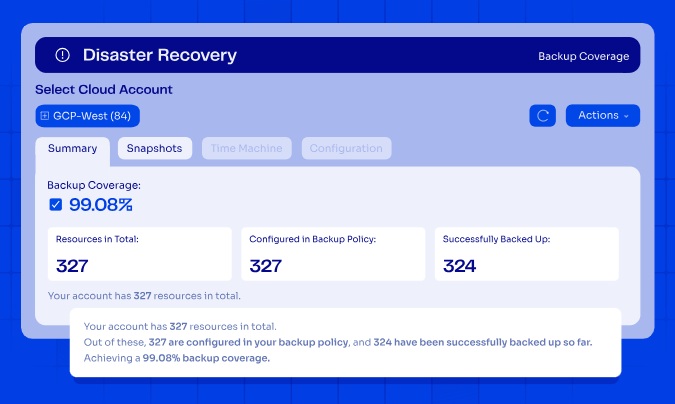
Traditional backup restores data. ControlMonkey restores the configuration required to operate.
ControlMonkey is a Cyber Resilience Platform for Cloud Configuration Disaster Recovery. It continuously discovers, snapshots, compares, and recovers critical configuration across cloud infrastructure, identity, network, observability, SaaS, and third-party systems.
Instead of relying on manual rebuilds, incomplete IaC, scripts, or tribal knowledge during an incident, teams have a versioned history of their configuration and known-good recovery points they can restore from.
ControlMonkey follows a simple recovery model: Discover → Snapshot → Recover → Review & Govern.
Discover Cloud and SaaS Configurations
Identify cloud resources and third-party configurations across the operating environment, including resources managed and unmanaged by IaC. This helps teams understand what actually exists and identify gaps in recovery coverage.
Create Versioned Configuration Snapshots
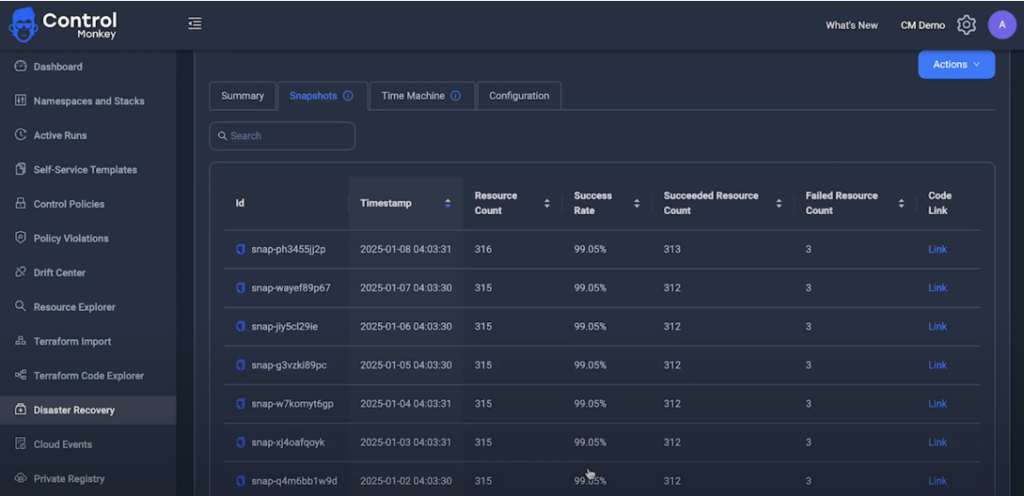
Continuously capture configuration states as versioned recovery points, creating a recovery-ready history of what actually existed. Teams can understand what changed over time and identify a previous known-good state when recovery is needed.
In short, with ControlMonkey, you move from reactive firefighting to proactive management-turning disaster recovery into a seamless, automated process that keeps your business running no matter what challenges arise.
As a SaaS platform, our availability depends heavily on Cloudflare and our network configuration. Traditional backup solutions didn’t address how we would recover routing policies or edge configurations in the event of an incident. ControlMonkey gives us confidence that our Cloudflare configurations are backed up and recoverable.
Recover to a Known-Good State
Restore individual resources, configurations, or full environments from a known-good state. Dependency-aware recovery reduces manual effort and human error when teams need to restore critical configuration during an incident.
Review and Govern Recovery Readiness
Give cloud and security teams visibility into what is protected, what changed, what can be restored, and where disaster recovery gaps remain. This makes configuration recovery readiness measurable rather than assumed.
The result is not simply better backup coverage. It is measurable configuration recovery readiness – helping teams reduce manual recovery effort and restore the operating environment when data recovery alone is not enough.
Platforms like ControlMonkey’s cyber resilience platform support this by scanning your cloud environment, capturing daily configuration snapshots, and making it possible to roll back to a known-good state when something breaks – across AWS, Azure, GCP, and the identity and SaaS platforms your business depends on.

As a SaaS platform, our availability depends heavily on Cloudflare and our network configuration. Traditional backup solutions didn’t address how we would recover routing policies or edge configurations in the event of an incident. ControlMonkey gives us confidence that our Cloudflare configurations are backed up and recoverable.

Key Takeaways for Building a Strong Cloud Disaster Recovery Plan
Neglecting to plan for infrastructure restoration leads to prolonged outages, lost revenue, and eroded brand trust. A comprehensive cloud and disaster recovery framework weaves governance, automation, and regular testing into daily operations. Tools like ControlMonkey refine your DR stance, coupling drift alerts with version-controlled backups so that you can rebuild entire environments fast.
Ultimately, true resilience isn’t merely safeguarding data; it’s about reassembling every piece of your cloud puzzle-no matter how complex-so your users stay connected and your organization continues to thrive, even in the face of the unexpected. Learn how ControlMonkey automates cloud disaster recovery
If you’re ready to optimize your cloud disaster recovery plan, consider integrating ControlMonkey for a proactive, automation-first approach.

A 30-min meeting will save your team 1000s of hours
A 30-min meeting will save your team 1000s of hours
Author