
Most organizations would say they are investing more in cyber resilience than ever before. They have better security controls, stronger identity protection, more sophisticated backup systems, incident response plans, and increasingly detailed business continuity processes.
And yet, when I speak with CIOs, CISOs, and cloud leaders about recovery, I often find the same gap. Everyone can explain what they are protecting. The conversation becomes much less clear when you ask what actually has to happen for the business to operate again.
That is the difference between having a collection of resilience technologies and actually being cyber resilient.
Cyber resilience is not simply the ability to prevent an attack. It is the ability to keep critical parts of the business operating through disruption and to recover the rest quickly enough that a technical incident does not become a prolonged business event.
The problem is that the systems businesses depend on have changed dramatically. Recovery now stretches across data, applications, cloud infrastructure, identity, networking, security controls, SaaS platforms, observability, and third-party services. Most organizations have tools protecting each of those areas, but very few have a complete view of how they come back together.
That fragmentation is becoming one of the biggest blind spots in cyber resilience.
TL;DR: What Is Cyber Resilience?
- Cyber resilience is the ability to keep critical business operations running and recover when a cyber incident succeeds despite preventive controls.
- Cyber resilience goes beyond cybersecurity. Cybersecurity focuses on preventing and containing attacks; cyber resilience focuses on what happens when prevention is not enough.
- Recovery has to cover more than data. Modern businesses depend on cloud infrastructure, identity, networking, SaaS, security, observability, and configuration.
- A strong cyber resilience strategy starts with the business. Define the Minimum Viable Business, map its dependencies, and understand what must recover first.
- ControlMonkey helps close the configuration recovery gap. It makes cloud and SaaS configurations recoverable with continuous discovery, versioned snapshots, change history, and recovery from known-good states.
What Cyber Resilience Actually Means
NIST defines cyber resiliency as the ability to anticipate, withstand, recover from, and adapt to adverse cyber conditions.
I like that definition because it makes one thing very clear: prevention is only one part of the job.

“The ability to anticipate, withstand, recover from, and adapt to adverse conditions, stresses, attacks, or compromises on systems that use or are enabled by cyber resources.”

For years, much of the security conversation focused on stopping the incident. Better endpoint protection, stronger access controls, segmentation, vulnerability management, detection, and response all reduce the probability and impact of an attack. They remain essential.
But no security architecture stops everything.
A ransomware attack may get through. An administrator may make the wrong change. A compromised identity may be used to alter a policy. An automation workflow may push a bad configuration across hundreds of resources. An AI agent with legitimate permissions may make a change nobody expected.
Cyber resilience starts from that uncomfortable assumption.
Something will eventually go wrong. What matters then is whether the organization can continue operating and recover.
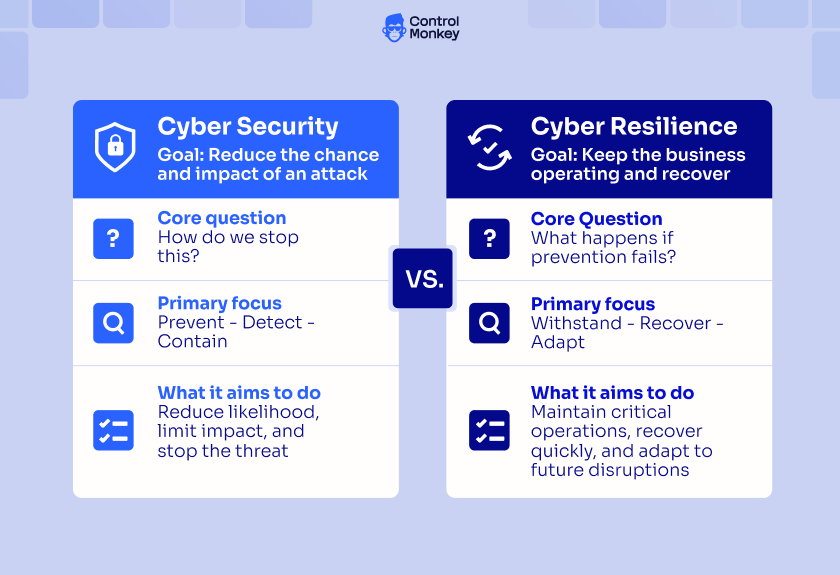
Cyber Resilience vs. Cybersecurity: What’s the Difference?
I often see cybersecurity and cyber resilience used almost interchangeably. They should not be.
Cybersecurity asks how we reduce the likelihood and impact of an attack. Cyber resilience asks what happens to the business when prevention is not enough.
That sounds like a small distinction, but operationally it is enormous. Security teams can successfully contain an attacker and the business can still remain offline for days. A backup team can successfully restore a database and customers can still be unable to access the application.
The security incident may technically be over while the business incident is only beginning.
A mature cyber resilience strategy has to account for that second half of the problem.
Cyber Resilience Is Fragmented Today
This is the pattern I see repeatedly in conversations with enterprises.
The data team has a backup strategy. The security organization has incident response. The identity team has recovery procedures. Cloud teams maintain infrastructure and sometimes Infrastructure as Code. Network teams manage DNS, routing, CDN, firewalls, and load balancers. SaaS applications have their own administrators, APIs, policies, and configuration models.
Individually, many of those areas may be well protected.
The problem appears when you try to recover the business service that depends on all of them.
Take a customer-facing application. Its data may sit in a protected database, but the service may also depend on AWS or Azure configuration, an Okta or Microsoft Entra ID policy, Cloudflare DNS, network rules, certificates, secrets, Datadog monitors, SaaS integrations, and several third-party services.
During normal operations, those dependencies are easy to forget because they simply work.
During recovery, they become the recovery plan.
This is why I increasingly think about cyber resilience as a dependency problem. It is not enough to know that individual systems are protected. You need to know what a critical business service depends on and whether those dependencies can be recovered together.
Restoring Data Does Not Restore the Business
Data backup remains fundamental to disaster recovery. If a ransomware attack encrypts a database or critical files are destroyed, a trusted copy of that data is essential.
But I have started asking a different question in recovery discussions: what happens after the data is restored?
- Imagine the database has been recovered, but production identity policies were deleted. The data is there, but employees or customers cannot authenticate.
- Or the application has been restored, but DNS configuration is wrong. The system is running, but nobody can reach it.
- Or infrastructure is back online, but firewall policies, Cloudflare configuration, certificates, observability monitors, or SaaS integrations are still damaged. Technically, pieces of the environment have recovered. Operationally, the business has not.
That is the part of disaster recovery that many organizations still underestimate.
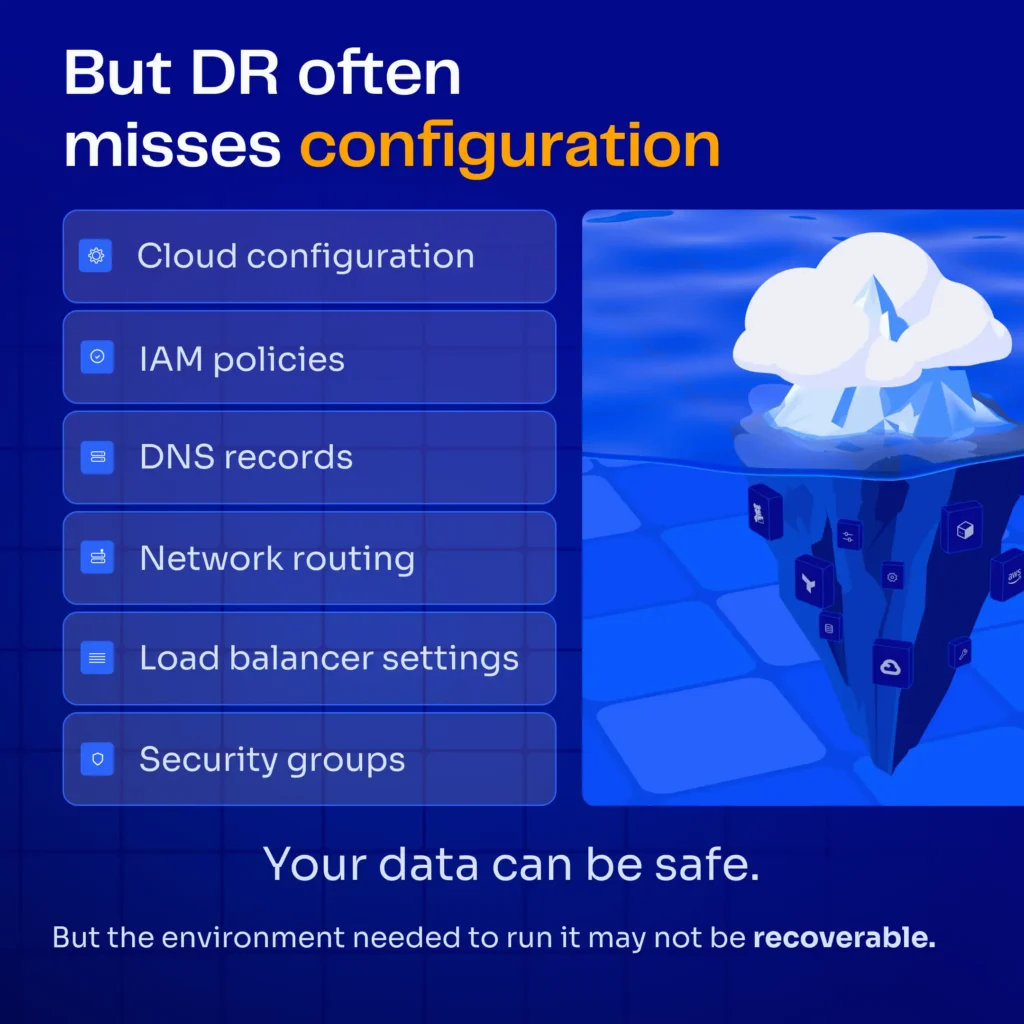
Modern applications do not run on data alone. They run on a combination of data and configuration.
Gartner’s 2026 Hype Cycle for Backup and Data Protection Technologies
Gartner’s 2026 Hype Cycle for Backup and Data Protection Technologies reflects this expansion through its emerging Cloud Application Infrastructure Recovery category. Gartner predicts that by 2030, 35% of organizations will use Cloud Application Infrastructure Recovery solutions to complement Infrastructure as Code-based disaster recovery orchestration, up from less than 5% in 2026.
The recovery model is expanding because the operating environment has expanded.
The Hidden Configuration Layer
Configuration is one of the least visible parts of cyber resilience because, when everything is working, nobody thinks about it.
Configuration determines who can access a system, where traffic goes, which security policies are enforced, how cloud resources behave, how applications communicate, and whether engineers can see what is happening during an incident.
It is distributed everywhere: AWS, Azure, Google Cloud, Okta, Microsoft Entra ID, Cloudflare, Datadog, networking platforms, security tools, SaaS applications, and dozens of other systems.
Some of that configuration may be managed through Infrastructure as Code. Some will not be.
Terraform Does Not Mean Everything Is Recoverable
This is another assumption I often challenge in conversations with cloud teams. When someone tells me their infrastructure is recoverable because they use Terraform, my next question is simple: does Terraform represent everything that exists right now?
Usually, the answer is more complicated.
There are console changes. Drift. SaaS settings. APIs. Scripts. Security tools. Third-party services. Configuration changed by teams outside the infrastructure organization. Increasingly, there are automated and AI-assisted workflows changing environments as well.
Infrastructure as Code is extremely valuable, but it does not automatically mean the complete operating state is recoverable.
That difference is the recoverability gap: the distance between what an organization believes it can recover and everything that is actually required to resume operations.
How to Build Cyber Resilience: Start With the Minimum Viable Business
When we talk about disaster recovery, teams naturally start listing applications and infrastructure. I think that is often the wrong starting point.
The first question should be:
What does the business absolutely need in order to operate?
This is the idea behind the Minimum Viable Business. If a serious cyber incident forced the company to operate with only a portion of its normal systems, what customer journeys, revenue processes, internal capabilities, and regulatory functions would have to come back first?
I have seen this question change the recovery conversation completely because it forces technical teams and business leaders to make decisions together. Suddenly, recovery is no longer about which application is labelled “critical.” It becomes about which business capability cannot be unavailable for six hours, twelve hours, or two days.
Once that is clear, you can work backwards.
- What data does that capability need?
- Which infrastructure supports it?
- Which identities need access?
- Which network paths need to function?
- Which SaaS systems and third parties are involved?
- Which monitoring and security controls need to be available?
This is where the real recovery architecture starts to emerge.
Cyber Resilience Requires Recovery Readiness
Once critical dependencies are mapped, the next step is understanding whether they are actually recoverable.
For data, most mature organizations already ask good questions. Where are the backups? How frequently are they taken? What is the retention period? What is the RPO? What is the RTO? Have we tested restoration?
The same discipline needs to be applied to configuration.
Do we have a copy of the current configuration? Do we have historical versions? Can we determine what changed before an incident? Can we identify the last known-good state? Can we restore an individual resource or policy without reconstructing it manually?
Those questions sound basic. In practice, many organizations still rely on documentation, scripts, tickets, repositories, and institutional knowledge to rebuild parts of the operating environment.
That can work during normal operations, when engineers have time to investigate.
During a major incident, it is a very different proposition.
If configuration cannot be restored predictably, the organization does not really know its recovery time.
The Last Known-Good State Matters
One of the hardest parts of recovery is often not restoring something. It is knowing what to restore it to.
If an identity policy has been modified several times over the previous week, which version is safe? If a routing rule was corrupted, when did the problem begin? If a cloud resource was changed through an API or console, what did the working configuration look like before the incident?
This becomes even more important as cloud environments change faster.
Cloud environments change faster.
Automation means more changes. AI-assisted workflows will mean more changes again. The speed of change is increasing, but most organizations’ ability to reconstruct historical configuration has not increased at the same rate.
Recovery therefore needs a reliable history of known-good states.
During an incident, engineers should be able to understand what changed, compare the current environment with an earlier state, and recover the right version. They should not have to perform digital archaeology under pressure.
Test the Business Recovery Path
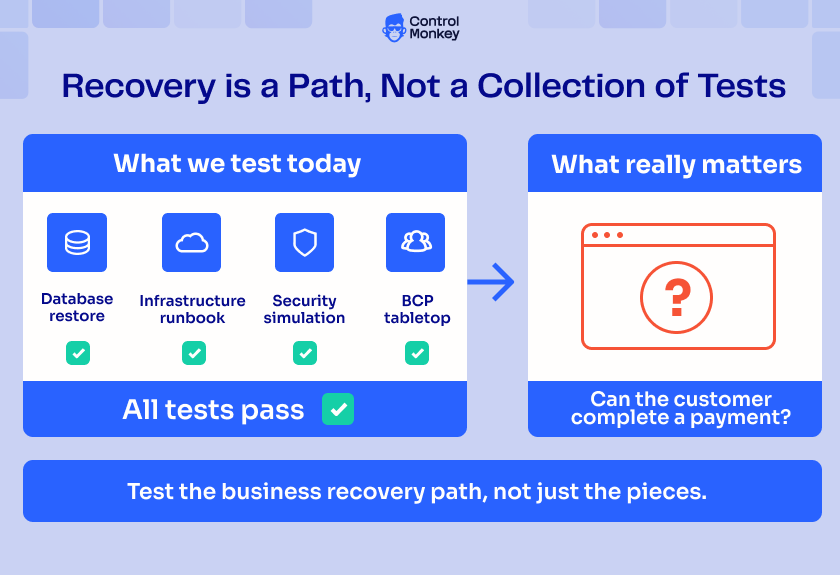
Another pattern I see is organizations testing pieces of recovery independently.
The database team performs a restoration test. Infrastructure teams test a runbook. Security runs an incident simulation. Business continuity teams conduct tabletop exercises.
Those exercises are valuable, but the harder test is whether the dependencies work together.
If the business says a customer payment service must recover within four hours, test what that really means. Can the data be recovered? Can customers authenticate? Is DNS correct? Are network policies available? Are secrets and integrations intact? Can the operations team monitor the restored environment?
A backup restore test answers an important question.
It does not answer the whole question.
The organization needs to test whether the business capability can come back.
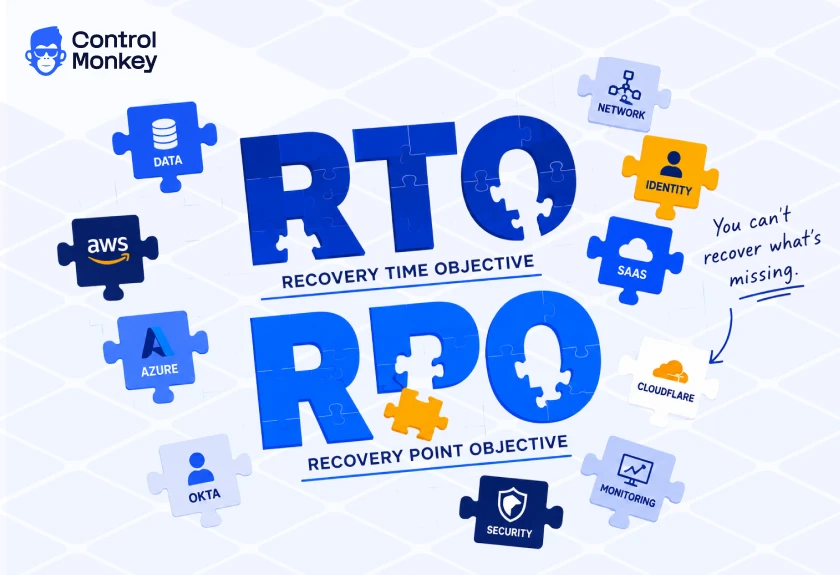
RTO and RPO Need to Include Configuration
This leads to one of the most important changes I believe organizations need to make in their cyber resilience programs.
They need to start thinking about RTO and RPO for configuration.
If your database can be restored to a five-minute recovery point but the identity, networking, and SaaS configuration around it has to be rebuilt from three-month-old documentation, the database RPO tells only part of the story.
The same is true for recovery time.
If data comes back in one hour but engineers spend another twelve hours reconstructing the configuration required to operate, the real business RTO is not one hour.
This is why recovery readiness cannot be measured only by backup success.
Leaders need visibility into what is protected, what changed, what can actually be restored, and where the recovery gaps remain.
Configuration Has to Become Recoverable
This is the problem we are focused on at ControlMonkey.
We call the category Cloud Configuration Disaster Recovery: making the configuration layer behind modern cloud operations recoverable in the same way organizations have spent years making data recoverable.
ControlMonkey continuously discovers cloud and SaaS configurations across infrastructure, identity, network, observability, and third-party systems. It captures versioned configuration snapshots, provides historical change context, and helps teams restore supported configurations from previous known-good states.
This is not a replacement for data backup, endpoint security, identity protection, or incident response.
Those layers remain essential.
The point is that restoring the data is only useful if the operating environment around it can also recover.
Cyber resilience has to connect those layers.
Cyber Resilience Is Ultimately a Business Question
The cyber resilience market contains a lot of technology. Backup. Security. Identity. Cloud. Network. SaaS protection. Incident response. Business continuity.
The mistake is assuming that having all of those tools automatically creates resilience.
It does not. The test is much simpler.
When something significant breaks, do you know what the business needs first? Do you know every dependency required to deliver it? Can you determine what changed? Can you recover the data? Can you recover the configuration around it? And have you tested whether those pieces actually bring the business back?
That is cyber resilience. Everything else is preparation for that moment.

A 30-min meeting will save your team 1000s of hours
A 30-min meeting will save your team 1000s of hours
Author