For more than two decades, I’ve worked with partners and customers across cybersecurity and cloud. Most of that time, the focus was clear: build stronger environments, reduce risk, detect threats faster and prevent disruption.
That work is still essential.
But the market is changing. Customers know that prevention will never be perfect, and the risk no longer comes only from attackers. Employees, automation and increasingly AI agents are all making changes across cloud and SaaS environments.
So the question for partners is changing too.
It is no longer only: How do we stop something from happening?
It is also: How quickly can the customer recover when something does?
I remember walking around AWS re:invnet in 2025 Looking back at photos from that event, what strikes me most is how much the cloud conversation has changed since then.
Back then, we spent most of our time talking about what happens before an incident.
Today, partners need to spend much more time on what happens after.

Protection Is Only Half of the Resilience Conversation
Security partners have become very good at building the pre-incident stack.
We help customers deploy endpoint protection, identity security, network security, CNAPP, SIEM, MDR and dozens of other controls designed to reduce the probability and impact of an attack.
But the environment we are protecting has changed.
It is no longer modified only by a small infrastructure team following a predictable change process. Cloud and SaaS environments are constantly being changed by developers, platform teams, security teams, APIs, Infrastructure as Code, automation and increasingly AI-assisted workflows.
That changes the resilience problem.
A customer may have excellent protection and still experience a serious outage because somebody changed the wrong identity policy, deleted a network rule, modified a security configuration or pushed an incorrect change through automation.
There does not need to be an attacker. The operational outcome can be exactly the same.
Users cannot authenticate. Applications become unreachable. Security controls behave incorrectly. Engineers lose visibility. The business stops.
That is why cyber resilience can no longer mean only protecting the organization from external threats. It also has to mean protecting the organization from the consequences of its own change.
And when those changes happen, prevention is no longer the question.
Recovery is.
The Channel Is Already Moving Toward Resilience
This is not only something I see in conversations with partners. The broader channel is moving in the same direction.
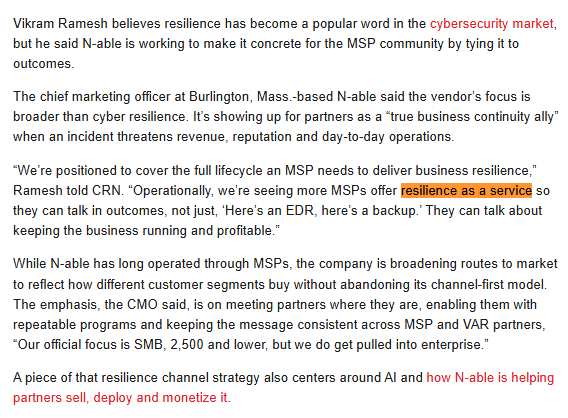
CRN reported in 2026 that N-able is seeing more MSPs build resilience-as-a-service offerings, shifting the customer discussion away from individual technologies such as endpoint protection or backup and toward the bigger outcome: keeping the business running.
Why does that matter?
Because N-able is not an isolated example. It is one signal of a wider change in how partners are positioning themselves. The opportunity is moving from selling individual protection technologies to helping customers own a business outcome: how prepared they are for disruption, and how quickly they can recover when it happens.
That is a much more strategic conversation for a partner. It creates room for services, assessments, ongoing recovery-readiness work and a deeper relationship with the CIO and CISO.
For the channel, that should be an important signal.
Customers are not asking only for more protection. They increasingly need someone who can help them understand what happens when protection is not enough.
The Bigger Partner Opportunity Starts After the Incident
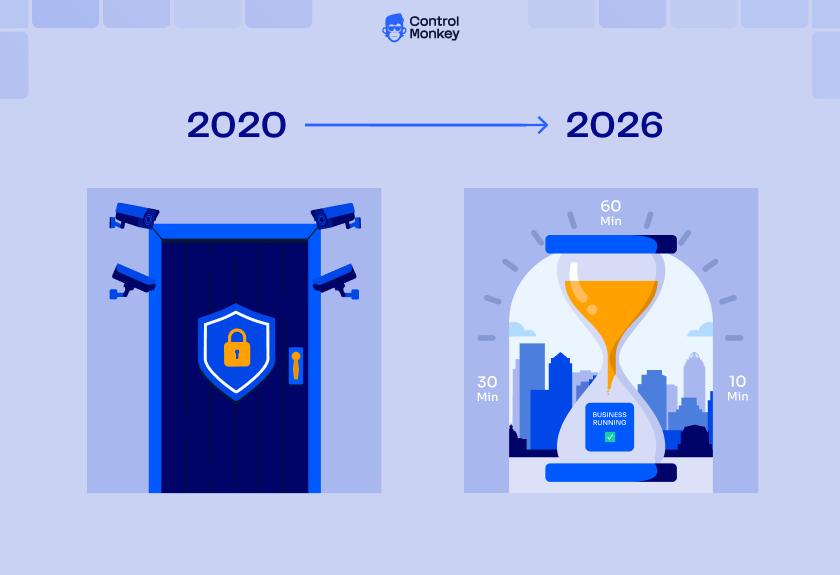
For years, the partner conversation has naturally focused on the pre-incident environment.
Where are the vulnerabilities? Which endpoint platform should we deploy? How should identity be secured? What should we monitor? Which security controls are missing?
Those are still the right questions.
But I believe the next generation of partners will become just as good at designing the post-incident environment.
If a critical service went down tomorrow, what would need to come back first? Which applications does the business actually need to operate? Which identity, network, security and cloud configurations have to exist before those applications become usable again?
What is protected? What is not? What was the last known-good state? What still has to be rebuilt manually?
And perhaps the most important question: has anyone actually tested those assumptions?
That takes the partner far beyond product resale.
It opens conversations around recovery assessments, business continuity, configuration protection, recovery architecture, recovery testing, managed resilience services and ongoing recovery-readiness reviews.
More importantly, it moves the partner closer to the business.
Instead of talking only about the security stack with the security team, partners can sit with the CIO, CISO, infrastructure leaders and application owners and ask a much more strategic question:
If something serious happens tomorrow, how quickly can we get the business operating again?
That is a very different relationship.
Recovery Has Become More Complicated Than Backup
A critical application today may depend on AWS or Azure, Okta or Entra ID, Cloudflare, Palo Alto Networks, GitHub, Datadog and dozens of other cloud and SaaS services.
Each one contains configuration the business depends on. Identity controls access. Networks keep applications reachable. Security policies determine what is allowed. Observability helps teams understand what is happening.
Restoring the database does not restore any of that.
A company can recover its data and still have employees unable to authenticate, applications unreachable or security policies blocking access. That is why data recovery alone is not business recovery.
Gartner’s 2026 Hype Cycle for Backup and Data Protection Technologies reflects this shift. Gartner predicts that by 2030, 35% of organizations will use Cloud Application Infrastructure Recovery solutions alongside IaC-based DR, and 70% will prioritize identity-system recoverability alongside preventive IAM controls.
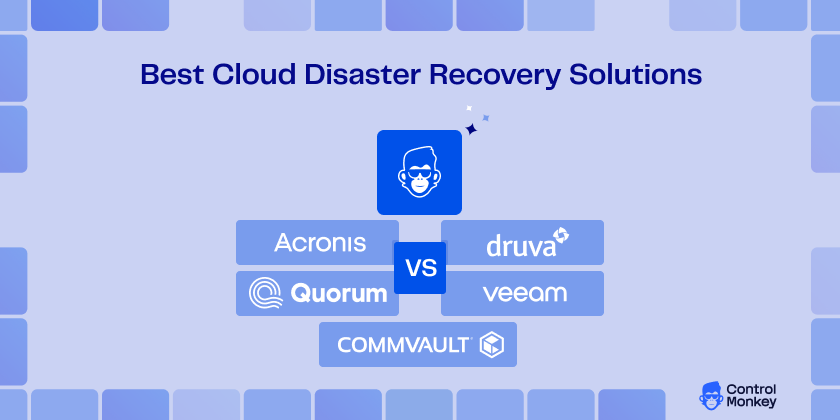
That emerging category is exactly where ControlMonkey is positioned. Gartner named ControlMonkey a Sample Vendor for Cloud Application Infrastructure Recovery.
The direction is becoming clear: recovery now has to account for much more than data and workloads.
AI Makes the Recovery Question More Urgent
I think AI will accelerate this shift.
Most of the cybersecurity conversation around AI focuses on how attackers will use it. But partners also need to think about AI as an operator.
AI agents are starting to interact with cloud infrastructure, identity systems, security tools and SaaS platforms. As they gain more permissions, they will be able to make more changes, much faster than a human operator.
That creates enormous productivity gains. It also changes the risk model.
Preventive controls can define what an agent is allowed to do. They cannot guarantee that every allowed action will produce the right outcome. The risk may not be a malicious system, but a legitimate agent making the wrong decision with legitimate permissions.
The same principle applies to people and automation.
As more actors can change the environment, organizations need to know what changed, what the last trusted state was and how to recover when a legitimate action causes disruption.
The larger the change surface becomes, the more valuable recoverability becomes.
The Missing Layer Is Configuration
This is the part of the resilience problem we are focused on at ControlMonkey. Traditional data backup remains essential. ControlMonkey does not replace it.
But modern recovery also requires the configuration behind cloud infrastructure, identity, networking, security, observability and SaaS platforms to be recoverable.
ControlMonkey continuously discovers this configuration and captures versioned recovery points. That gives teams a history of what changed, visibility into previous known-good states and a way to restore critical configurations when an incident, mistake or unwanted change affects the environment.
For partners, however, the real opportunity is larger than the technology itself.
It creates a new conversation with the customer.
Instead of asking only, “Is your data backed up?”, partners can start asking:
- Is your identity environment recoverable?
- Are your network and security configurations protected?
- Can you see what changed before an outage?
- Can you identify your last known-good configuration?
- Which parts of the environment still depend on scripts, documentation or tribal knowledge?
- What is the real RTO once all of those dependencies are included?
Those questions expose gaps that traditional backup assessments often never see. They also give the partner somewhere meaningful to go next.
From Security Reseller to Resilience Partner
I have watched the channel reinvent itself several times throughout my career.
Partners moved from hardware resale into software. From on-premises infrastructure into cloud. From licenses into managed services. From individual security products into broader security architectures.
I believe cyber resilience is another one of those shifts.
The strongest partners will continue helping customers reduce the probability of an incident. But they will also help customers reduce the business impact when the incident happens.
That means looking beyond the pre-incident architecture and helping customers design the post-incident architecture: what must come back, in what order, from which trusted state and within what business timeframe.
For partners, this creates services, recurring revenue and a much more strategic relationship with the customer.
For customers, it answers the question that ultimately matters. Not whether every attack can be stopped.
Not whether every employee, automation workflow or AI agent will always make the right decision.
But whether the organization can recover when eventually one of them does not. Protection will always matter.
But the next partner opportunity is owning what happens after protection fails.

A 30-min meeting will save your team 1000s of hours
A 30-min meeting will save your team 1000s of hours
Author