
Veolia increased recoverable cloud coverage, reduced ClickOps, and established daily recovery points for critical cloud configuration.

By increasing recoverable infrastructure coverage and reducing ClickOps, we created a much stronger foundation for cloud resilience

About Veolia Germany
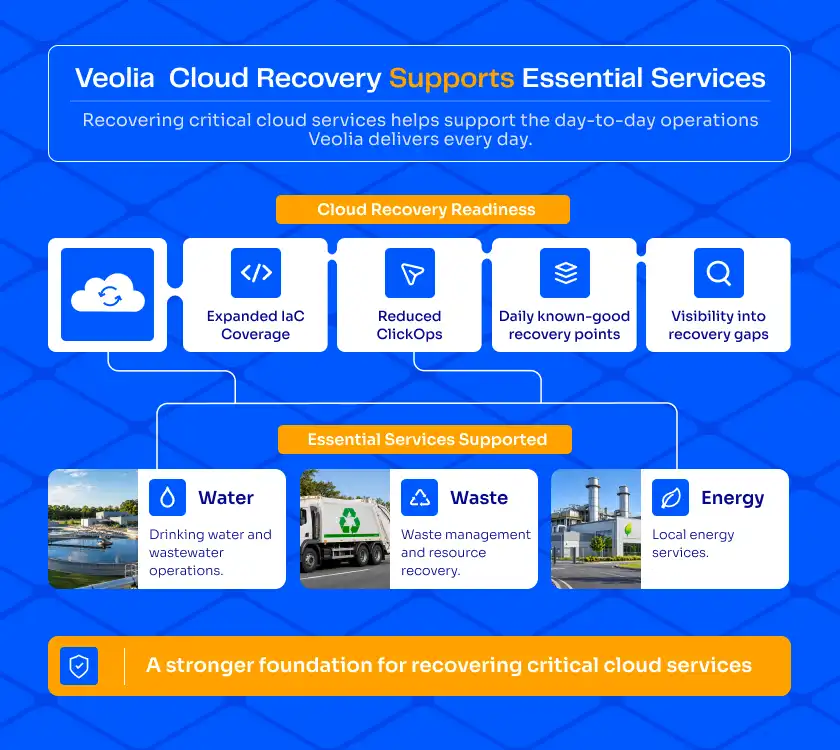
As a leading global provider of environmental services, Veolia works every day to promote environmental safety for the benefit of public health, as well as the competitiveness of industries and regions. With 215,000 employees working closely with local partners across five continents and cutting-edge technologies, the Group combats environmental pollution, reduces CO₂ emissions and regenerates resources by providing practical solutions that draw on its expertise in water and water technologies, waste management (including the disposal of hazardous waste) and local energy.
In 2025, Veolia supplied 110 million people with drinking water, treated wastewater for 97 million people, produced 45 million megawatt-hours of energy and processed 64 million tonnes of waste.
In Germany, Veolia and its subsidiaries employ around 12,000 people at approximately 250 locations.
In order to support our Veolia teams, they operate a mature cloud environment that supports critical business services.
The Cloud Infrastructure
The Infrastructure team had already established a robust Infrastructure-as-Code (IaC) practice and was using ControlMonkey to manage day-to-day cloud changes.
The next priority was resilience.
Veolia wanted to understand which parts of its cloud environment could be recovered consistently, reduce the uncertainty created by manual configuration changes, and protect resources that remained outside IaC.
By mapping its environment, expanding IaC coverage, reducing ClickOps, and introducing daily configuration recovery points, Veolia created a stronger foundation for recovering critical cloud services after accidental changes, configuration loss, or a cyber incident.
The Challenge: Making Cloud Recovery Scalable
Veolia had already developed an advanced cloud operating model. Changes were managed through established deployment workflows and IaC, with ControlMonkey helping teams validate and govern changes.
However, day-to-day automation and disaster recovery address different risks.
Even in a mature environment, some resources inevitably remain unmanaged, configurations can drift, and urgent changes may still be made manually. These gaps matter during recovery because critical cloud services depend on more than application data.
Security configurations, permissions, networking, storage settings, and other infrastructure components may also need to be restored before business services can operate.
Traditional backups protect data, but they do not necessarily preserve the full cloud configuration required to return the business to operation.
● Map the cloud resources and dependencies required for recovery
● Increase the share of production infrastructure covered by code
● Reduce manual changes outside approved workflows
● Protect configuration that remained unmanaged by IaC
● Maintain known-good recovery points
● Track progress in cloud recovery readiness
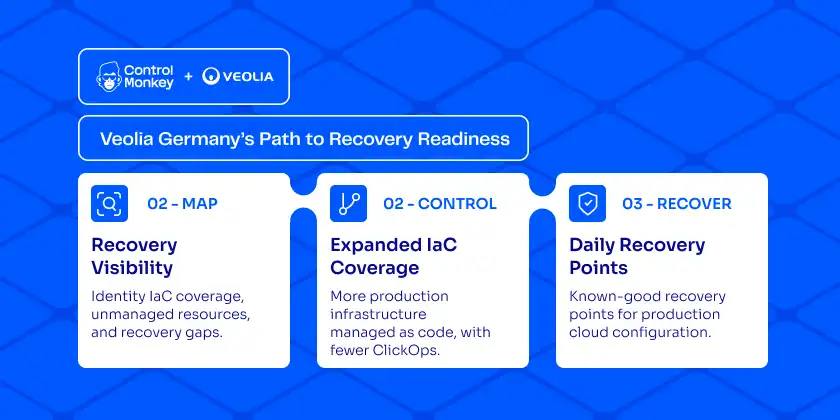
Mapping the Recovery Surface
The first step was establishing visibility.
ControlMonkey helped Veolia identify which cloud resources were already managed through IaC and where recovery gaps still existed.
This gave the team a clearer view of the recovery surface: which resources could be recreated through a controlled process, which still depended on manual reconstruction, and where additional protection was required.
It also created a foundation for extending recovery planning beyond the cloud itself to other critical dependencies over time.
Expanding Recoverable Infrastructure Coverage
Once the environment was mapped, Veolia focused on increasing IaC coverage across production.
Over time, the team significantly expanded the portion of production infrastructure managed through code, bringing a much larger share of critical cloud configuration into a consistent, repeatable, and auditable recovery model.
This meant that more production configuration could be recreated through a defined process rather than rebuilt manually during an incident.
Across critical cloud services, we significantly increased IaC coverage. That gave us a much stronger foundation for recovering cloud configuration consistently and at scale
Reducing ClickOps and Recovery Uncertainty
Expanding IaC coverage was only part of the resilience strategy.
Veolia also wanted to reduce ClickOps: manual cloud changes made outside the approved deployment process.
These changes may happen during troubleshooting, urgent operational work, or routine administration. But when they are not consistently validated or tracked, they increase uncertainty during recovery.
ControlMonkey helped Veolia move more production changes through an approved and auditable deployment path while ClickOps in production declined.
This improved more than governance. It gave Veolia greater confidence that changes could be traced, reviewed, and recovered if needed.
Reducing ClickOps was not only about improving governance. It was about reducing recovery uncertainty. The more changes we can validate, track, and manage consistently, the more confident we are that critical cloud configuration can be recovered when needed.
From Visibility to Recovery Readiness
ControlMonkey gave Veolia a clearer view of what could be recovered, what remained outside IaC, and where manual changes could create recovery gaps.
The team can track configuration changes over time, identify unmanaged resources, and maintain daily known-good recovery points for production configuration.
This reduces dependence on manual reconstruction and gives security and infrastructure leaders clearer evidence of recovery coverage.
Veolia can measure progress through practical indicators:
● More critical configuration managed through IaC
● Fewer ClickOps changes in production
● More changes validated before deployment
● Broader protection for resources outside code
● Greater visibility into known-good recovery states
Business and Security Impact of Controlmonkey on Veolia
- More cloud configuration can be recovered consistently
- By increasing IaC coverage across production, Veolia expanded the portion of its environment that could be restored through a controlled and repeatable process.
- Less dependence on manual rebuilding
- Daily configuration snapshots reduce the need to reconstruct cloud resources from memory or incomplete documentation during an incident.
- Lower risk from unmanaged changes
- Declining ClickOps and stronger deployment validation give Veolia greater confidence that production changes are visible, traceable, and auditable.
- Clearer evidence of recovery readiness
- The team can identify recovery gaps, track configuration changes, and measure progress in expanding recoverable coverage.
- Stronger operational continuity
- By protecting cloud configuration alongside data, Veolia is better positioned to restore the infrastructure and dependencies required for critical services to operate.
Looking Ahead
Veolia continues to expand recovery coverage across its cloud environment and evaluate the additional dependencies that should form part of its broader resilience strategy.
The broader goal is to protect the configuration required for business recovery, not only the resources already managed through IaC.
By first mapping the environment, then increasing recoverable coverage, reducing ClickOps, and protecting the remaining cloud state through daily snapshots, Veolia has established a scalable foundation for cloud disaster recovery.
Request a demo to see how it works:

A 30-min meeting will save your team 1000s of hours
A 30-min meeting will save your team 1000s of hours