Co-Writer: Aharon Twizer, CEO and Co-founder – ControlMonkey
Co-Writer: Akram Al Sheikh, Sr. Security Partner Solutions Architect – AWS
AI Agents Are Changing Cloud Risk: How ControlMonkey and AWS Backup Keep You Recoverable
AI agents no longer only suggest changes to cloud infrastructure; they make them. They triage
alerts, fix connectivity issues, and clean up resources by calling the same Amazon Web Services (AWS) APIs your engineers use, in seconds and sometimes without a human approving each step.
The speed that makes agents valuable also lets mistakes spread quickly. An agent that fixes a problem in seconds can delete a firewall rule, open a security group, or stop an audit trail equally fast. Data backups don’t restore that configuration.
This post explains why configuration-level recovery is becoming a baseline requirement for running AI agents on AWS. It also shows how ControlMonkey, an AWS Resilience Competency Partner, works with AWS Backup and AWS security services to restore a known-good state.
Machine-Speed Change, Human-Speed Recovery
Agents act with whatever permissions they hold. That creates risk on two fronts:
- Accidental change. The AWS Well-Architected Generative AI Lens calls this excessive agency: an agent “determines the best solution to a problem is to take broader actions beyond its scope.” It can chain production changes before anyone notices.
- Adversarial change. An agent compromised through prompt injection or a poisoned tool, or an attacker using the agent’s stolen credentials, acts with legitimate access: disabling logging, opening network paths, or removing segmentation.
In both cases, changes can affect production configuration before anyone reviews them, in the configuration that keeps applications reachable and secure. Recovery still runs at human speed, with engineers rebuilding from tickets, partial infrastructure as code (IaC), and memory.
What the Data Shows
- Agents are scaling, but many projects won’t survive. Gartner predicts that 33% of enterprise software applications will include agentic AI by 2028, up from less than 1% in 2024. It also predicts that over 40% of agentic AI projects will be canceled by the end of 2027 due to escalating costs, unclear business value, or inadequate risk controls (Gartner Press Release, “Gartner Predicts Over 40% of Agentic AI Projects Will Be Canceled by End of 2027,” June 25, 2025).
- Agents widen the attack surface. Gartner predicts that by 2028, 25% of enterprise breaches will be traced back to AI agent abuse (Gartner Press Release, “Gartner Unveils Top Predictions for IT Organizations and Users in 2025 and Beyond,” October 22, 2024).
- Misconfiguration ties for the top cause of AI breaches. In IBM’s 2026 Cost of a Data Breach Report, more than 20% of organizations reported a breach targeting AI models or applications. Cloud misconfigurations affecting AI workloads tied for the most common cause (27%).
- Downtime is a board-level cost. Splunk and Oxford Economics put unplanned downtime at $600 billion a year for Global 2000 companies. Every technology leader surveyed reported AI-related downtime, and 68% worry their AI agents will behave unpredictably.
- Regulators expect recovery. The EU Digital Operational Resilience Act (DORA), which has applied since January 17, 2025, requires financial entities to document “restoration and recovery procedures and methods” for their ICT systems and data.
Michael Roza, a lead author of the Cloud Security Alliance (CSA) Top Threats to Cloud Computing 2026 report, notes that the most exposed organizations are “the ones whose governance, visibility, and change management have not kept pace with the complexity of their environments.”
Why Backing Up Data Isn’t Enough
AWS Backup centralizes and automates data protection across AWS services, from Amazon Aurora and Amazon DynamoDB to Amazon Simple Storage Service (Amazon S3). In compliance mode, AWS Backup Vault Lock blocks early deletion of recovery points, even by the account root user. Logically air-gapped vaults add isolation and cross-account recovery.
But restoring a database into a network whose firewall rules, security groups, routes, or DNS records have changed leaves the application unreachable, or exposed. AWS Backup can protect AWS CloudFormation stacks, but network and security resources aren’t standalone AWS Backup resource types. Those created outside a template, whether in the console, by a script, or by an agent, have no AWS Backup recovery point. The AWS Well-Architected Framework is explicit: “Back up data, applications, and configuration to meet your requirements for recovery time objectives (RTO) and recovery point objectives (RPO).”
A Layered Model: Prevent, Detect, Recover
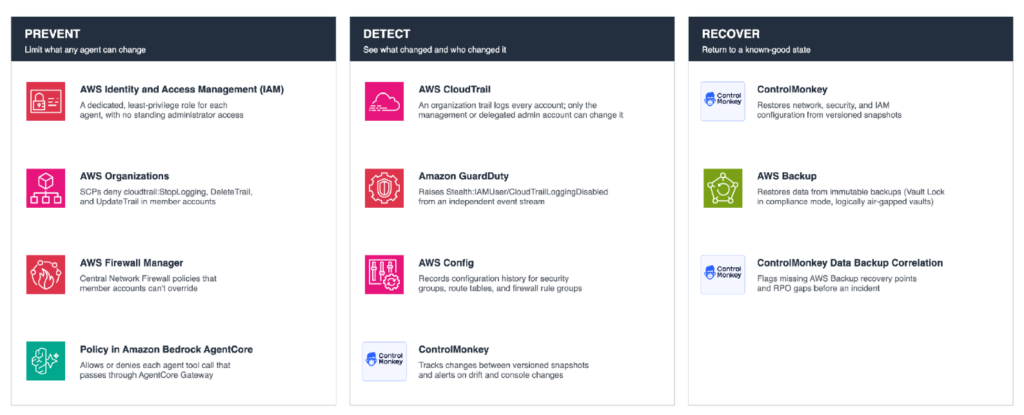
A single control is unlikely to stop all unwanted changes. The Generative AI Lens recommends containment: “Implementing least privilege and permissions bounded agents limits the scope of agentic workflows.” The AWS Agentic AI Security Scoping Matrix then scales controls with the agency you grant.
- Prevent. Give each agent its own least-privilege AWS Identity and Access Management (IAM) role. Use service control policies (SCPs) in AWS Organizations to deny high-impact actions, such as stopping AWS CloudTrail logging, and keep agents out of the management account, where SCPs don’t apply. Route agent tool calls through Amazon Bedrock AgentCore Gateway so that Policy in Amazon Bedrock AgentCore can allow or deny each call; IAM and SCPs still bound direct API calls. Manage firewall policies centrally with AWS Firewall Manager.
- Detect. Record API activity with a CloudTrail organization trail. Detect threats with Amazon GuardDuty, which reads CloudTrail management events independently of your trails. Track configuration history with AWS Config and ControlMonkey.
- Recover. Restore data with AWS Backup, and restore configuration with ControlMonkey.
How ControlMonkey and AWS Work Together
ControlMonkey is a cyber resilience platform for cloud configuration disaster recovery. AWS Backup protects the data layer; ControlMonkey protects the configuration layer around it, across cloud, SaaS, identity, network, and security systems. ControlMonkey holds the AWS Resilience Software Competency and the AWS AI Software Competency. In July 2026, ControlMonkey and AWS signed a Strategic Collaboration Agreement, and through the AWS ISV Accelerate Program, AWS and ControlMonkey teams engage customers jointly.
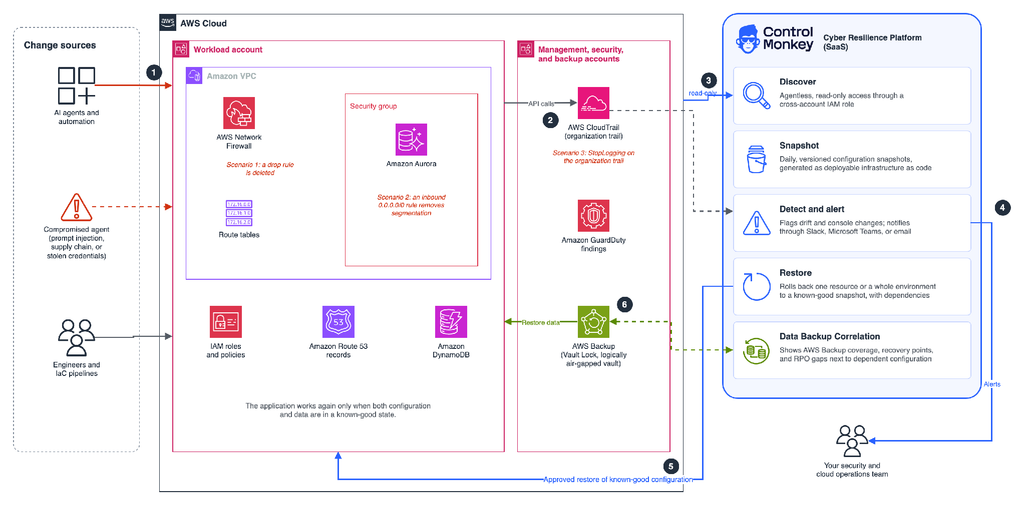
- An AI agent, an engineer, or a compromised identity changes network or security configuration through AWS APIs.
- CloudTrail records each call, and GuardDuty flags suspicious activity, such as CloudTrail logging being disabled.
- ControlMonkey discovers resources across accounts through a read-only, cross-account IAM role, and takes daily, versioned snapshots stored as code.
- ControlMonkey uses CloudTrail to show who made each change, flags drift and console changes, and alerts the team through Slack, Microsoft Teams, or email. A side-by-side view shows what was created, modified, or deleted.
- The team selects a known-good snapshot and approves the restore. ControlMonkey restores one resource or a full environment, including dependencies, and controls who can restore and approve changes.
- If data was affected, AWS Backup restores it. ControlMonkey Data Backup Correlation shows AWS Backup coverage, available recovery points, and RPO risk before an incident.
ControlMonkey’s Resilience Score gives security leaders a metric to report: the percentage of discovered resources that are backed up and recoverable from a known-good snapshot.
Four Scenarios, One Recovery Pattern
| Scenario | What happens | How it’s caught | How it’s recovered |
|---|---|---|---|
| 1 – Accidental: rule cleanup | An agent deletes a drop rule from an AWS Network Firewall rule group because the rule has no recent matches. | CloudTrail shows which role called UpdateRuleGroup; ControlMonkey shows the change against the last snapshot. | Restore the rule group from the snapshot. Then manage firewall policies centrally with Firewall Manager. |
| 2 – Accidental: auto-remediation | To clear a connectivity alert, an agent adds an inbound 0.0.0.0/0 rule to a database security group, opening it to every network that can route to it. | The AWS Config rule vpc-sg-open-only-to-authorized-ports, if deployed, flags it; ControlMonkey shows the change against the last snapshot. | Restore the security group rules. Then audit rules continuously with Firewall Manager security group policies. |
| 3 – Adversarial: compromised agent | An attacker hijacks an agent that runs with management account credentials and stops the organization trail, halting log delivery for every account, before making further changes. | GuardDuty, enabled in the management account, raises Stealth:IAMUser/CloudTrailLoggingDisabled. Its default severity is Low, so route it to an alert. | Restart logging. Compare ControlMonkey snapshots from before and after the incident to roll back changes made while logging was off, and investigate with CloudTrail Event history in each affected account and Region. Remove agent access to the management account. |
| 4 – Adversarial: identity persistence | An attacker who controls an agent adds a statement to an existing IAM role’s trust policy that allows an external AWS account to assume the role. This gives the attacker access that lasts after the agent’s credentials are revoked. | IAM Access Analyzer generates an external access finding for the role. CloudTrail records the UpdateAssumeRolePolicy call and the agent role that made it. ControlMonkey shows the trust policy change against the last snapshot. | Restore the trust policy from a snapshot taken before the change. Revoke active sessions for the role, rotate or disable the agent’s credentials, and use CloudTrail to review actions taken by the external principal. Then add iam:UpdateAssumeRolePolicy and iam:CreateRole to the deny list for agent roles. |
Customer Success: Block
Block, the company behind Square and Cash App, runs hundreds of AWS accounts. In late 2023, a resilience review at one Block business unit found that while data backups were in place, “the infrastructure configuration itself—networking, security, IAM, routing—had no guaranteed path to recovery.” Block now uses ControlMonkey to snapshot infrastructure configuration daily, creating a recovery point for every asset. One engineer rolled out coverage across key accounts in two weeks.
The case study reports that “recovery of resources that once took hours now only requires looking at the Git diff between snapshots.”

It’s not just about backing things up. It’s about knowing what’s covered, where the gaps are, and how to fix them

Get Started
The question for security and resilience leaders is no longer whether an agent will make a bad change. It is whether you can recover before it makes the next one.
- Procure ControlMonkey through AWS Marketplace, including private offers with negotiated pricing.
- See how AI Agent Rollback restores cloud and SaaS configuration after unintended agent changes.
- Request a free Cloud Resilience Assessment. It is 100% read-only, and most assessments are completed in 5–7 business days, with a Cloud Resilience Score and a prioritized remediation plan.

A 30-min meeting will save your team 1000s of hours
A 30-min meeting will save your team 1000s of hours
Author